Last Updated: November 27, 2026
Quick Summary
Qualifying rain events are the storms that meet the rainfall threshold and timing rules set by your stormwater permit. To identify them, find the exact rule in your permit, measure each storm’s total over the required period, and compare it against the threshold. Log every event, qualifying or not.
- Each permit sets its own threshold, measurement window, and sampling timeline, so check your permit rather than local weather reports.
- Measure rainfall with an on-site gauge placed in an open area away from buildings and trees.
- Treat storms separated by less than the permit’s dry gap as one event and measure their combined total.
- Record start and end times, rainfall total, source, threshold applied, and the qualification decision in every log entry.
- Schedule post-event inspections in advance, since many permits set a deadline after a qualifying event.
Table of Contents
- How to Identify Qualifying Stormwater Rain Events
- Regulatory Definitions and Compliance Timing
- Step-by-Step: Identifying a Qualifying Event
- Stormwater Rain Gauge Monitoring and Rainfall Data Sources
- Stormwater Rain Log Template and Audit-Ready Records
- Stormwater Rain Event Inspection Requirements and Timing
- Antecedent Dry Period Stormwater Considerations
- Your Next Step: Set Up a Rain Event Tracking Process
- Frequently Asked Questions
How to Identify Qualifying Stormwater Rain Events
A qualifying rain events definition starts with a rainfall that meets the size and timing rules set by your stormwater permit, and that triggers certain sampling, inspection, or reporting duties. In short, qualifying rain events are the storms your permit says you must act on. The first step is always the same: find the exact rule in your permit and apply it to your rain records. Getting this right matters, because a missed event can mean a missed sample, and a missed sample is a compliance problem.
Many facilities assume any heavy rain counts. That is often wrong. Each permit sets its own threshold, measurement window, and sampling timeline, so the definition depends on what your permit says.
This guide walks through how to find the threshold that applies to your facility, how to separate one storm from several, where rainfall data comes from, and how to keep records that hold up under review.
Regulatory Definitions and Compliance Timing
Permits define qualifying rain events in specific terms. Common elements include a minimum rainfall amount, a measurement period such as a 24-hour window, and a timing rule for when sampling must begin. Some permits also set a minimum gap between events, sometimes called an antecedent dry period.
Read these terms carefully. A permit may define rainfall in inches, measured over a fixed period, and it may count a storm only if it occurs during scheduled operating hours. Compliance deadlines usually start from the event’s end or from the first measurable rain, depending on the permit language.
Watch out: a qualifying event is counted from the permit’s own definition, not from what the weather service reports for your city. A storm that looks large on the news may fall below your permit’s threshold.
Step-by-Step: Identifying a Qualifying Event
Work through these steps in order for every rain event:
- Pull the permit language on qualifying events.
- Note the rainfall threshold and the measurement period.
- Record the start and end time of each storm.
- Measure total rainfall over the required period.
- Compare the total against the threshold.
- Check the antecedent dry period, if your permit has one.
- Log the result and the date, even if the event does not qualify.
Determining the Applicable Rainfall Threshold for Your Permit
Your threshold comes from your permit, and sometimes from a specific section for your industry or site type. Check whether the permit applies one threshold to all sites or sets different values for different activities.
Keep a copy of the permit section you relied on. Auditors will ask where your threshold came from, and a written citation answers that question quickly.
Separating One Event From Multiple Storms
Storms that happen close together can look like one long event. Most permits tell you when separate storms count as distinct events. A common approach is to require a dry gap of a set number of hours between storms.
When two storms fall within that gap, treat them as one event and measure their combined total. When the gap is longer, treat them as separate events. Write down the timing you used, so the decision can be reviewed later.
Stormwater Rain Gauge Monitoring and Rainfall Data Sources
Accurate rainfall numbers depend on a reliable measurement source. The most defensible option is a rain gauge on your own site, read after each storm. A gauge placed in an open area, away from buildings and trees, gives the most representative reading.
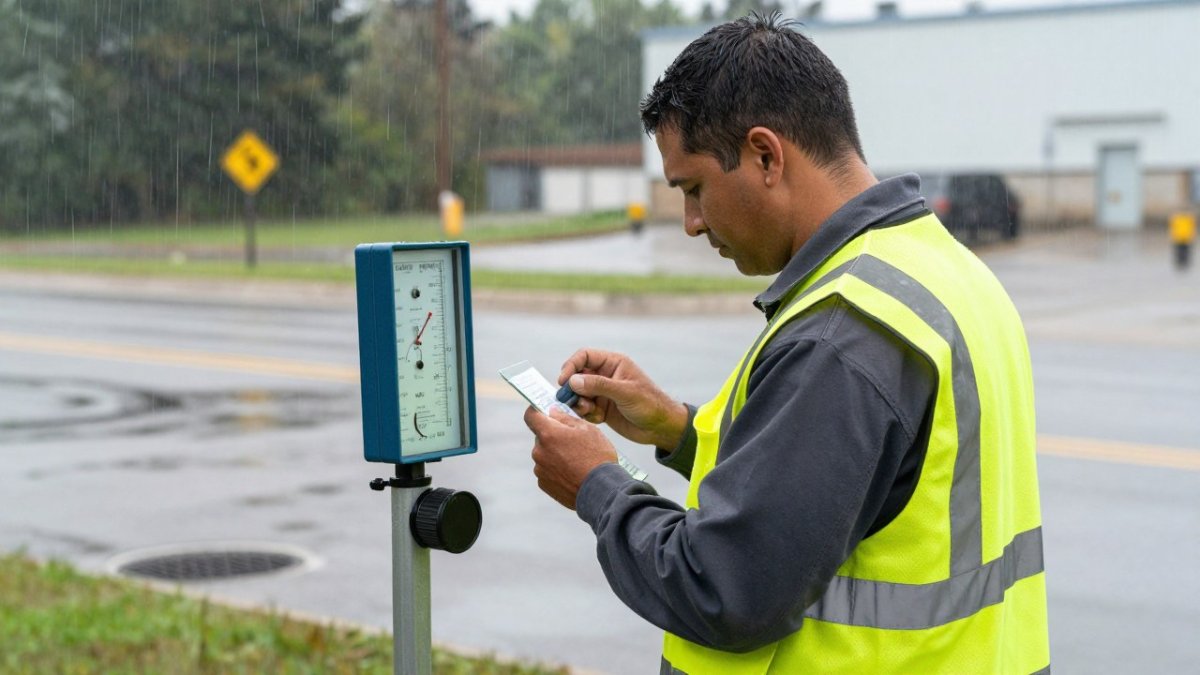
Some operators also use nearby weather station data. This can work, but confirm that the station is close enough to your facility and that its data covers the same time window. Document which source you used for each event.
Check your gauge regularly. Clean it, confirm it reads correctly, and note any periods when it was damaged or blocked.
Michael Karl McNeil recommends keeping the gauge reading, the time it was taken, and the source in every rain log entry. For guidance on the sampling steps that follow a qualifying event, see California Stormwater Sampling and Monitoring Procedures. If you need to set up your own monitoring, see How to Rent Stormwater Monitoring Equipment in California.
Stormwater Rain Log Template and Audit-Ready Records
A rain log is the record that proves your qualifying-event decisions. The version below is built to survive an audit, because every field maps to a question an inspector is likely to ask.
Fields every entry should carry
- Event identifier, a sequential number or date-based code so entries can be referenced in inspection reports.
- Storm start and end date and time, recorded to the minute, with the time zone noted once at the top of the log.
- Rainfall total and measurement period, the amount in inches and the window over which it was measured (for example, a rolling 24-hour period).
- Measurement source, on-site gauge, nearby weather station, or other source, with the gauge or station identifier.
- Permit threshold applied, the number from the permit and the permit section it came from.
- Antecedent dry period, hours since the last measurable rain, and whether that gap met the permit’s dry-interval rule.
- Qualification decision, qualified or did not qualify, with a one-line reason.
- Inspection date and time, when the post-event inspection occurred, and whether it met the permit’s deadline.
- Findings and corrective actions, what was observed and what was done, with photo references.
- Entry initials and date, who made the entry and when.
A worked entry
A log line for a qualifying event might read: Event 14; rain began 03/12 at 14:20 and ended 03/13 at 06:45; total 0.62 inches over the 24-hour window; source on-site gauge G-1; threshold 0.5 inches per permit section 4.2; antecedent dry period 41 hours, meets the 24-hour rule; qualified; inspection 03/13 at 09:10, within the 24-hour deadline; findings, sediment at outfall 2, photo 14-A; corrective action, silt fence repaired 03/14; entry MK 03/13.
Handling exceptions and missing data
Real facilities miss readings. A gauge clogs, a storm arrives overnight, or an area is unsafe to inspect. The log should have a documented path for each case:
- Gauge failure or blockage, record the date the problem was found, the estimated rainfall from the nearest reliable source, and the repair date. Do not leave the field blank.
- Missed inspection window, record why the inspection could not occur (unsafe conditions, site access, active discharge) and when the inspection was completed instead.
- Inaccessible areas, note the area, the reason, and the date access was restored.
- Disputed readings, if the on-site gauge and a nearby station disagree, record both and state which one you relied on and why.
Keeping the log defensible
Use a bound field book or a controlled electronic file with an audit trail that records edits. Make entries at the time of the event, not reconstructed weeks later. Review the log monthly so gaps are caught while memories are fresh, and keep the log with the SWPPP so the threshold, the decision, and the inspection record sit in one place.
Watch out: a log that shows a qualifying event with no corresponding inspection entry is often treated as a missed inspection, even if the inspection happened and was simply recorded elsewhere. Cross-reference inspection reports to the event identifier.
Stormwater Rain Event Inspection Requirements and Timing
Many permits require an inspection after a qualifying event, and some set a deadline for it. Plan for this by knowing your permit’s timing rule before the storm arrives. Assign a responsible person and a backup.
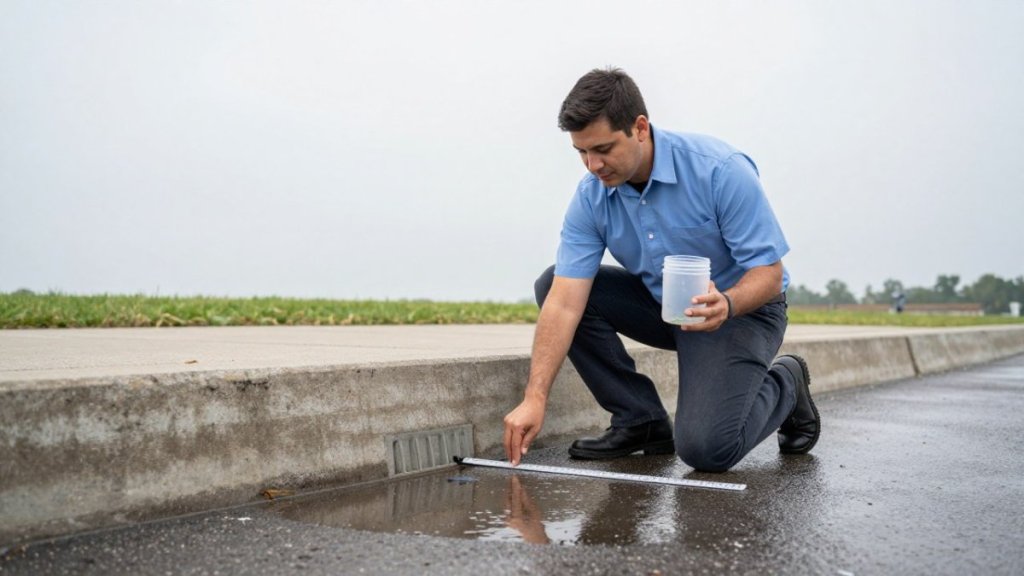
During the inspection, look for signs of runoff: standing water, sediment, discharge at outfalls, and any visible pollutants. Photograph what you find and record it in the log. If a reading later shows a result above the threshold, the corrective action steps for exceedances explain what to do next. For the steps to follow when conditions require action, see 5 Best Practices for SWPPP Site Monitoring. Requirements for stormwater compliance timing in California are covered in SWPPP Compliance Requirements for California 2026.
Exceptions and safety rules also matter. Do not enter unsafe areas during active storms, and document any inspection you could not complete along with the reason.
Antecedent Dry Period Stormwater Considerations
Some permits require a minimum dry period before a new storm can be treated as a separate qualifying event. This antecedent dry period protects against sampling storms that are too close together to represent distinct runoff.
Track the time since the last measurable rain at your site, not since the last forecast. A short shower may reset the dry period even if it does not qualify on its own, so check your permit for how small rains are handled.
Your Next Step: Set Up a Rain Event Tracking Process
Start by confirming your permit’s threshold, measurement period, and dry-period rule. Then install or confirm a rain gauge, create a log, and assign responsibility for each storm. Review your first few events together to check that the process works.
If you want a second professional review of your qualifying-event process, contact Michael Karl McNeil through this site.
Frequently Asked Questions
What qualifies as a stormwater rain event?
A qualifying stormwater rain event is a rainfall that meets the amount and timing criteria set by the specific permit or stormwater plan that applies to the facility. Permits typically define a rainfall threshold, often expressed in inches measured over a set period such as 24 hours, and the event must reach that threshold to trigger sampling or inspection duties. Because thresholds differ between permits, the first step is always to read the applicable permit’s definition, then confirm the measurement period and the measurement method it specifies before recording any event.
How much rain is needed to trigger a stormwater inspection?
The required amount depends on the permit that governs the site. Many general industrial permits tie inspection and sampling duties to a rainfall amount within a defined period, so the threshold is a value written into the permit rather than a universal number. Check the permit language for the exact inch amount, the measurement window, and whether the threshold applies to a single storm or to cumulative rainfall. Record the rainfall that triggered the duty so the trigger can be shown during an audit.
How long must it be dry between qualifying rain events?
Permits that count separate events usually require a dry period between storms so that two rainfalls are not treated as one. The required length of the antecedent dry period is set by the permit, and it is commonly stated in hours. Confirm the number in your permit, then log the start and end time of each storm so you can show that the dry period was met. If rain resumes before the required dry period ends, the storms are generally treated as a single event.
What should a stormwater rain log include?
A stormwater rain log should record the date and time each storm started and ended, the total rainfall measured, the rain gauge reading source, the measurement period used, and whether the event met the permit threshold. Add the name of the person who took the reading, any observed runoff or discharge from the site, and the inspection or sampling action taken. Keep entries complete and dated at the time of recording, since audit-ready records depend on contemporaneous documentation.


Leave a Reply