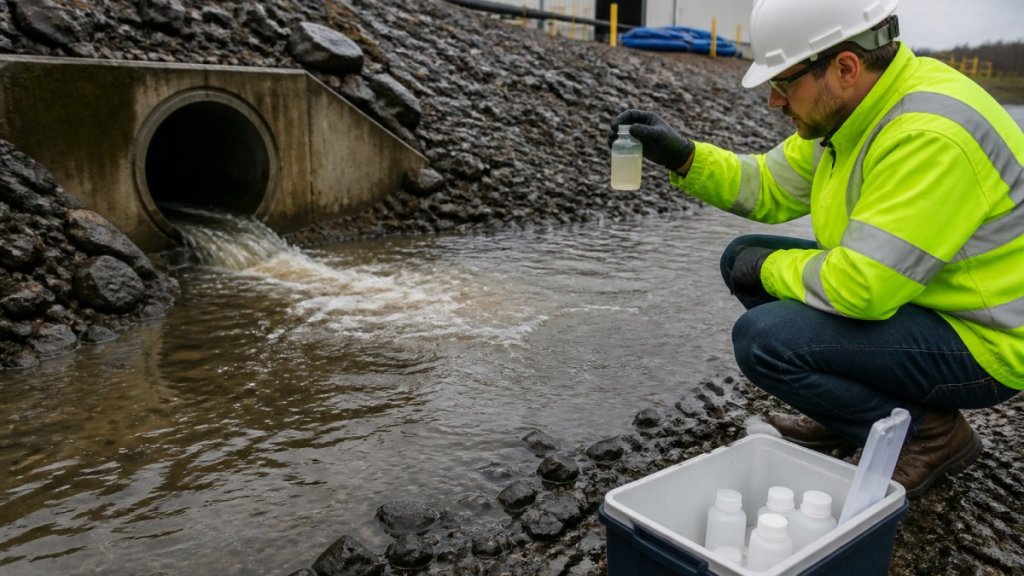
Last Updated: October 30, 2026
Quick Summary
An industrial stormwater exceedance is a sampling result above the numeric benchmark a permit sets for a pollutant, signaling that controls may not be working. Respond by confirming the result, securing the site, finding the source, selecting matching controls, and documenting every step.
- Confirm the lab report’s pollutant, measured value, benchmark, and holding times before making large changes.
- Map the drainage area feeding the sampled outfall to find the source of the exceedance.
- Use source control first, then treatment for pollutants that remain.
- Assign each BMP a maintenance owner, location, and inspection frequency.
- Plan follow-up sampling at the same outfall and method to verify the fix.
Table of Contents
- What an Industrial Stormwater Benchmark Exceedance Means
- Immediate Response: Confirming the Result and Securing the Site
- Investigating the Source of the Exceedance
- Selecting Industrial Stormwater Best Management Practices to Reduce Pollutants
- Building an Industrial Stormwater Corrective Action Plan
- Documenting Each Step: Stormwater Exceedance Documentation
- Your Next Step: Planning Follow-Up Sampling and SWPPP Updates
- Frequently Asked Questions
What an Industrial Stormwater Benchmark Exceedance Means
When a stormwater sample comes back above a benchmark value, facility operators need to act quickly. An industrial stormwater exceedance is a sampling result that is higher than the numeric benchmark set for a pollutant under a stormwater permit. It is a signal that the facility’s controls may not be keeping pollutants out of runoff, and it triggers specific obligations.
Exceedances can draw closer regulatory attention. How you respond matters as much as the number itself. A documented, methodical response shows that the facility is managing the problem.
The steps below follow a practical sequence: confirm the result, secure the site, find the source, select controls, plan corrective actions, and document everything.
Immediate Response: Confirming the Result and Securing the Site
The first step is to confirm the result before making large changes. Check the laboratory report for:
- The exact pollutant and measured value
- The benchmark value it was compared against
- The sample date, outfall or discharge point, and sampling method
- The laboratory’s quality control notes and holding times
Once the result is confirmed, take practical steps to limit further pollutant releases:
- Inspect the sampled area and the drainage path to the outfall
- Cover or contain materials that could be washed into runoff
- Clean up visible spills, sediment, or debris
- Keep records of every action, with dates and times
Worker safety comes first during site walks, especially after rain, when surfaces are slick and trenches or drains may hold standing water.
Investigating the Source of the Exceedance
Finding the source is the core of any corrective action. Start by mapping the drainage area that feeds the sampled outfall. Walk the site and note activities, storage areas, equipment, and surfaces that could release pollutants.
Common source categories include:
- Material storage: uncovered stockpiles, drums, or bulk materials exposed to rain
- Vehicle and equipment activity: tracking of sediment, leaks, or washdown water
- Process areas: outdoor handling, loading docks, or wash areas
- Erosion and sediment: bare soil or disturbed areas draining to the outfall
Collect targeted follow-up samples where practical. A sample taken upstream of a suspected area can help narrow down where the pollutant enters the drainage system. Proper sample collection technique, including representative location and timing relative to discharge, helps make these results reliable.
Watch out: Do not assume the first suspect is the source. Confirm with sampling or observation before spending money on a fix.
Selecting Industrial Stormwater Best Management Practices to Reduce Pollutants
Once the source is identified, select best management practices (BMPs) that address it directly. BMPs are the physical, operational, or managerial controls used to reduce pollutants in stormwater (the EPA). The mistake many facilities make is reaching for a single control, usually a silt fence, when the exceedance points to a pollutant that a silt fence cannot touch.
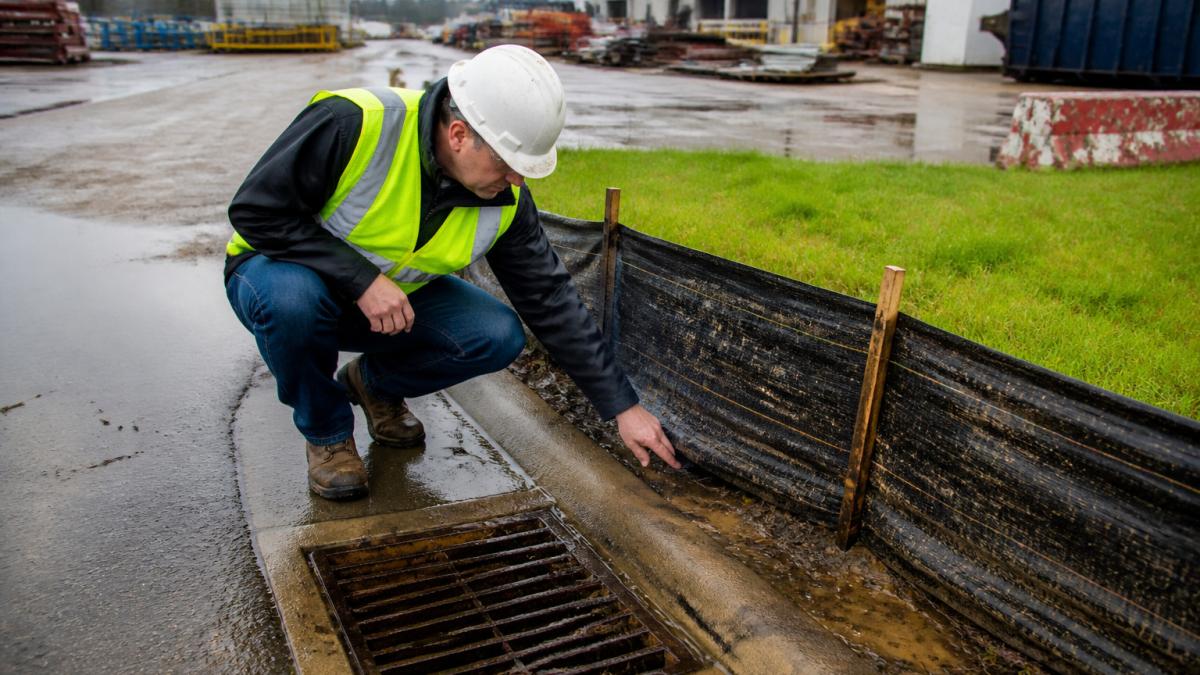
Match the control to the pollutant, the activity, and the pathway the pollutant takes to the outfall:
| Pollutant or source | Typical BMP category | Example control | Mechanism |
|---|---|---|---|
| Total suspended solids | Erosion and sediment control | Silt fence, gravel inlet protection, check dams | Slows flow so particles settle before discharge |
| Metals (zinc, copper, lead) | Source control | Covered storage, drip pans, spill kits, roofed loading areas | Keeps rain off exposed metal-bearing materials |
| Oil and grease | Source control and treatment | Covered equipment, absorbent booms, oil-water separators | Prevents contact and captures free product |
| Vehicle tracking | Operational control | Stabilized entrance, sweeping, wheel wash | Removes sediment before it reaches pavement |
| Exposed materials and powders | Housekeeping | Covers, berms, secondary containment, regular cleanup | Eliminates the source rather than treating runoff |
| pH excursions | Source control | Neutralizing berms, controlled drainage, cover | Prevents contact between rain and alkaline materials |
| Nutrients and organics | Housekeeping and source control | Covered stockpiles, no outdoor washdown, sweep instead of hose | Removes the loading pathway |
A practical sequence is source control first, then treatment for what remains. Source control is generally a practical first step before end-of-pipe treatment. Treatment controls, filtration, settling basins, media filters, oil-water separators, make sense when source control cannot fully address the pollutant or when the outfall drains a large, mixed-use area.
For each BMP, document four things: the location, the pollutant it targets, the maintenance schedule, and the inspection frequency. A BMP without a maintenance owner is a BMP that will fail. Many facilities find that inexpensive housekeeping changes, covering a stockpile, sweeping instead of hosing down pavement, moving drums under roof, reduce exceedances before larger capital projects are needed.
Before committing to a structural BMP, run a quick cost-versus-loading check. If a covered storage area removes the pollutant pathway, it can reduce the load a downstream filter must treat.
Watch out: Do not stack BMPs that treat the same pollutant at the same point in the drainage path. Two sediment controls in series rarely help if the source is still exposed; one source control upstream usually does more. Addressing the root cause through site grading or structural improvements often proves more effective than redundant filtration, especially when fixing property drainage to prevent standing water from mobilizing pollutants.
Building an Industrial Stormwater Corrective Action Plan
A corrective action plan turns findings into a schedule. It should be written, specific, and assigned to named people. Under most industrial stormwater permits, the plan is not optional paperwork, it is the record that shows the facility responded to the exceedance within the timeframe the permit sets. Check the current SWPPP requirements for California to confirm your plan meets them.
A solid plan usually includes:
- The exceedance, the pollutant, the measured value, and the benchmark or limit it was compared against
- The root cause found during the source investigation, with the evidence that supports it
- Each corrective action, with a responsible person, a due date, and a completion date
- The BMPs to be installed or improved, with locations and maintenance owners
- The follow-up sampling plan to verify the fix, including the outfall, method, and target event
- How the plan will be reflected in the Stormwater Pollution Prevention Plan (SWPPP)
Interpreting the result before you plan. The number alone does not tell you what to do. Compare the result to the correct benchmark or limit in the permit, some permits use benchmark values for comparison only, while others set numeric effluent limits that carry reporting and possibly enforcement consequences. Check whether the exceedance is a single result or part of a pattern across events. A single elevated result during a high-intensity event may point to a different cause than a persistent exceedance across multiple storms. Also check the laboratory’s quality control notes: a result flagged for holding-time or preservation issues may need to be re-sampled before you spend money on controls.
Verification sampling mechanics. Follow-up sampling is what closes the loop. Use the same outfall, the same collection method, and a comparable qualifying event so results can be compared directly. Plan the follow-up before the next storm, not after it. If the permit requires sampling within a set number of qualifying events after a corrective action, put those events on the calendar. Document the event qualification, rainfall amount, antecedent dry period, discharge start time, so the follow-up is defensible.
Reporting responsibilities. Know what the permit requires you to report, to whom, and by when. Some permits require the exceedance and corrective action to be summarized in an annual report; others require notification closer to the event. Keep the reporting obligation separate from the corrective action itself so neither gets missed.
Keep the plan practical. Focus on actions the facility can complete and check. Update the SWPPP so that the site’s written procedures match what actually happens on the ground, and keep the corrective action plan, the SWPPP, and the sampling records cross-referenced so an inspector can follow the trail from result to fix.
A corrective action plan is strongest when it answers three questions in writing: what caused the exceedance, what changed, and how you will know it worked. The verification sampling plan is the part most facilities skip, and the part inspectors ask about first.
Documenting Each Step: Stormwater Exceedance Documentation
Documentation is what shows regulators that the facility responded properly. Keep a single, organized record for each exceedance that includes:
- Copies of the laboratory reports and sampling field sheets
- Photos and notes from the site inspection
- The source investigation findings
- BMP installation records, maintenance logs, and inspection checklists
- Dates, names, and signatures for each corrective step
Your Next Step: Planning Follow-Up Sampling and SWPPP Updates
The most important next step is planning follow-up sampling. Choose sampling events that will show whether the corrective actions worked, especially during qualifying rain events. Use the same sampling location and method as the original exceedance so the results can be compared directly.
Then update the SWPPP to reflect the new controls, responsibilities, and monitoring schedule. If your facility needs help building a compliant corrective action plan, Michael Karl McNeil can review your sampling results, site conditions, and existing SWPPP to identify the next practical steps.
Frequently Asked Questions
What should a facility do after an industrial stormwater benchmark exceedance?
Confirm the result with the laboratory data, review the sampling record, and begin an investigation promptly. Identify likely sources on the site, implement interim controls where practical, and record each action with dates and responsible staff. The facility should then review its Stormwater Pollution Prevention Plan (SWPPP) and determine whether corrective actions, follow-up sampling, or reporting obligations apply under the facility’s permit.
What is the difference between a benchmark exceedance and a permit violation?
A benchmark is a numeric indicator value used to evaluate whether stormwater controls are performing adequately. Exceeding a benchmark generally triggers investigation and corrective action under the permit, while a permit violation involves failing to meet a specific permit requirement, such as an effluent limitation, required procedure, or reporting deadline. The permit text governs how each situation is classified, so facilities should check the terms of their coverage in the State or Regional Water Board permit.
When should a facility collect follow-up stormwater samples?
Follow-up sampling timing is set by the permit. Facilities should confirm the sampling schedule in their permit and use the same sampling procedures and outfall locations as the original sample so the results can be compared directly.
How should a facility update its SWPPP after an exceedance?
The SWPPP should be revised to describe the cause identified during the investigation, the corrective actions taken, the revised best management practices, and the new inspection or maintenance steps. Updates should be dated, signed by the responsible person, and kept with the plan so the revision history is clear during regulatory review.


Leave a Reply