Last Updated: November 22, 2026
Quick Summary
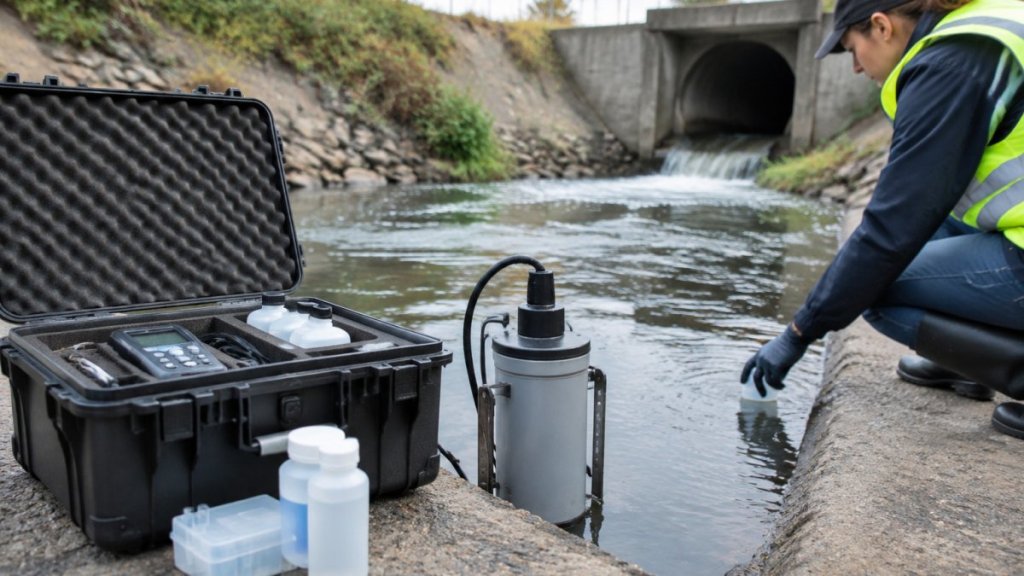
California stormwater monitoring equipment rental supplies calibrated field instruments, automatic samplers, and flow meters to a permitted site for a defined period, with the renter handling setup, sample collection, and return in working condition. Renting puts calibrated instruments on site during active discharge windows and removes them when the sampling season closes.
- Short-term rental fits construction sites with a defined grading season and one-off discharge events.
- Long-term rental fits industrial facilities facing recurring calibration and sampling cycles across wet seasons.
- Start with the permit language, list the parameters it names, then work backward to the instrument.
- Confirm the calibration date in writing and recalibrate in the field before the first sample.
- Match the rental term to your reporting cycle, including any resampling if a lab flags an issue.
Table of Contents
- How does stormwater monitoring equipment rental work in California?
- What a rental package typically includes
- Short-term rental versus long-term monitoring
- Matching equipment to the monitoring task
- Your stormwater monitoring equipment checklist before checkout
- Automatic water sampler rental for runoff and discharge sampling
- California Industrial General Permit monitoring and what it demands of your gear
- Stormwater sample collection and chain of custody in the field
- Planning a rental deployment with McNeil Safety Consulting
- Frequently Asked Questions
How does stormwater monitoring equipment rental work in California?
California stormwater monitoring equipment rental works by providing calibrated field instruments, automatic samplers, and flow meters to a permitted site for a defined period, with the renter responsible for setup, sample collection, and return in working condition. On many industrial sites, the permit requires data, the data requires instruments, and buying those instruments for a short wet season rarely makes sense.
The rental model solves a timing problem. Construction and industrial sites need water quality readings during active discharge windows, which in California concentrate into a few storm events rather than a steady year-round flow. Renting puts calibrated instruments on site when the rain comes and takes them away when the sampling season closes.
Below, we walk through what a typical rental package includes, how short-term and long-term terms differ, and how to match gear to the monitoring task before you sign anything.
What a rental package typically includes
Rental packages generally bundle the instrument itself, calibration documentation, and the field supplies needed to collect a valid sample. Confirm with the provider exactly what ships with each unit.
Ask whether technical support is included during the rental term, who services the equipment if a probe fails mid-event, and whether replacement units ship quickly.
Confirm what field supplies are provided and what your crews must source separately.
Short-term rental versus long-term monitoring
Short-term rental fits construction sites with a defined grading season, one-off discharge events, and projects where monitoring ends when the permit coverage terminates. Long-term monitoring fits industrial facilities under ongoing permit obligations, where equipment may stay on site across multiple wet seasons and calibration intervals recur on a schedule.
The decision usually comes down to three questions:
| Situation | Better fit | Why |
|---|---|---|
| Single construction season | Short-term rental | Coverage ends with the project |
| Ongoing industrial discharge | Long-term rental | Recurring calibration and sampling cycles |
| One storm event or investigation | Short-term rental | Narrow window, limited scope |
| Multi-year facility permit | Long-term rental | Predictable servicing and support |
Confirm the servicing and calibration arrangements for your rental term, and confirm the calibration date before the unit ships.
Matching equipment to the monitoring task
A common mistake is renting the wrong instrument for the parameter. A meter that reads pH and turbidity will not measure flow, and a flow meter will not tell you anything about dissolved oxygen.
A practical selection workflow runs in five steps. First, pull the permit and write down every parameter, discharge point, and monitoring frequency it names. Second, identify the sampling method the permit or sampling plan requires: grab sample, time-weighted composite, flow-weighted composite, or continuous measurement. Third, estimate the deployment window, from a single storm event to a full wet season. Fourth, list the field conditions the instrument will face: sediment load, depth of flow, access to the outfall, power availability, and whether the site is staffed during storms. Fifth, match the instrument class to those four answers, then confirm range, calibration interval, and data download method before you commit.
Use the table below to compare equipment classes by monitoring task, typical use case, and limitations.
| Monitoring task | Typical equipment | Best fit | Limitations to plan around |
|---|---|---|---|
| Grab sampling for pH, turbidity, conductivity, dissolved oxygen, temperature | Multiparameter water-quality meter with probes | Construction and industrial outfalls checked by staff during events | Reads only the moment of measurement; cannot capture first flush if no one is on site |
| Composite sampling across a storm event | Automatic water sampler with time or flow trigger | First-flush capture, flow-weighted composites, overnight events | Programming errors are common; intake line must stay submerged; bottle configuration must match the analytical method |
| Runoff volume and discharge rate | Flow meter, weir, or flume with level sensor | Outfall and channel measurement for permit reporting | Requires a stable cross-section; debris and sediment can foul sensors |
| Groundwater level and quality | Well sounder, water-level meter, multi-parameter probe | Monitoring wells and receiving-water checks | Well diameter and depth must match the instrument; purging method affects readings |
| Field documentation and sample integrity | Bottles, preservatives, coolers, chain-of-custody forms | Every sampling event | Holding times and preservation requirements vary by parameter and laboratory method |
Match the instrument range to your expected readings, too. A turbidity meter built for drinking water will not serve a construction outfall carrying sediment.
Watch out: renting a meter calibrated weeks before your event and assuming it holds. Confirm the calibration date in writing, and recalibrate in the field per the manufacturer’s schedule before the first sample.
If you want a broader view of what a site monitoring routine should include, our guide to SWPPP site monitoring best practices covers the routines that keep a program defensible.
Your stormwater monitoring equipment checklist before checkout
Run this checklist before any unit leaves the counter. It catches the failures that show up in the field at the worst possible moment.
- Calibration certificate is current and dated within the required interval
- All probes, cables, and connectors are present and undamaged
- Battery life or power supply covers the full deployment window
- Data logging and download method confirmed, with cables or software included
- Sample tubing, intake strainers, and bottles match your sampling plan
- Chain-of-custody forms and labels are in the case
- Personal protective equipment sized for the crew on site
- Return instructions, cleaning requirements, and shipping labels included
- Technical support contact confirmed for the rental term
Two items on that list get skipped most often: the download method and the return instructions. A logger you cannot retrieve data from is a paperweight, and a unit returned dirty or missing parts can trigger charges.
Watch out: renting a meter calibrated weeks before your event and assuming it holds. Confirm the calibration date in writing, and recalibrate in the field per the manufacturer’s schedule before the first sample.
If you want a broader view of what a site monitoring routine should include, our guide to SWPPP site monitoring best practices covers the routines that keep a program defensible.
Automatic water sampler rental for runoff and discharge sampling
An automatic water sampler collects stormwater samples on a trigger, either at set time intervals or when flow reaches a threshold, so your crew does not have to be on site during the first flush.
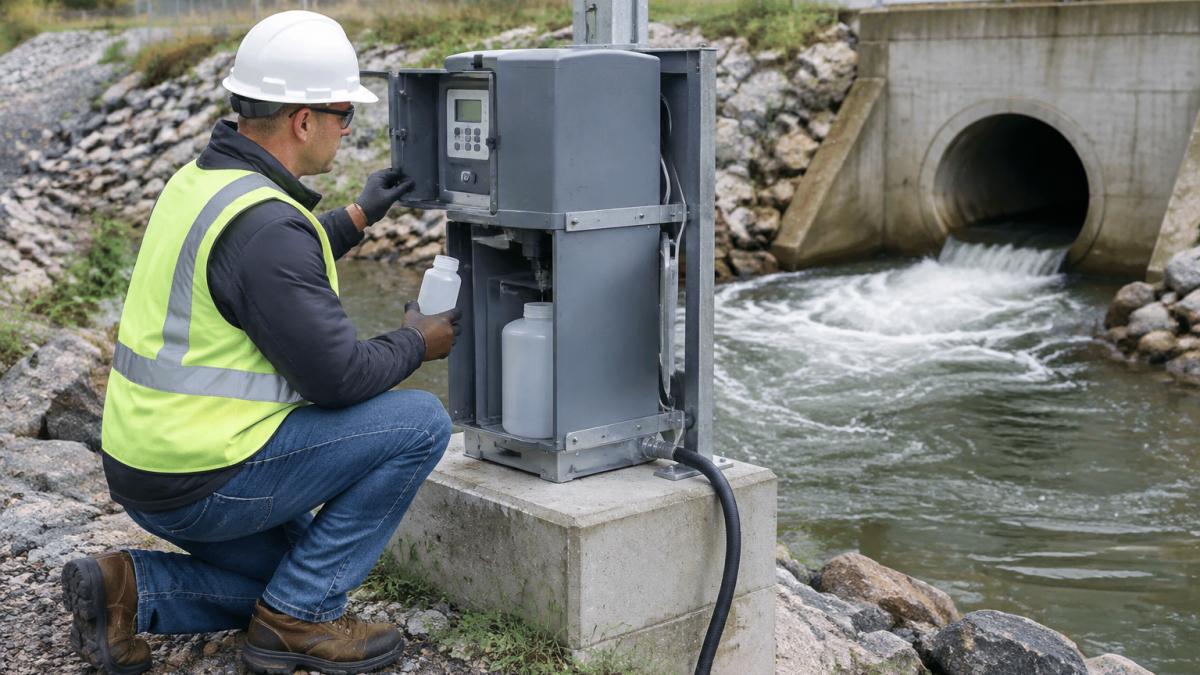
Set the sampler up around your sampling plan, not the other way around. Decide the trigger, the interval, the bottle configuration, and the preservation requirements before deployment. Confirm the unit’s intake line reaches your sample point and that the strainer stays submerged through the expected flow range.
Run a full test cycle with clean water before the unit goes on the outfall.
California Industrial General Permit monitoring and what it demands of your gear
The California Industrial General Permit sets the monitoring obligations that most industrial facilities operate under, and those obligations drive equipment selection. Because discharge-point sampling and analytical parameters depend on the facility’s activities and reporting status, the same attention to site-specific requirements also matters in municipal water monitoring.
A permit-to-equipment decision guide helps here. Start with your facility’s status under the permit. A facility working toward baseline status typically needs a full parameter suite at each qualifying discharge point during the reporting year.
Next, map each discharge point to a sampling method. An outfall with steady, accessible flow supports grab sampling with a multiparameter meter. An outfall that only runs during storms and is unstaffed at night needs an automatic sampler with a flow or time trigger.
Then match the rental term to the reporting cycle. A facility with annual reporting needs equipment available across the full monitoring year, including any resampling if a laboratory flags a holding-time or quality issue.
Your gear has to support that workflow end to end: collection at the right points, preservation within holding times, and documentation that ties each sample to its outfall.
Two practical implications follow. First, confirm your sampler and meter can handle the parameter list your permit names, not a generic list. Second, confirm the rental term covers your reporting cycle, including any resampling if a lab flags a holding-time issue. Our overview of SWPPP compliance requirements lays out the permit picture in more detail.
Stormwater sample collection and chain of custody in the field
Chain of custody is the documented trail that follows a sample from collection to the laboratory, and it is the part of stormwater sampling most often handled casually. Every sample needs a record of who collected it, when, where, and how it was preserved and transported.
In practice, that means labeling bottles before you leave the truck, recording collection times to the minute, and keeping the cooler sealed and documented until it reaches the lab. Field crews who fill out custody forms back at the office are reconstructing, not recording, and reconstructed records invite scrutiny.
Sample collection technique matters for the same reason. Grab samples from the wrong depth or with a contaminated container produce data that looks fine and means nothing. For the step-by-step procedure, see our guide to industrial stormwater sampling.
Planning a rental deployment with McNeil Safety Consulting
A rental deployment works when the equipment list, the permit obligations, and the sampling schedule line up before anything ships. That planning step is where most programs either get ahead of the problem or spend the season reacting to it.
Michael Karl McNeil holds a Qualified SWPPP Developer credential registered with the California State Water Resources Control Board, plus a Master of Science in Environmental Health and a background in fire prevention.
To see how an engagement runs, review how SWPPP compliance consulting works in practice. For the state-specific procedures that ground rental decisions, our article on California stormwater sampling and monitoring procedures covers the sampling detail.
Stormwater monitoring gaps are easier to close before a wet season begins. If your site lacks a confirmed instrument list, a calibration schedule, or a chain-of-custody routine, plan those items now.
Frequently Asked Questions
What equipment do I need to collect stormwater samples?
Most industrial sites need a water-quality meter for pH, conductivity and turbidity, a sample collection kit with clean bottles and a cooler, and an automatic water sampler if you must catch first-flush runoff outside working hours. Add a flow meter or weir for runoff measurement and a field log or chain of custody form for every sample. The exact list depends on the parameters in your permit and the discharge points you are monitoring.
Can stormwater monitoring equipment be rented instead of bought?
Yes. Short-term rental covers a single storm event or quarterly sampling round without tying up capital in instruments you use a few times a year. Long-term rental suits sites running continuous flow monitoring or groundwater monitoring across a wet season. Confirm calibration status, case contents and return dates before checkout so the kit is ready to deploy when the rain arrives.
How do I choose an automatic water sampler for stormwater monitoring?
Match the sampler to your triggering method first. Flow or level-triggered samplers suit NPDES and Industrial General Permit sites where you must capture the start of discharge; time-interval samplers work for simpler runoff measurement. Check bottle count and volume against your lab’s sample requirements, confirm the sampler is calibrated and powered, and decide whether you need a refrigerated compartment for holding samples before pickup.
How do I maintain chain of custody for stormwater samples?
Record each sample at the point of collection: site, outfall, date and time, sampler name, parameter list and preservative used. Seal the cooler, sign the chain of custody form, and log every transfer until the lab accepts the sample. Keep field notes on rainfall, flow and any deviation from the sampling plan. A complete, signed record is what makes the data usable for permit compliance and monitoring reports.


Leave a Reply