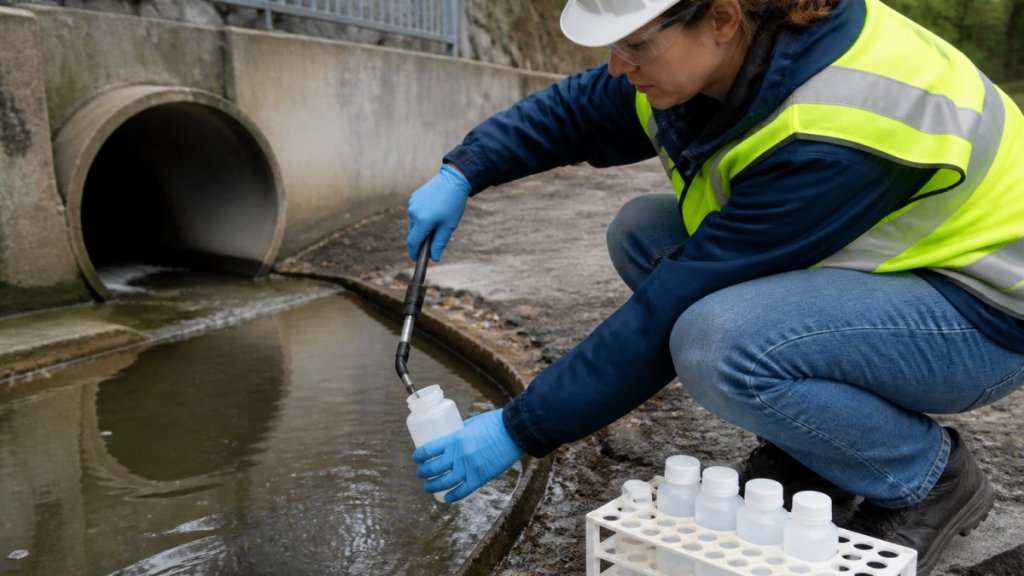
Last Updated: October 23, 2026
Quick Summary
Stormwater sampling is the act of collecting runoff from an industrial site and sending it to a lab to prove the discharge meets permit limits. In California, facilities covered by the Industrial General Permit must sample the first qualifying storm events and file results electronically. Collect within the four-hour window, measure field parameters on site, and keep the chain of custody complete.
- A qualifying storm event must produce a discharge and meet the permit’s threshold for the site’s monitoring status.
- Record discharge start time at each point, then collect in order of priority starting with the point that flowed first.
- Label the container before you fill it, since a wet label written after collection smears.
- Match the response to the level: numeric action level and numeric effluent limit trigger different requirements.
- Build the annual report from the field logs and lab reports kept during the year.
Table of Contents
- Why California Stormwater Sampling and Monitoring Procedures Matter
- Qualifying Storm Event Stormwater Sampling: When a Storm Counts
- Stormwater Sample Collection Equipment and Field Measurements
- Stormwater Sampling Field Procedures: Step by Step
- Using a Stormwater Sampling Field Log Template
- Sampling Methods by Site and Pollutant Type
- Reporting Results and Following Up After Laboratory Analysis
- Conclusion
- Frequently Asked Questions
Why California Stormwater Sampling and Monitoring Procedures Matter
Stormwater sampling is the act of collecting runoff from an industrial site and sending it to a lab to prove the discharge meets permit limits. Industrial facilities covered by the Industrial General Permit must monitor what leaves their property, and the results go on the record (Industrial Stormwater Program).
This guide from Michael Karl McNeil walks through the full procedure, from deciding whether a storm counts to filing results electronically.
Why does it matter so much? Because a missing sample is a violation. A contaminated sample is a violation. A sample taken outside the window is a violation.
A few practical habits separate clean compliance from citation risk:
- Read the permit before the first storm, not after
- Train the sampler, not just the manager
- Keep field logs in ink and keep them
For a fuller picture of site monitoring between storms, see our guide on SWPPP site monitoring best practices.
Qualifying Storm Event Stormwater Sampling: When a Storm Counts
A qualifying storm event is a precipitation event that produces a discharge from a designated discharge point and meets the permit’s threshold for that site. Not every rainstorm triggers sampling.
The Industrial General Permit ties sampling frequency to a facility’s monitoring status, which shifts as results accumulate.
Here is the decision path we use in the field:
- Did measurable rain fall at the site? Check the rain gauge, not the forecast. Record start time and estimated depth.
- Is there a discharge from a discharge point or outfall? Inspect every point, not just the one that usually flows.
- Does the event meet the permit’s qualifying threshold for this site’s monitoring status?
- Is the site in a sampling period, or has it already met its event count for the year?
- Can the sample be collected safely and within the window? If not, the event may still be reportable even when the sample is not collectible.
If any answer is no, document why and stand down. Documented stand-downs protect you.
The Four-Hour Sampling Window and Discharge Point Check
The four-hour window is the core timing rule: once a qualifying discharge begins, the sampler has a limited window to collect the sample. Miss it and the sample may not count.
Check every discharge point at the start of the event. Note the time discharge began at each one. Then collect in order of priority, starting with the point that began flowing first.
The most common field failure we see is a sampler who waits for the rain to “settle” before collecting. That delay can push the grab sample past the window. Collect within the window, then note conditions honestly.
Decision Tree for Storms That Do Not Cooperate
Field conditions rarely follow the plan. Use this decision tree when the normal path breaks down:
- Rain fell but no discharge at any point. Document the gauge reading and the inspection of each point. No sample is collected, but the event is logged. If the site’s permit requires an annual minimum number of sampled events, note the shortfall and plan for the next event.
- Discharge began but the sampler was not on site. Record the estimated start time from the gauge and any flow evidence, collect as soon as possible within the window, and note the delay in the field log. Do not backdate.
- Discharge is occurring but the point is unsafe to reach. Steep banks, traffic, confined spaces, and fast-moving water are legitimate safety stops. Do not enter. Document the condition with a photo, note the safety reason, and collect from the nearest safe access point if one exists. Safety trumps the sample; the documentation explains why.
A written decision tree in the SWPPP binder turns scattered timing rules into instructions a new sampler can follow at 2 a.m. in the rain. Review it with the team before the season, and update it whenever the permit or the site’s monitoring status changes.
The underlying obligations are spelled out in the SWPPP compliance requirements for California, which we recommend reading alongside the permit itself.
Stormwater Sample Collection Equipment and Field Measurements
Stormwater sample collection equipment falls into three groups: what you collect with, what you measure with, and what you record with. Get all three right and the sample holds up. Miss one and the lab result may be unusable.
Collection gear:
- Clean sample containers supplied by the lab, pre-preserved where required
- Extension pole and dipper for outfalls you cannot safely reach
- Nitrile gloves, changed between points
Field measurement gear:
- Calibrated pH meter
- Conductivity meter
- Turbidity meter
Recording gear:
- Field log or tablet with the site’s form
- Indelible pen
- Camera for point photos
Measure field parameters at the time of collection. Record them on the spot. Memory is not a data source.
Sample Containers, Preservation, and Chain of Custody
Sample integrity starts with the container. Use only lab-supplied containers matched to the analytical method. Pre-preserved bottles save time in the field, but only if the sampler knows which bottle goes with which test.
Chain of custody is the paper trail that proves nobody tampered with the sample. It needs:
- Collector name and signature
- Date and time of collection at each point
- Sample identification matching the lab’s labels
One gap in the chain and the result is open to challenge. Close every gap.
Stormwater Sampling Field Procedures: Step by Step
The field procedure is where compliance is won or lost. Follow these steps in order, every event, every time.
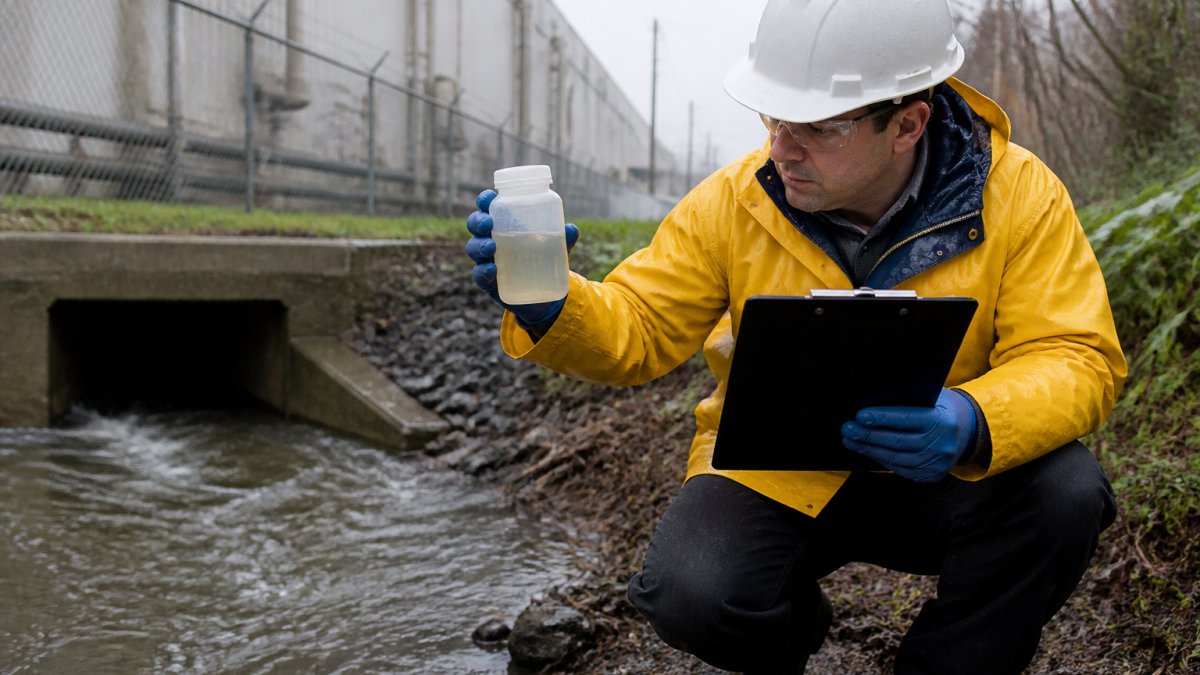
- Mobilize before the storm. Stage containers, meters, and logs the day before forecast rain.
- Confirm the event. Check the rain gauge and inspect each discharge point.
- Start the clock. Record the time discharge begins at each point.
- Collect the grab sample. Fill the container without overfilling, cap it, and label it immediately.
- Measure field parameters. pH, conductivity, and turbidity at the point of collection.
- Preserve and cool. Place samples on ice and record the temperature.
- Complete the chain of custody. Sign, date, and time every entry.
- Deliver to the lab. Meet the holding time for each method.
For a companion walkthrough of the sampling execution itself, read how to conduct industrial stormwater sampling.
Label the container before you fill it. A wet label written after collection smears, and an unlabeled sample is a rejected sample.
Follow these steps in order for every qualifying event.
| Step | What to do |
|---|---|
| 1 | Mobilize before the storm; stage containers, meters, logs |
| 2 | Confirm the event with rain gauge and discharge point inspection |
| 3 | Start the clock; record discharge start time at each point |
| 4 | Collect the grab sample, cap and label immediately |
| 5 | Measure pH, conductivity, turbidity at collection point |
| 6 | Preserve and cool samples on ice; record temperature |
| 7 | Complete chain of custody; sign, date, time entries |
| 8 | Deliver to lab; meet holding time for each method |
Using a Stormwater Sampling Field Log Template
A stormwater sampling field log template keeps every event consistent. Consistency is what an inspector looks for.
Build your log with these fields:
- Event ID and date
- Rain start time and estimated depth
- Discharge point ID and flow start time
Print the log on water-resistant paper. Keep a completed example in the binder as a training aid. New samplers copy what they see.
Sampling Methods by Site and Pollutant Type
The right method depends on what you are sampling for and where the water comes from.
Grab samples work for most permit parameters.
Composite samples mix aliquots across the event.
Visible pollutant observations are required at each discharge point.
Non-visible pollutant monitoring applies where the permit requires it after exceedances. Follow the permit’s schedule exactly.
Match the container and preservation to the method.
Reporting Results and Following Up After Laboratory Analysis
Reporting closes the loop. Once the lab returns results, compare them to the permit’s numeric limits. Then file them through the correct system within the deadline.
The California Environmental Reporting System guide explains how results get submitted electronically. Keep the lab report, the chain of custody, and the field log together for each event.
Reading Results Against the Permit’s Response Levels
The Industrial General Permit uses two thresholds that trigger action: the numeric action level and the numeric effluent limit. They are not the same, and the response differs.
- At or above the numeric action level. The result is an exceedance that requires a response. The permit’s typical path is to review the sampling record for errors, then evaluate the source and implement best management practices or other corrective measures. Document the evaluation and the action taken.
- At or above the numeric effluent limit. This is a more serious exceedance. The response is more formal, typically including a written evaluation, corrective action, and a follow-up sample or additional monitoring as the permit requires. Track the deadline for each step.
- Below both levels. No response required beyond filing, but a trend of rising results is worth investigating before it becomes an exceedance.
A common pattern is a facility that treats every exceedance the same. That flattens the response and leaves the formal steps for limit exceedances undocumented. Match the response to the level.
Corrective Actions and Follow-Up Sampling
When a result stands after review, the corrective action should be specific enough to verify later. “Improve housekeeping” is not a corrective action.
Follow-up sampling is often required after an exceedance. Put the follow-up event on the calendar and treat it like any other qualifying event: same window, same chain of custody, same field log. The follow-up result is what shows whether the corrective action worked.
The Annual Reporting Cycle
Results do not live event by event forever. The permit requires an annual report that summarizes the year’s sampling, exceedances, and corrective actions. Build the annual report from the same field logs and lab reports you kept during the year, which is why the file organization matters from the first storm. A facility that has to reconstruct the year from scattered emails loses time and credibility.
A clean file is your best defense. Lab report, chain of custody, and field log together tell the whole story of one event, and the annual report tells the story of the year.
Conclusion
Stormwater compliance in California rewards preparation and punishes improvisation. Train your samplers, keep your logs, and treat every storm as a test.
If you would rather have an experienced hand walk your team through it, Michael Karl McNeil brings a Qualified SWPPP Developer credential, industrial hygiene training, and decades of fire service prevention work to every site. Learn how SWPPP compliance consulting works, then get in touch to schedule a site review and get your sampling procedures ready before the next storm.
Frequently Asked Questions
How do you collect a stormwater sample at an industrial facility?
Collect a grab sample directly from the discharge point within the first four hours of a qualifying storm event. Use clean, permit-specified containers, wear gloves, and avoid disturbing sediment at the outfall. Fill containers to the required volume, cap them immediately, label each with the facility name, date, time, and sample location, then preserve and transport them on ice to the laboratory. Record field measurements such as pH and conductivity in your field log before leaving the site.
When should stormwater samples be collected in California?
Samples must be collected during a qualifying storm event, which generally means rainfall that produces a discharge and meets the permit’s minimum storm criteria. The four-hour sampling window begins when discharge starts, so crews should be ready to mobilize as soon as rain begins. Sampling outside that window or during a non-qualifying event can invalidate the result and create a reporting problem, so track forecasts and keep equipment staged during the rainy season.
What happens if a facility cannot collect a stormwater sample during a qualifying storm event?
Document the reason in the field log and in the facility’s monitoring records. Acceptable reasons typically include safety hazards, inaccessible discharge points, or no discharge occurring. The facility should note the conditions, the time of the attempt, and any corrective action taken, then report the exception through the required reporting system. Repeated missed events can trigger additional requirements, so review access and safety planning before the rainy season starts.
What equipment is needed for stormwater sampling?
Typical stormwater sample collection equipment includes clean sample containers supplied by the laboratory, gloves, a dipper or sampling pole, a cooler with ice, a field meter for pH and conductivity, a field log or template, permanent markers, and chain-of-custody forms. Bring a flashlight, rain gear, and a safety vest for wet-weather work. Confirm container types and preservation requirements with the laboratory before the storm arrives so samples are not rejected on arrival.


Leave a Reply