Table of Contents
- What SWPPP Compliance Consulting Actually Involves
- SWPPP Inspection Best Practices and Site Monitoring
- Construction General Permit Requirements and Obligations
- Stormwater Sampling Procedures and Water Quality Testing
- Regulatory Compliance and NPDES Permit Management
- Best Management Practices and Erosion Control Implementation
- Common Compliance Gaps and How to Identify Them
- Frequently Asked Questions
Last Updated: September 22, 2026
What SWPPP Compliance Consulting Actually Involves
A stormwater pollution prevention plan, or SWPPP, is a site-specific document that describes the best management practices and pollution prevention measures a construction project will use to prevent stormwater runoff from carrying sediment, chemicals, and other pollutants into nearby waterways. SWPPP compliance consulting helps construction managers, contractors, and facility operators understand what their regulatory obligations actually are and how to meet them in practice.
I’ve spent twenty-five years in the federal and state fire service, most of it in fire prevention, and have a Master of Science in Environmental Health. I run McNeil Safety Consulting out of San Gabriel, California, working across California and the Western states. What I’ve learned is that most construction teams approach stormwater management as a box-checking exercise: get the permit, fill out the forms, hope nothing goes wrong. The problem is that stormwater compliance isn’t optional, and the consequences of getting it wrong extend far beyond a citation.
The Clean Water Act requires that construction projects disturbing one or more acres of land obtain an NPDES permit, a National Pollutant Discharge Elimination System permit issued under federal law. That permit comes with specific conditions. Your SWPPP is the document that proves you understand those conditions and have a plan to follow them. When a site inspector arrives, and they will, they’re looking for evidence that your SWPPP compliance consulting has actually shaped how your site operates day to day. Rigorous documentation begins long before the first shovel hits the dirt, as the initial phase of preparing land for construction establishes the erosion control standards that inspectors will eventually hold you accountable for.
What this consulting actually covers is straightforward: it starts with understanding your regulatory obligations, moves into designing erosion control and sediment management practices specific to your site, then shifts into the ongoing work of inspections, maintenance, documentation, and water quality monitoring that keeps you compliant for the life of the project. The qualified SWPPP developer, the person with the credentials to sign off on the plan, needs to understand local geology, rainfall patterns, proximity to sensitive waters, and the specific construction sequence your project will follow.
Most teams discover too late that SWPPP compliance consulting isn’t something you do once and forget. It’s a continuous process that runs from the first day of grading through final site stabilization.
SWPPP Inspection Best Practices and Site Monitoring
Regular site inspections are the backbone of SWPPP compliance. The Construction General Permit requires qualified personnel to conduct inspections at minimum once every seven days during active construction and within 24 hours after a rainfall event of 0.5 inches or greater, or as specified by the permit. These aren’t casual walk-throughs.
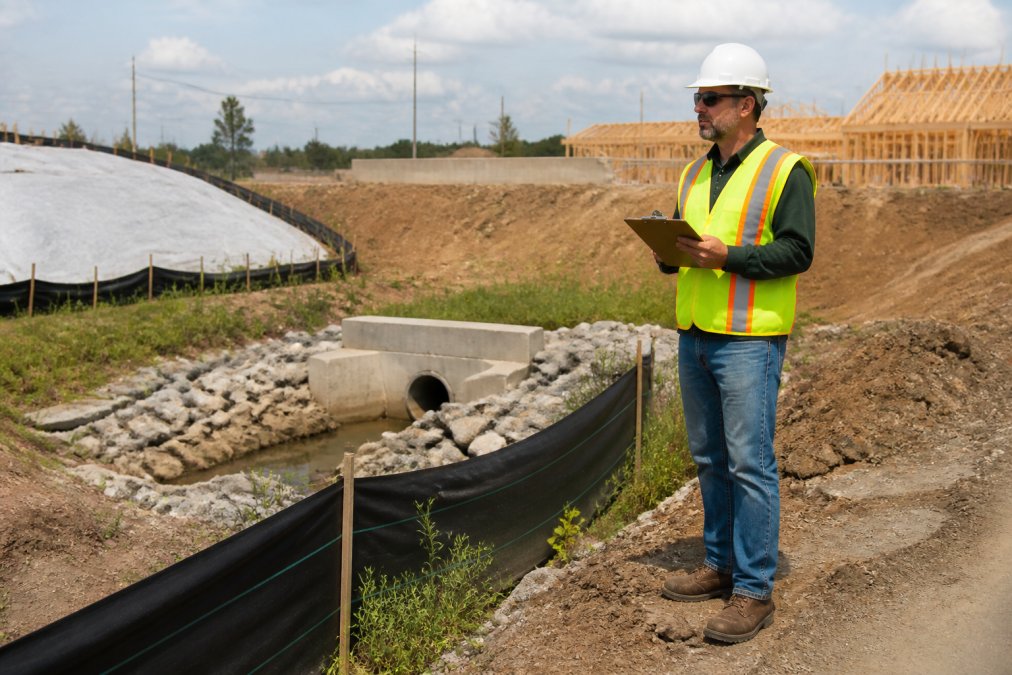
A proper inspection documents the condition of every erosion control measure on site: sediment fencing, silt fences, inlet protection devices, stabilized construction entrances, and tracking control measures. You’re looking for visible damage, sediment buildup, areas where stormwater is bypassing controls, and any signs that pollutants are escaping the site. The inspector notes whether vegetation is establishing on disturbed areas, whether dust is being controlled, and whether materials are stored properly away from storm drains.
The inspection report becomes your evidence that you’re actively managing the site. Inspectors want to see that you’re not just installing controls and hoping, they want to see that you’re monitoring them, maintaining them, and adjusting them when conditions change. A site with documented weekly inspections, maintenance records, and corrective actions taken demonstrates that the contractor takes SWPPP compliance seriously.
What most teams miss is that inspection records are your defense. When regulators or attorneys ask whether you were negligent, your inspection records answer that question. If you skipped inspections, that’s evidence you weren’t paying attention. If you documented problems but didn’t fix them, that’s worse.
Construction General Permit Requirements and Obligations
The Construction General Permit is California’s statewide permit that covers construction activities. If you’re disturbing one or more acres of soil, you need coverage under this permit. That means you need an NPDES permit and a SWPPP compliance consulting plan before you start work.
The permit requires several specific things. First, a qualified SWPPP developer must prepare your plan. That person holds credentials, such as a Qualified SWPPP Developer registered with the California State Water Resources Control Board, and has signed off on the document. Second, your plan must identify all potential sources of pollution on the site: construction materials, equipment maintenance areas, concrete washout locations, and exposed soil. Third, you must specify which best management practices you’ll use to prevent those pollutants from entering stormwater.
The permit also requires that you designate a responsible person, someone on site who understands the plan and can make decisions about maintenance and repairs. That person needs to know what the controls are supposed to do, recognize when they’re failing, and have the authority to stop work if necessary to prevent pollution.
Documentation is mandatory. You must maintain daily logs of weather, inspection records, maintenance activities, and any corrective actions. If a spill occurs, you document it, contain it, and report it. These records stay on site and are available for inspection. The responsible person signs or initials them. They’re not optional paperwork, they’re the evidence that your SWPPP compliance consulting actually shaped site operations.
Stormwater Sampling Procedures and Water Quality Testing
Water quality monitoring happens when your site discharges stormwater to surface waters. The permit requires sampling and analysis of stormwater discharge to verify that your erosion control measures are working and that pollutants aren’t leaving the site at unacceptable levels.
Sampling is done during active rainfall or shortly after. A qualified sampler collects water from the discharge point, the location where stormwater leaves your site, and sends it to a certified laboratory. The lab analyzes it for turbidity, which is a measure of suspended sediment (Turbidity and Water). High turbidity means your sediment controls aren’t catching the fine particles, and stormwater runoff is carrying sediment into the receiving water.
The permit specifies action levels. If your turbidity exceeds the threshold, you have to identify why and implement additional controls. Maybe your sediment fencing is damaged. Maybe you need additional inlet protection or sediment traps. Maybe you need to stabilize exposed areas faster. The sampling results tell you whether your current approach is working or whether you need to adjust.
What’s important is that sampling isn’t guesswork. You’re following a specific protocol: sampling location, time of collection, handling procedures, chain of custody, laboratory certification. The results are only valid if the sampling was done correctly. A poorly collected sample is worse than no sample at all because it can give you false confidence that your controls are working when they’re not.
Regulatory Compliance and NPDES Permit Management
Your NPDES permit is a legal document. It contains specific requirements, conditions, and limits. Understanding what your permit actually says is the first step to compliance.
The permit specifies which activities require the SWPPP, which activities don’t, and which activities require additional permits. It defines when inspections are required, what records you must keep, and what triggers reporting obligations. It identifies the regulatory agency responsible for enforcement, typically the regional water quality control board in your area.
Permit compliance means following every requirement, every condition, and every deadline. If the permit says inspections are required weekly, then weekly inspections aren’t optional. If the permit requires reporting of spills above a certain quantity, you report them. If the permit specifies a timeline for corrective action, you meet that timeline.
The permit also contains provisions for non-compliance. If you fail to conduct required inspections, fail to implement required controls, or fail to maintain records, the regulatory agency can issue a cease-and-desist order, levy civil liability, or refer the matter for criminal prosecution. The penalties are significant. Civil liability can reach thousands of dollars per day of violation. Criminal penalties can include fines and imprisonment.
What this means in practice is that SWPPP compliance consulting isn’t a suggestion. It’s a legal requirement. Your permit is the law at your site, and you’re responsible for knowing it and following it.
Best Management Practices and Erosion Control Implementation
Best management practices, or BMPs, are the specific tools and techniques you use to prevent pollution. Erosion control BMPs include sediment fencing, silt fences, inlet protection, sediment traps, and dust control. Pollution prevention BMPs include spill prevention, material storage, and waste management.
Selecting the right BMPs for your site depends on several factors: the topography and slope, the soil type, the proximity to sensitive waters, the rainfall patterns in your area, and the specific construction activities you’ll be conducting.
Common Compliance Gaps and How to Identify Them
In my experience, common compliance problems appear repeatedly when reviewing sites and working with construction teams. Recognizing them early is the key to avoiding violations.
Frequently Asked Questions
What is SWPPP compliance and who needs it?
A stormwater pollution prevention plan is a site-specific document required under the Clean Water Act and NPDES permitting when construction disturbs one or more acres of soil. The plan identifies potential pollution sources, specifies best management practices to prevent discharge of sediment and other pollutants, and establishes inspection and maintenance schedules. Any project meeting the acreage threshold must have a SWPPP before disturbing soil.
What does a Qualified SWPPP Developer do during the active construction phase?
A QSD develops the initial plan, certifies its compliance with regulatory requirements, and typically conducts regular site inspections to verify that erosion control measures are installed and maintained correctly. The QSD also updates the plan if site conditions change, ensures training requirements are met, and documents compliance activities. The QSD’s role bridges the gap between the regulatory requirement and on-site execution.
How do Construction General Permit requirements affect daily site operations?
The Construction General Permit establishes baseline requirements for all permitted projects: you must implement the SWPPP, conduct weekly inspections, maintain erosion control devices, manage waste and materials, and perform corrective actions when inspections reveal problems. These activities require coordination between site management, the QSD, and field crews. Permit language also specifies when you must notify the regulatory agency of non-compliance or significant rainfall events.
What are common compliance gaps that create liability?
The most frequent issues are incomplete or inaccurate site assessments that miss pollution sources, erosion control devices installed incorrectly or not maintained, inadequate or missing stormwater sampling documentation, failure to update the plan when site conditions change, and poor training records for site personnel. Many of these gaps are discovered only during regulatory inspections, at which point corrective action becomes mandatory and enforcement action becomes possible.


Leave a Reply