Last Updated: November 16, 2026
Quick Summary
Stormwater monitoring is the systematic collection, field measurement, and laboratory analysis of discharges from a construction site to demonstrate compliance with permit benchmarks and water quality standards. In California, it ties directly to the Construction General Permit issued by the State Water Resources Control Board, the controlling document for sites disturbing one acre or more.
- The Construction General Permit assigns sites a Risk Level of 1, 2, or 3 based on sediment delivery and receiving water sensitivity.
- Sample at the discharge point identified in your SWPPP, not at a convenient puddle or ponded water.
- Log instrument ID and calibration date with every field reading so an inspector can verify the number.
- Build the lab pickup schedule around the shortest holding time in your parameter set, not the longest.
- For each deficiency, record what failed, when it was found, what was done, and when the fix was verified.
Table of Contents
- California Construction Stormwater Monitoring Best Practices: The Compliance Framework
- Construction Stormwater Monitoring and Sampling: Triggers, Field Procedures, and Analysis
- Construction Site Stormwater Inspections: Rain-Event Readiness and Routine Checks
- Best Management Practices for Erosion, Sediment, and Pollution Prevention
- Building a Construction SWPPP Template California Teams Can Actually Use
- What a Construction Stormwater Monitoring Report Must Include
- Schedule a Stormwater Compliance Review for Your Project
- Frequently Asked Questions
California Construction Stormwater Monitoring Best Practices: The Compliance Framework
California construction storm water monitoring best practices begin with one principle: every sample you pull has to survive a regulator’s review years after the rain has dried.
Stormwater monitoring is the systematic collection, field measurement, and laboratory analysis of discharges from a construction site to demonstrate compliance with permit benchmarks and water quality standards. It ties directly to the Construction General Permit issued by the State Water Resources Control Board, the controlling document for California sites.
Below, we walk through who needs coverage, when sampling triggers, how inspections and BMPs fit together, and what a report must contain. Get the framework right and the field work becomes routine.
Who Needs a Construction Stormwater Permit
Any project that disturbs one acre or more of soil needs permit coverage, and so does any smaller project that is part of a larger common plan of development (the EPA). The threshold is about disturbed area, not total parcel size, which catches owners who assume a compact site is exempt.
Linear projects, utility work, and phased subdivisions all fall under the same rule. If earth is moved, the permit applies.
Permit Requirements by Project Type and Risk Level
California sorts sites by risk, and the risk level drives how much monitoring you owe. The permit assigns a Risk Level of 1, 2, or 3 based on sediment delivery and receiving water sensitivity.
A few practical consequences:
- Higher risk levels require more frequent sampling and inspection
- Sites near impaired waters face tighter benchmarks and corrective-action triggers
- Risk level can shift if site conditions change, so revisit the calculation
Treating every site as low risk to save field time would be a documentation error. The risk determination is documented, and an inspector will check whether it matches the actual receiving water.
Construction Stormwater Monitoring and Sampling: Triggers, Field Procedures, and Analysis
Construction stormwater monitoring and sampling run on two clocks: routine schedules set by risk level, and event-driven sampling triggered by rain. Miss either and the gap shows up in your annual report. The sections below translate the permit’s monitoring obligations into a field workflow a crew can execute in the rain.
When Sampling Is Required
Sampling is generally required during qualifying rain events and at established routine intervals for higher-risk sites. A qualifying event is defined by the permit, and discharge timing matters: you sample when runoff actually leaves the site, not when the first drop falls.
First, a storm that produces no discharge is not a sampling event, but it is still an inspection event, document the absence of discharge so the record shows you were watching. Second, a qualifying event that begins overnight may still require a sample if discharge is flowing at first light; the permit’s definition governs, not the clock on the wall.
Non-stormwater discharges, such as dewatering or washwater, must be eliminated or separately covered. Sampling them as if they were stormwater corrupts your dataset and can trigger a false exceedance that costs more time to explain than to prevent.
Sampling Locations and Field Parameters
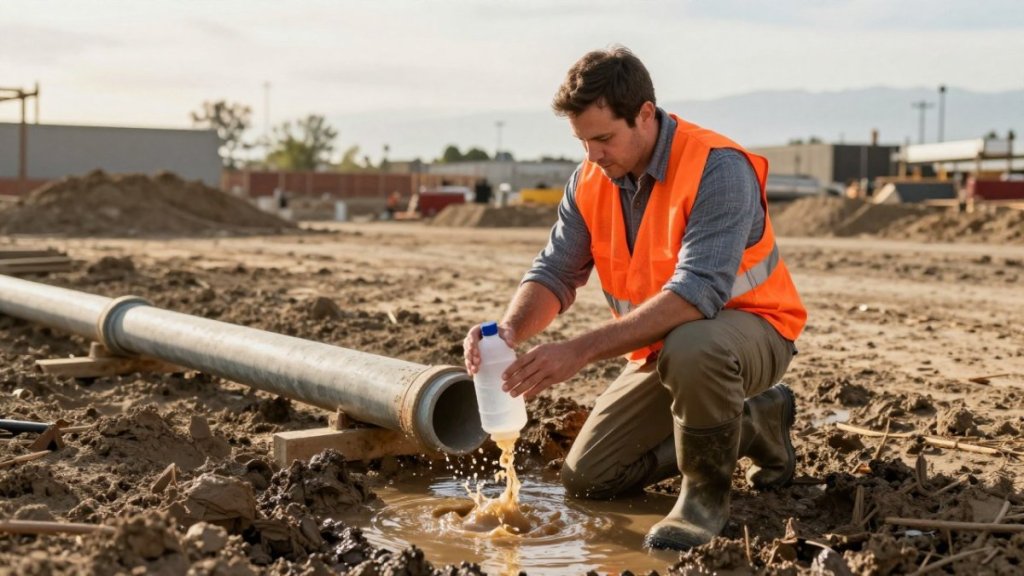
Sample at the discharge point identified in your SWPPP, not at a convenient puddle.
Field parameters are measured on site because they change between the outfall and the lab bench. Typical field measurements include pH, turbidity, temperature, and specific conductance, logged at the time of collection.
Sampling a stagnant pool behind a silt fence instead of the actual discharge would produce a result describing ponded water rather than the runoff leaving the site.
Field Sampling Procedure
Field procedure is where good programs separate from sloppy ones. Follow this sequence every event:
- Record the rain event start time and discharge observation before sampling
- Collect the sample from the discharge point in a clean, permit-approved container
- Measure field parameters on site and log them immediately
- Label the sample with site ID, date, time, and parameter set
- Chain of custody to the lab, with signatures at every handoff
- Store and ship per the lab’s holding-time requirements
Container prep matters more than most crews assume. Use the container material the analytical method requires, pre-cleaned for the parameter set, and never reuse a container across events without the documented cleaning step.
Holding times are critical to defensible data. If a sample sits in a truck bed past the method’s holding time, the lab result may be technically valid but practically useless for compliance purposes.
A detailed walkthrough of construction site stormwater sampling procedures that hold up is available for further reading.
From Sample to Record: Documentation and Analysis
A sample is only as good as the record that travels with it. For each event, the file should contain the rain event log, the discharge observation, the field parameter sheet, the chain-of-custody form, the lab report, and the corrective-action note if a result exceeds a benchmark.
When results come back, compare them against the applicable benchmarks and numeric action levels before filing. The annual reporting requirements that apply to your sampling data are available for further reading.
Construction Site Stormwater Inspections: Rain-Event Readiness and Routine Checks
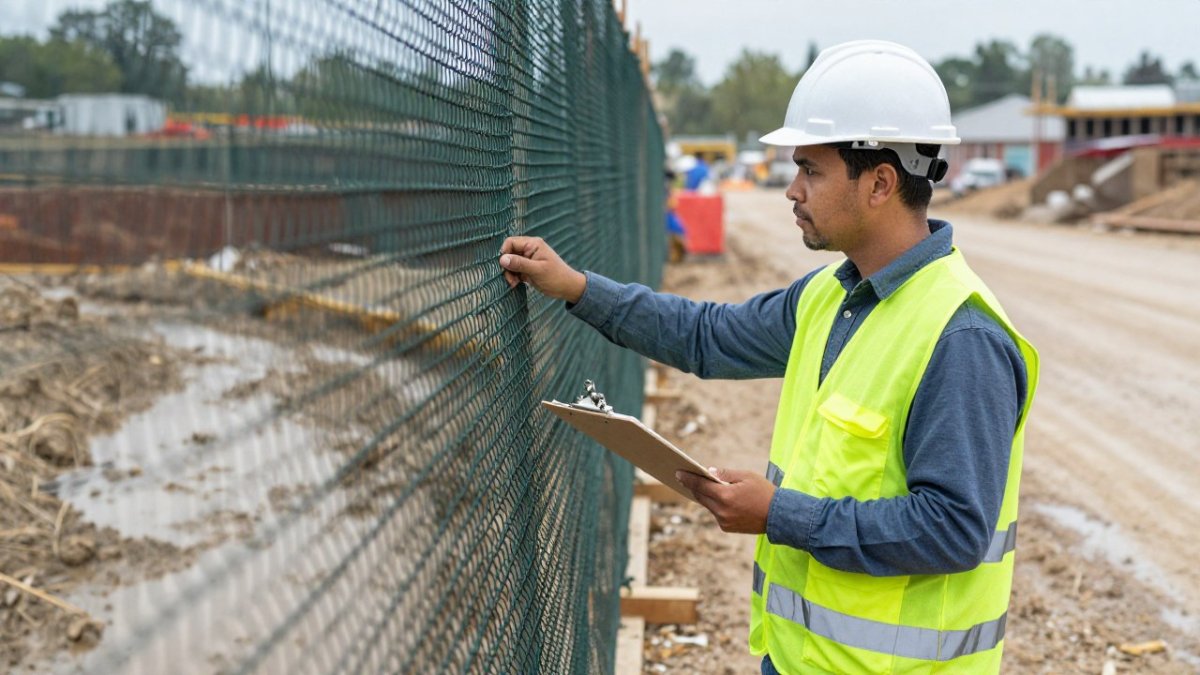
Construction site stormwater inspections are the early-warning system for everything else. The same phase-based checks can also keep debris and hazardous materials from becoming runoff hazards, so Junk Crusher practices belong alongside BMP inspections.
Pre-Storm Readiness Checklist
Before forecast rain, walk the perimeter and confirm the following:
- Sediment barriers are intact, keyed into the ground, and free of tears or sagging
- Inlet protection is seated and clear of accumulated sediment
- Stockpiles are covered and bermed, with covers weighted against wind
A pre-storm walk that finds a torn silt fence is a success, not a failure, it is the cheapest possible time to fix a control.
During-Storm Observations
You cannot fix a site in the middle of a storm, but you can document what the storm did. During a qualifying event, observe and record discharge points, whether controls are being overtopped, and whether any obvious pollutant is leaving the site.
If discharge is occurring and sampling is triggered, the during-storm observation and the sample collection should be logged as one event, with times that line up.
Post-Storm Inspection and Corrective Action
After the event, inspect discharge points, repair undermined controls, and log the condition of every temporary control.
Corrective action is the part most programs under-document. For each deficiency, record what failed, when it was found, what was done, and when the fix was verified.
Watch out: closing a corrective action in the log before the repair is actually verified is a documentation failure that is easy to catch and hard to explain.
Inspection Frequency and Recordkeeping
Inspection frequency follows your risk level and permit terms, and the routine schedule is separate from the rain-event schedule. Keep a single inspection log that shows both, with the date, the inspector, the areas checked, the findings, and the corrective actions. Photographs dated to the inspection are the strongest supporting record, especially for controls that are later removed or covered by construction.
The best practices for SWPPP site monitoring provide further guidance on this topic.
Best Management Practices for Erosion, Sediment, and Pollution Prevention
Best management practices fall into three families, and each addresses a different failure mode. Erosion control keeps soil in place; sediment control captures what moves anyway; pollution prevention keeps materials out of the flow.
Sediment barriers, silt fence, trackout control, and concrete washout areas are the backbone of most sites. Materials management, covered stockpiles, and lined washout keep non-stormwater discharge out of your sampling points.
Summary Table of BMP Categories
| BMP Category | Primary Purpose | Common Examples | Maintenance Focus |
|---|---|---|---|
| Erosion control | Keep soil in place | Mulch, blankets, seeding | Reapply after storms |
| Sediment control | Capture mobilized soil | Silt fence, sediment basins | Remove accumulated sediment |
| Trackout control | Stop offsite tracking | Gravel pads, wash racks | Rebuild pad, clear mud |
| Pollution prevention | Keep materials out of flow | Covered stockpiles, washout | Inspect liners and covers |
| Runoff control | Manage flow and ponding | Onsite ponding basin, diversions | Clear inlets, check grades |
Building a Construction SWPPP Template California Teams Can Actually Use
A construction SWPPP template California teams can actually use is one that field crews can follow in the rain, not a binder that lives on a shelf.
Start with the site map, then the risk determination, then the BMP plan by construction phase. Add the inspection and sampling schedule, the monitoring locations, and the corrective-action procedure.
The common construction stormwater permit violations field guide is available for further reading.
What a Construction Stormwater Monitoring Report Must Include
A construction stormwater monitoring report must include the sampling dates and times, field measurements, laboratory results, the rain event data, inspection findings, and any corrective actions taken. The permit defines the required elements, and the annual report rolls them into a single compliance record.
Numeric Action Levels and Corrective-Action Thresholds
Numeric action levels are the benchmark values that trigger a required response when an analytical result exceeds them. Exceed a threshold and you must investigate, document, and correct. The permit sets the specific thresholds and the response timeline, so read the current version rather than relying on memory.
Corrective action is documented evidence that a response occurred. For the reporting cycle that follows, review the annual reporting requirements that apply to your sampling data.
Schedule a Stormwater Compliance Review for Your Project
Compliance gaps are commonly associated with documentation and timing.
Michael Karl McNeil holds a Qualified SWPPP Developer registration with the California State Water Resources Control Board and is a Registered Industrial Hygiene Professional and Registered Environmental Professional. Find qualified SWPPP developer services in California.
Visit the Michael Karl McNeil website to learn more about the services offered.
The next storm event will test your monitoring program whether or not it is ready.
Frequently Asked Questions
Who needs a construction stormwater permit in California?
Any construction project that disturbs one acre or more of soil, or is part of a larger common plan of development that reaches one acre, needs coverage under the Construction General Permit issued by the State Water Resources Control Board. Projects disturbing less than one acre may still need coverage if they pose a risk to water quality. The permit requires a Stormwater Pollution Prevention Plan, a qualified developer and practitioner, and monitoring and sampling based on the site’s risk level.
How often should construction sites be inspected for stormwater issues?
Inspection frequency follows the site’s risk level and the permit’s written schedule. Routine construction site stormwater inspections cover BMP condition, sediment buildup, trackout, concrete washout, and non-stormwater discharges. Additional inspections are required before and after rain events, and any control device that fails must be repaired and documented. Keep every inspection on a dated form with the inspector’s name and the corrective action taken so the record holds up during a compliance review.
When is stormwater sampling required at a construction site?
Sampling is triggered by qualifying rain events and by the site’s risk level under the permit. Construction stormwater monitoring and sampling generally requires collecting discharge samples during a rain event that produces runoff, following the permit’s field procedures for grab or composite samples. Samples go to a certified laboratory for analysis, and results are compared against the applicable numeric action levels. Missing a sampling trigger is one of the most common compliance failures, so track rain forecasts and assign a qualified sampler in advance.
What should a construction stormwater monitoring report include?
A complete construction stormwater monitoring report records the sampling date and time, the rain event, the discharge point, the field measurements, the laboratory results, and a comparison against numeric action levels. It should also note any exceedance, the corrective action taken, and the inspection and BMP maintenance records for that period. Digital records with photos and timestamps make reporting faster and give regulators a clear chain of custody. File each report on schedule and keep copies on site.
What should a site team do after a stormwater monitoring result exceeds a limit?
An exceedance of a numeric action level calls for a documented response, not just a note in the file. The team should review the result, identify the likely source, inspect the BMPs, and make repairs or upgrades to reduce pollutant discharge. Record the corrective action, the date it was completed, and any follow-up sampling. Repeat exceedances may require additional treatment controls or a revised SWPPP. Prompt, documented corrective action is what regulators look for when they review the monitoring report.


Leave a Reply