Table of Contents
- Why Your California Project Needs a Qualified SWPPP Developer
- QSD vs QSP Responsibilities: Who Does What
- Construction General Permit Compliance Requirements
- Services a Qualified SWPPP Developer Provides
- How to Choose a QSD: Credentials and Experience
- Common Audit Pitfalls and How to Avoid Them
- The Cost of Non-Compliance vs. Professional Services
- Conclusion
- Frequently Asked Questions
Last Updated: September 8, 2026
Stormwater runoff carries sediment, heavy metals, and other pollutants from construction sites into waterways, making regulatory compliance critical for any California development project. A qualified swppp developer services california provider ensures your project meets State Water Resources Control Board requirements while avoiding costly enforcement actions. Michael Karl McNeil, a Qualified SWPPP Developer registered with the California State Water Resources Control Board, brings over twenty-five years of fire service and environmental health experience to stormwater compliance. This guide explains what these services include, how they differ from inspector roles, and how to protect your project from audit failures.
Why Your California Project Needs a Qualified SWPPP Developer
The Construction General Permit requires nearly all construction activity disturbing one acre or more to obtain coverage through a SWPPP (waterboards.ca.gov). Without proper coverage, your project faces stop-work orders, administrative civil liabilities, and significant project delays. A qualified SWPPP developer prepares the plan, conducts the initial site assessment, and ensures your documentation aligns with current regulatory expectations before you submit your Notice of Intent through SMARTS.
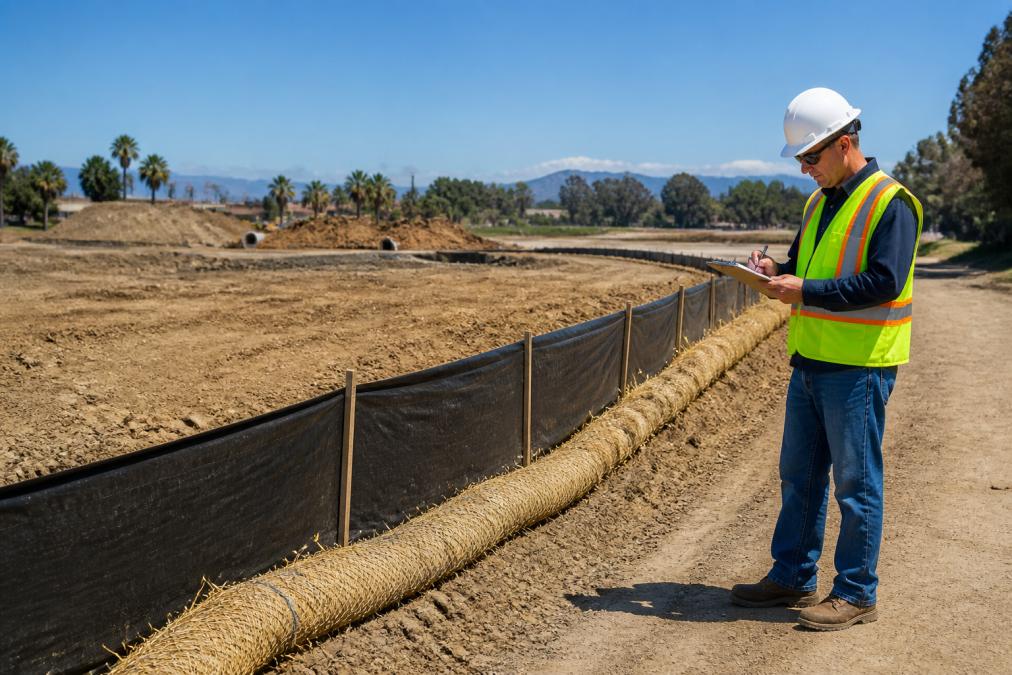
A well-prepared SWPPP functions as your operational roadmap for erosion and sediment control throughout every construction phase. Projects that treat the SWPPP as a living document rather than a filing requirement tend to pass inspections with fewer corrective actions.
QSD vs QSP Responsibilities: Who Does What
A Qualified SWPPP Developer (QSD) prepares and oversees the stormwater compliance program, while a Qualified SWPPP Practitioner (QSP) handles the day-to-day site inspections and sampling. The distinction matters because the Construction General Permit assigns specific duties to each role, and using one person for both functions may create conflicts during an audit.
| Role | Primary Responsibility | Typical Activities |
|---|---|---|
| QSD | Plan development and compliance oversight | SWPPP preparation, site assessment, selecting Best Management Practices, certifying reports |
| QSP | Field implementation and monitoring | Site inspections, water quality monitoring, sampling, maintenance of BMPs |
Most projects need both roles filled, either by separate individuals or by a firm that can staff both positions. The QSD develops the plan and remains responsible for its adequacy, while the QSP verifies that erosion and sediment control measures actually function as designed.
Construction General Permit Compliance Requirements
The Construction General Permit (CGP) establishes a tiered system based on project risk and receiving water quality. Compliance begins with determining your project’s risk level, which drives inspection frequency, sampling requirements, and numeric action levels for turbidity. Your qualified SWPPP developer must document this risk assessment accurately in the SWPPP.
Key compliance elements include submitting the Notice of Intent through SMARTS, implementing the erosion and sediment control measures described in your plan, conducting inspections at the required frequency, and filing compliance reports with the appropriate Water Board. The permit also requires amending the SWPPP whenever there is a significant change in site conditions, construction activities, or the effectiveness of control measures, a common finding during regulatory inspections.
Services a Qualified SWPPP Developer Provides
A qualified SWPPP developer offers more than plan writing. The scope of services typically spans the entire project lifecycle, from pre-construction assessment through final stabilization and the Notice of Termination.
SWPPP Preparation and Site Assessment
The process begins with a thorough project site assessment. The developer evaluates soil types, slopes, drainage patterns, and proximity to receiving waters to select appropriate Best Management Practices, forming the backbone of your SWPPP and demonstrating that your plan responds to actual conditions rather than generic templates.
The SWPPP itself must include a project description, a site map showing all discharge points, a description of erosion and sediment control BMPs, and a monitoring and reporting plan. A qualified SWPPP developer also prepares the associated documentation required for permit registration, including the risk determination and site-specific considerations.
Stormwater Inspection and Reporting Services
Once construction begins, a QSP conducts inspections at the frequency specified in your permit, typically every 14 days or after significant storm events (waterboards.ca.gov). These inspections verify that BMPs remain functional, identify any discharges of sediment or other pollutants, and document conditions requiring corrective action.
The inspection reports must be certified and uploaded to SMARTS within the permit’s required timeframe. A qualified SWPPP developer often provides or coordinates these services, ensuring continuity between the plan and its implementation and reducing the risk that field observations contradict the SWPPP.
How to Choose a QSD: Credentials and Experience
Selecting a Qualified SWPPP Developer is a procurement decision with long-term liability implications, not just a credential check. The market offers two distinct paths: hiring an external consultant or training an in-house employee, each with different cost structures, risk profiles, and operational trade-offs.
External Consultant vs. In-House QSD: A Decision Framework
Most developers default to hiring an external QSD because the certification process is time-intensive and the ongoing compliance workload is intermittent. However, for firms running continuous construction programs across multiple sites, an in-house QSD can amortize costs and provide faster response times.
| Factor | External Consultant | In-House Employee |
|---|---|---|
| Upfront cost | Hourly or fixed-fee contract | Salary plus certification training and PDH maintenance |
| Availability | Shared across multiple clients | Dedicated to your projects |
| Liability | Consultant carries professional liability for their work | Company assumes full liability for employee errors |
| Depth of expertise | Exposure to many site types and regulatory scenarios | Limited to your company’s project types |
| Scalability | Easy to scale up or down per project | Fixed overhead regardless of project volume |
A common pattern among mid-sized developers is hiring an external QSD for initial SWPPP preparation and risk assessment, then training a field superintendent as a QSP for day-to-day inspections. This hybrid model keeps plan development in expert hands while building internal capability for routine monitoring, though the QSP must report findings to the QSD.
Verifying Credentials Beyond the Certificate Number
The California State Water Resources Control Board maintains a public registry of qualified SWPPP developers. Before engaging anyone, verify the following:
- Active registration status, The QSD certification must be current and not suspended or revoked.
- Underlying professional license, Most QSDs hold a Professional Engineer (PE), Professional Geologist (PG), or Landscape Architect license. Confirm the license is active with the relevant state board, since a lapsed license can invalidate the QSD’s authority to certify certain documents.
- Regional Water Board familiarity, California has nine Regional Water Quality Control Boards, and each interprets the Construction General Permit with slight variations. A QSD who has worked extensively with your specific regional board will anticipate local expectations more accurately than one who operates statewide without regional focus.
- Enforcement history, Ask whether the QSD has been subject to any administrative civil liability orders or audit findings in the past five years. A clean enforcement record is not guaranteed by certification alone.
Interview Questions That Separate Experts from Generalists
Standard interviews focus on years of experience and project count. More revealing questions probe how the QSD handles situations that trigger regulatory scrutiny:
- “Describe a time you amended a SWPPP mid-construction due to unexpected site conditions. What triggered the amendment and how did you document it?”
- “How do you handle a situation where the general contractor refuses to install a BMP you specified because it interferes with their schedule?”
- “What is your process for conducting a pre-audit internal review before a Regional Water Board inspection?”
- “If a Notice of Violation is issued, what is your role in the corrective action process and how do you communicate with the Water Board?”
A qualified SWPPP developer with genuine field experience will answer these questions with specific examples and procedural detail; a candidate who responds with generalities likely lacks the depth needed for complex projects.
The Cost-Benefit Question Most Guides Ignore
Professional QSD services typically cost between $3,000 and $10,000 for SWPPP preparation on a mid-sized project, with ongoing inspection and reporting billed separately (the EPA). The more relevant comparison is against non-compliance: a single Notice of Violation can trigger administrative civil liability starting at $5,000 per day, and a stop-work order can cost $1,000 to $5,000 per day in idle labor and equipment. Framed this way, the QSD fee is a small fraction of the potential downside.
For in-house training, the cost includes the QSD certification course (typically $1,500 to $3,000), the underlying professional license requirements, and annual PDH maintenance, plus the employee’s salary during training and opportunity cost of time away from project duties. Unless your company maintains a continuous pipeline of construction projects requiring CGP coverage, the external consultant model usually delivers better value and lower liability exposure.
Before hiring a QSD, run a simple calculation: compare the consultant’s fee against your project’s daily cost of a stop-work order. If the fee is less than three days of project delay, the decision makes itself.
Common Audit Pitfalls and How to Avoid Them
Regulatory audits frequently uncover a disconnect between the SWPPP document and actual field conditions, where the plan describes BMPs never installed or modified without updating the plan. Another frequent finding is incomplete inspection documentation, including missing signatures, incorrect dates, or reports that do not accurately describe site conditions.
Poor housekeeping practices also draw scrutiny. Materials stored on site, such as fuels, concrete washout, or waste containers, must be managed to prevent contact with stormwater. A qualified SWPPP developer helps you avoid these pitfalls by conducting periodic internal reviews that mirror regulatory inspection protocols, identifying gaps while there is still time to correct them.
Do not assume that a generic SWPPP template satisfies the Construction General Permit. Regulators routinely reject plans that lack site-specific details, and an inadequate plan can trigger administrative civil liability even when your erosion control measures perform well in the field.
The Cost of Non-Compliance vs. Professional Services
Stormwater enforcement in California follows a predictable escalation path. The Construction General Permit authorizes Regional Water Quality Control Boards to issue administrative civil liability complaints with penalties scaling based on violation severity, duration, and compliance history. First-time documentation errors typically start around $5,000, while repeat offenses involving actual sediment discharges can reach $25,000 per day or more.
The Real Cost Structure of an Enforcement Action
A Notice of Violation rarely arrives as a single penalty. The full cost includes:
- Administrative civil liability, The direct fine assessed by the Water Board, which can be negotiated downward through a settlement but never eliminated entirely.
- Corrective action expenses, The cost of installing additional BMPs, conducting supplemental sampling, and hiring outside consultants to prepare the corrective action report.
- Project delay, A stop-work order halts all construction activity, not just the areas related to the violation. Idle labor, equipment rental, and extended financing costs accumulate daily.
- Increased scrutiny, Once a project receives an enforcement action, the Water Board typically requires more frequent inspections and reporting for the remainder of the permit term, increasing your ongoing compliance costs.
- Reputational damage, Enforcement actions are public records. Lenders, investors, and future project partners can access this history, potentially affecting your ability to secure financing or win bids.
The Post-Construction Transition: A Hidden Cost Trap
The cost analysis rarely accounts for what happens after construction ends. When a project reaches final stabilization and the Notice of Termination is filed, Construction General Permit coverage ends, but the site’s stormwater obligations do not disappear. Many projects trigger post-construction requirements under local municipal separate storm sewer system (MS4) permits or the state’s Industrial General Permit if the facility continues to operate with outdoor exposure.
A qualified SWPPP developer who only focuses on the construction phase may leave you unprepared for this transition, as the construction SWPPP is not the same document required for long-term operational compliance. Post-construction requirements typically include:
- Permanent BMPs, Structural controls like detention basins, infiltration trenches, or vegetated swales that must be maintained in perpetuity.
- Operation and Maintenance Plans, Documentation of how permanent BMPs will be inspected, cleaned, and repaired over the facility’s lifespan.
- Long-term monitoring, Some projects require ongoing water quality sampling and reporting under a separate permit, with its own set of compliance deadlines.
How Professional Services Mitigate Transition Risk
A full-scope qualified SWPPP developer will flag these downstream obligations during the initial site assessment, not after construction wraps. Integrating post-construction planning into the original SWPPP is minimal, often just additional documentation and coordination with local agencies, while retrofitting a site after construction can run into the hundreds of thousands of dollars if permanent BMPs were not designed into the original grading plan.
When evaluating professional services, ask whether the provider offers support through the Notice of Termination and into the post-construction phase. Some firms limit their scope to the construction permit and hand off the site without preparing you for what comes next; others, like Michael Karl McNeil‘s practice, provide environmental assessment services that bridge the gap between construction compliance and long-term stormwater management.
The cheapest QSD bid is rarely the most cost-effective choice. A provider who only prepares the SWPPP and disappears until the next inspection leaves you exposed to transition costs that dwarf the fee difference between consultants.
Conclusion
Stormwater compliance in California demands more than filling out forms. It requires a qualified SWPPP developer who understands the Construction General Permit, can prepare site-specific plans, and knows how to navigate audits and enforcement. Michael Karl McNeil, a Qualified SWPPP Developer registered with the California State Water Resources Control Board, offers stormwater, environmental, and property assessment services across California and the Western states. Get started with Michael Karl McNeil and protect your project from compliance failures before they cost you time and money.
Frequently Asked Questions
Do I need a QSD to prepare a Stormwater Pollution Prevention Plan?
Yes, for most construction projects disturbing one acre or more in California, the Construction General Permit requires a Qualified SWPPP Developer to prepare or oversee the SWPPP. The QSD must be registered with the State Water Resources Control Board and have completed approved training. Working with a qualified professional ensures your plan meets regulatory standards and reduces the risk of non-compliance penalties.
What is the difference between a SWPPP QSD and a QSP?
The QSD (Qualified SWPPP Developer) is responsible for developing and overseeing the SWPPP, conducting site assessments, and ensuring the plan meets Construction General Permit requirements. The QSP (Qualified SWPPP Practitioner) handles day-to-day implementation, performs regular site inspections, and collects stormwater samples. Both roles are required under the permit, but they have distinct responsibilities.
What services should I expect from a professional QSD?
A professional QSD provides site assessment, SWPPP preparation, permit registration through SMARTS, and guidance on selecting Best Management Practices. They also coordinate with the QSP on stormwater inspection and reporting services, help prepare for regulatory audits, and advise on post-construction compliance. This comprehensive approach keeps your project aligned with California’s stormwater regulations.
 Michael Karl McNeil
Leave a comment