Last Updated: November 4, 2026
Quick Summary
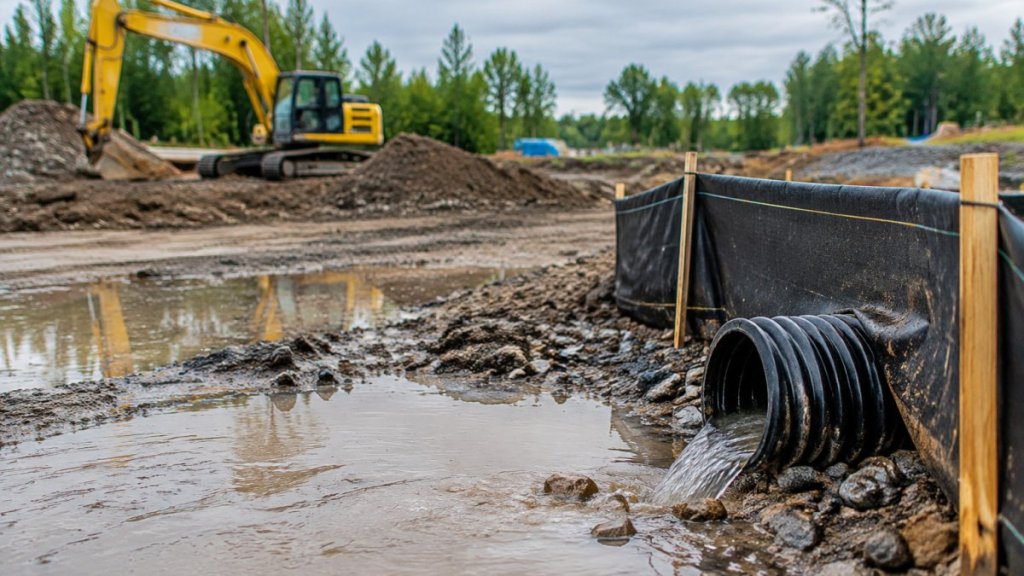
Construction stormwater permit violations happen when runoff leaving a job site carries sediment, chemicals or other pollutants off site in ways the permit does not allow. Most come from predictable gaps like failed controls and incomplete documentation rather than one dramatic event.
- Silt fence must be trenched into the ground, not stapled to the surface, or water passes underneath.
- Fiber rolls need stakes and ends turned uphill into a J-hook, or they roll away in the first storm.
- Inlet protection should be inspected for sediment depth, since a filled device lets flow go around it.
- Record every corrective action with a date and photo, because inspectors often cite the missing record even after a physical fix.
- Update the SWPPP whenever site conditions, phasing or contractors change instead of waiting for an annual review.
Table of Contents
- What Counts as a Construction Stormwater Permit Violation
- NPDES Construction General Permit Requirements You Must Meet
- The Most Frequent BMP and Sediment Control Failures
- Sediment and Erosion Control Failure Examples From the Field
- SWPPP Documentation Gaps That Trigger Enforcement
- Construction Site Stormwater Inspection Checklist for Field Crews
- Scheduling Your Next Site Walk Before an Inspector Does
- Frequently Asked Questions
What Counts as a Construction Stormwater Permit Violation
A construction stormwater permit violation happens when runoff leaving a job site carries sediment, chemicals or other pollutants into storm drains or nearby waters in ways the permit does not allow, and each such event can be cited as one of the stormwater permit violations a regulator reviews. Most violations come from a few predictable gaps rather than from one dramatic event.
Stormwater is rain and snowmelt that flows over the ground and picks up whatever it touches (the EPA). On a construction site, that includes soil, concrete wash, fuel, and trash.
A violation can take several forms:
- Discharging sediment-laden water off site
- Failing to install or maintain required best management practices (BMPs)
- Missing or outdated documentation in the Stormwater Pollution Prevention Plan (SWPPP)
- Skipping required inspections or sampling
- Letting a permitted activity begin before coverage is in place
Regulators look at both what leaves the site and whether the site followed its own plan, since stormwater permit violations are judged on the record as well as the runoff. A clean sample does not erase a documentation failure, and a well-written plan does not help if the controls on the ground are not working.
NPDES Construction General Permit Requirements You Must Meet
Most California projects that disturb one acre or more fall under the National Pollutant Discharge Elimination System (NPDES) Construction General Permit, administered through the State Water Resources Control Board (the EPA). Coverage requires filing for permit registration and preparing a SWPPP before ground disturbance begins.
Core obligations under the permit include:
- Developing and implementing a SWPPP that matches site conditions
- Installing BMPs for erosion control, sediment control, and non-stormwater discharges
- Inspecting the site and BMPs on the schedule the permit requires
- Keeping records of inspections, corrective actions, and training
- Monitoring discharges when the permit requires it
Requirements change over time, and a permit issued under one version may carry different duties than the current one. Confirm the current permit text on the State Water Board website before relying on any summary, including this one.
The Most Frequent BMP and Sediment Control Failures
Across many inspections, the same failures appear again and again. What separates a minor finding from an enforcement action is usually not the failure itself but how long it persists and whether the site’s own records show it was known.
Silt fence failures. Silt fence is the most commonly cited control and the most commonly misinstalled. The fabric must be trenched into the ground, not stapled to the surface. When the bottom edge is not keyed in, water passes underneath and the fence becomes decorative.
Fiber roll and wattle failures. Fiber rolls work only when they are staked and the ends are turned uphill to form a J-hook. Rolls laid flat without stakes roll away in the first storm.
Construction entrance failures. A stabilized construction entrance needs enough length and depth of aggregate to knock mud off tires before vehicles reach the pavement.
Inlet protection failures. Inlet protection is often installed once and never cleaned. Once the device fills with sediment, it stops passing water and the flow goes around it. Inspectors look for sediment depth, not just presence.
Stockpile failures. Uncovered and unstabilized stockpiles are a frequent finding, especially when stockpiles are placed near a perimeter control or an inlet. Cover alone is not enough if the stockpile sits on bare ground without a perimeter control.
Concrete washout failures. Washout on bare soil, washout pits that overflow, and washout located uphill of a drainage path are recurring citations. Concrete washwater is highly alkaline and is treated as an illicit discharge when it reaches waters.
Linear construction and phased work. On linear projects and phased sites, controls are often installed for the first phase and never updated when work moves. The SWPPP still lists controls that are no longer where the work is.
Most of these are maintenance and installation failures, not design failures. A control that worked on day one can fail after two storms if no one clears it, re-keys it, or repairs it.
Watch out: replacing a failed control without recording the corrective action still leaves a documentation gap, and inspectors frequently cite the record even when the physical fix was made.
Good practice is to walk the site after every rain event and before each scheduled inspection. Note what failed, fix it the same day if possible, and record the fix with a date and photo.
The table below summarises the most common control failures found in inspections and how each one typically goes wrong.
| Control | Common failure | Fix |
|---|---|---|
| Silt fence | Bottom edge not keyed into trench | Trench fabric into ground |
| Silt fence | Placed on contour, not perpendicular to flow | Orient perpendicular to flow |
| Fiber rolls | Laid flat without stakes | Stake and turn ends uphill into J-hook |
| Construction entrance | Too short, aggregate pushed into street | Adequate length and depth, sweep exit |
| Inlet protection | Filled with sediment, flow goes around | Inspect sediment depth and clean |
| Stockpiles | Uncovered or no perimeter control | Cover and install perimeter control |
| Concrete washout | On bare soil or uphill of drainage path | Contain away from drainage paths |
Sediment and Erosion Control Failure Examples From the Field
Field examples show how small problems become violations. A common case: a contractor installs a silt fence along the downslope edge of a grading area. After a heavy storm, the fence is undermined where the ground was never properly keyed in, and sediment flows into the gutter. The fence was in place, but it was not doing its job, and the SWPPP recorded it as functioning.
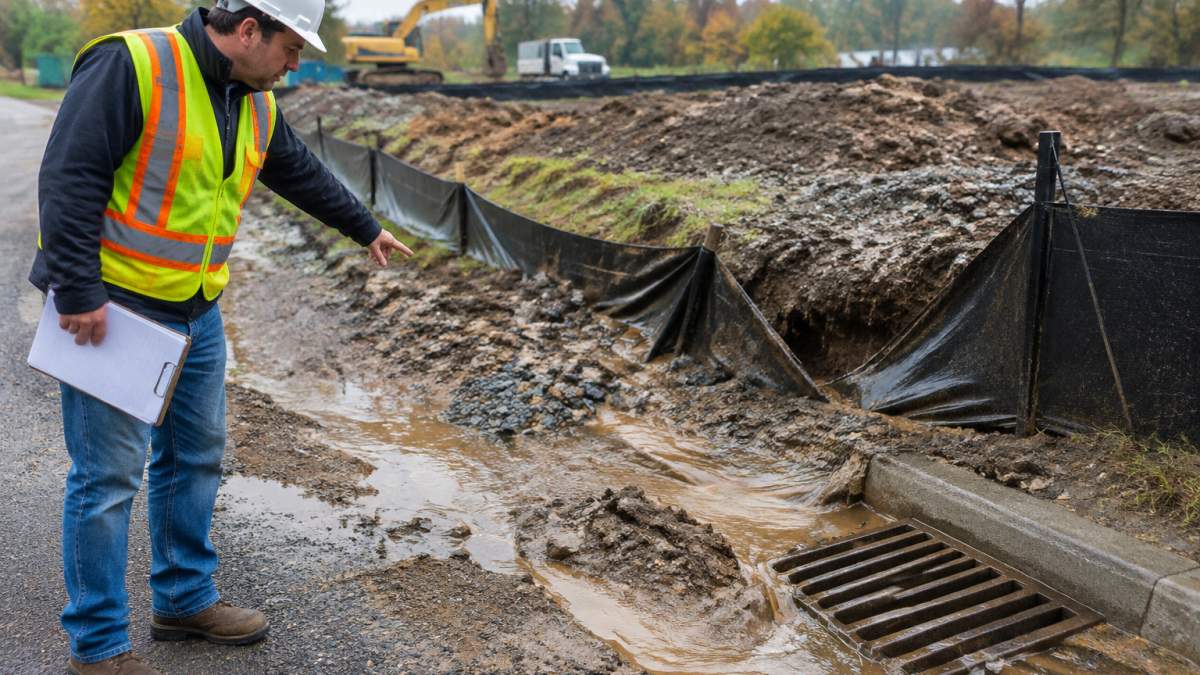
Another frequent case involves a site entrance where tracked mud builds up on the public street. Crews sweep the street when a complaint arrives, but the entrance itself is not maintained. Inspectors treat this as an ongoing discharge, not a one-time cleanup.
These examples share three features: the control existed on paper, the failure was visible to anyone walking the site, and the response came only after an outside party noticed. Routine inspection and prompt repair prevent most of these outcomes.
SWPPP Documentation Gaps That Trigger Enforcement
Documentation is often where enforcement begins, because a physical deficiency can be argued as recent while a missing record cannot. Regulators reviewing a site typically ask for the SWPPP, the inspection logs, the corrective action log, the rain event log, and training records. A gap in any one of these shifts the conversation from what the site looks like today to what the site can prove it did.
Common gaps include:
- An inspection log with blank fields, missing signatures, or dates that do not match the inspection schedule
- A SWPPP that still lists BMPs no longer on site, or omits controls added during a phase change
- No record of corrective action after a noted deficiency, or a corrective action noted without a completion date
- Training records that do not match the people actually working on the site, including subcontractors
- A rain event log that is not kept during the wet season, or that records rain without recording the inspection that followed
- A SWPPP that was never updated when the grading plan, phasing, or responsible personnel changed
The enforcement mechanism is straightforward: the permit requires the site to implement the SWPPP as written and to document inspections and corrections. When the record shows a deficiency was noted and not corrected, the site has documented its own noncompliance. When the record is silent, the site cannot show it inspected at all.
A simple habit prevents most of these gaps: update the SWPPP whenever site conditions, phasing, or contractors change, and do not wait for an annual review. For practical guidance, see best practices for SWPPP site monitoring records. Keep a written list of open items and close each one with a dated note and a photo. Assign one person to own the log so entries are not split across multiple binders or phones.
Watch out: backfilling inspection logs after a rain event, or signing a log for an inspection that was not performed, converts a recordkeeping gap into a falsification issue, which carries far greater exposure than the original deficiency.
Construction Site Stormwater Inspection Checklist for Field Crews
Field crews benefit from a short, repeatable checklist. Use it before, during, and after each inspection:
- Confirm the current SWPPP is on site and matches the phase of work
- Check every perimeter control for gaps, undermining, and sediment buildup
- Inspect the construction entrance and clear any tracked mud
- Verify inlet protection is in place and clean
- Check stockpiles for cover and stabilization
- Confirm concrete washout is contained and away from drainage paths
- Review the prior inspection log for open corrective actions
- Record findings, photos, and dated corrections
Scheduling Your Next Site Walk Before an Inspector Does
Waiting for an inspector to find problems is the most expensive way to learn about them. Read how to set up a defensible sampling program before your next walk. Schedule internal site walks on a fixed cadence, and add extra walks before forecast storms and after any major phase change.
When you schedule the walk, decide who will attend, what the checklist covers, and who has authority to order same-day repairs. Assign a single person to track open items so nothing is lost between walks.
If you find a deficiency that may have already caused a discharge, talk to your environmental counsel or consultant promptly. Early, documented response usually leads to better outcomes than delayed disclosure.
Frequently Asked Questions
What is a stormwater violation?
A stormwater violation occurs when a construction site discharges pollutants such as sediment, concrete washout, oil, or debris into waters of the United States without authorization, or when the site fails to follow the conditions of its stormwater permit. Under the Clean Water Act, discharges from construction activity disturbing one acre or more generally require coverage under an NPDES construction general permit. Violations can be recorded during inspections even when no visible discharge reaches a waterway, because failing to implement required best management practices or maintain required records is itself a noncompliance condition that regulators can cite.
How do inspectors identify non-compliance on construction sites?
Inspectors typically walk the perimeter and the active disturbance areas, looking for sediment tracked onto public roads, failed or missing perimeter controls, unstabilized slopes, overflowing concrete washout areas, and discharge points leaving the site. They also request the Stormwater Pollution Prevention Plan and check whether inspection logs are current, corrective actions were documented, and the plan reflects the site as it exists that day. Records that do not match field conditions are a common finding.
What are the most frequent NPDES construction stormwater permit failures?
The failures that appear most often in inspection findings include sediment controls installed but not maintained, stabilization not applied to inactive areas within required timeframes, stormwater inspections not performed or not documented at the required frequency, and SWPPPs that were never updated after site changes. Concrete washout discharges and uncontrolled stockpile runoff also show up frequently. Each can be corrected quickly if the site team catches it on its own inspection before a regulator does.
What is the role of a QSD in preventing stormwater violations?
A Qualified SWPPP Developer prepares or certifies the Stormwater Pollution Prevention Plan and helps match the controls on the plan to the actual site conditions, grading, and construction sequence. In California, QSDs are registered with the State Water Resources Control Board. Involving a QSD early, before grading begins, is one of the most effective ways to avoid violations, because the plan is built around how the site will really be worked rather than adjusted after an inspection finding.
Michael Karl McNeil works with contractors, property owners, and counsel on California stormwater compliance, including SWPPP development, field inspection support, and expert review. Qualified guidance depends on the specific site, permit coverage, and history, so consult a professional before making compliance decisions.


Leave a Reply