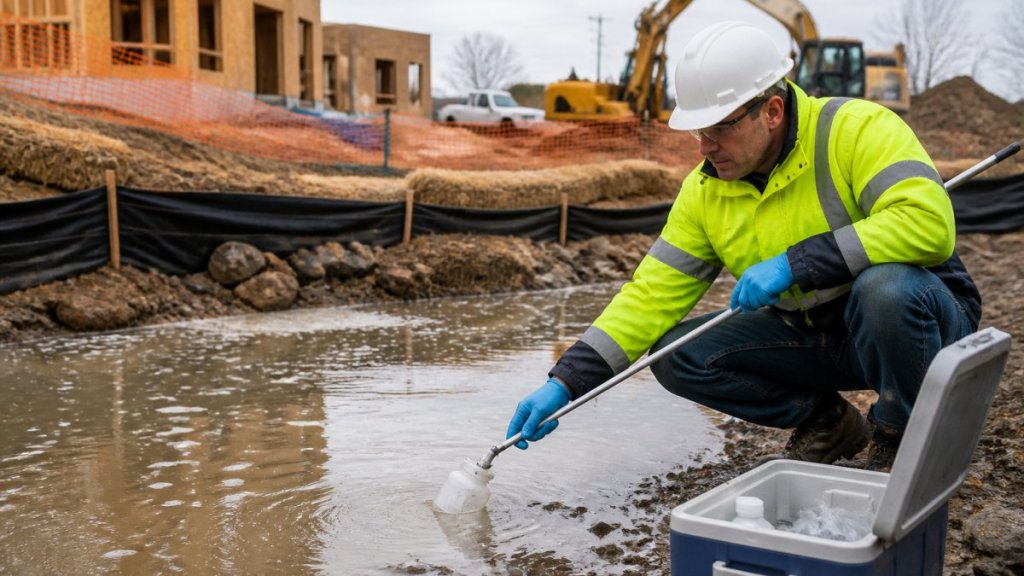
Last Updated: October 29, 2026
Quick Summary
Stormwater sampling procedures are the written, repeatable steps your crew follows to collect runoff samples that prove permit compliance. Your permit defines which outfalls and qualifying rainfall events trigger sampling, what parameters go to the lab, and what records you must keep. Build the plan around named roles, trigger rules, an outfall map, a stocked field kit, and chain of custody.
- Read your permit first: it defines outfalls, qualifying events, parameters, and record retention.
- Do not copy another site’s plan; requirements vary by discharge type, receiving water, and disturbed acreage.
- Write the qualifying event rule as a decision sequence your crew can follow without calling anyone.
- Confirm container, preservative, and holding time for every parameter with your lab before the first storm.
- Sample only where discharge is moving, at the designated outfall downstream of your stormwater BMPs.
Table of Contents
- Why Stormwater Sampling Procedures Decide Whether Your Permit Holds
- Construction Stormwater Sampling Requirements Under NPDES Permits
- Qualifying Rainfall Events: The Decision Rule Before You Sample
- Building a Stormwater Sampling Plan for Construction Sites
- Stormwater Sampling Equipment: What Belongs in the Field Kit
- Stormwater Sampling Field Log: Documentation That Survives an Inspection
- Sample Collection, Handling, and Chain of Custody in the Field
- Reading Results, Responding to Exceedances, and the Next Inspection
- What to Do Before the Next Rain Event
- Frequently Asked Questions
Why Stormwater Sampling Procedures Decide Whether Your Permit Holds
Construction site stormwater sampling procedures are the written, repeatable steps your crew follows to collect runoff samples that prove permit compliance. Get them right and an inspector sees a controlled, documented operation.
Sampling is the one part of a stormwater program where a single missed step becomes permanent: a sample from still water, an unlabeled jar, or a missing field log entry cannot be fixed after the fact.
Below, we break down how to build procedures that survive scrutiny, including permit requirements, qualifying rain events, and field kit contents.
Construction Stormwater Sampling Requirements Under NPDES Permits
Construction stormwater discharges are regulated under the National Pollutant Discharge Elimination System, created by the Clean Water Act (the EPA). Most sites need coverage under a general construction permit, and that permit sets the sampling obligations. The EPA’s construction stormwater guidance explains the framework that state programs build on.
What the Permit Text Actually Requires You to Do
Your permit, not a template, defines your sampling duty. Read it before you write a single procedure.
- Which outfalls must be sampled, and whether any are exempt
- Which rainfall events trigger sampling, and the threshold that makes an event qualify
- What parameters go to the lab, and the holding times for each
A common mistake is copying another site’s plan. Two construction sites in the same state can carry different monitoring requirements based on discharge type, receiving water, and total disturbed acreage.
How Requirements Differ Across State and Regional Permits
State programs vary widely. Some require sampling every qualifying event. Others scale monitoring frequency to the site’s risk level or the sensitivity of the receiving water.
If your project sits in California, state rules go further than the federal baseline. Confirm the current state requirements with the State Water Resources Control Board before you write your procedures.
Assuming your state’s general permit matches the federal template is a common compliance failure. Verify the state-specific text first.
Qualifying Rainfall Events: The Decision Rule Before You Sample
A qualifying storm event meets the permit’s threshold for triggering a discharge sample.
Write the rule down as a decision sequence your crew can follow without calling anyone:
- Track rainfall on site with a logged rain gauge, not a forecast.
- Confirm the event total meets your permit’s threshold.
- Check the dry period before the event against the permit definition.
- Confirm discharge is actually leaving the outfall.
- Record the decision, including the time and the gauge reading.
If any step fails, you do not sample. You document why. That written decision is what an inspector reviews when they ask why a file has no sample for a given storm.
Rainfall monitoring is continuous work, not a morning check. Assign a named person to read and log the gauge, and make sure the log survives a shift change.
Building a Stormwater Sampling Plan for Construction Sites
A stormwater sampling plan for construction sites assigns responsibility, defines triggers, and describes each step from rainfall monitoring to lab shipment.
Build the plan around these components:
- Named roles. Who monitors rainfall, who collects, who ships, who signs.
- Trigger rules. The qualifying event decision sequence, written out.
- Outfall map. Each sampling location identified and marked in the field.
Keep the finished plan short enough that a new hire can follow it under pressure. Build it around proven SWPPP site monitoring best practices.
The plans that hold up are the ones a field supervisor helped write; office-only plans tend to describe a site that does not exist.
Stormwater Sampling Equipment: What Belongs in the Field Kit
Stormwater sampling equipment is the tools, containers, and documentation supplies kept ready so a sample can be taken correctly at any hour. Assemble, check, and restock the kit before the rainy season. What separates defensible data from rejected data is whether containers, preservation, and holding times match the parameters your permit requires.
Match Containers and Preservation to Each Parameter
Your permit lists the parameters; the lab supplies the containers and tells you how each must be preserved. Do not substitute. Construction permits often list a short set, total suspended solids, pH, turbidity, and sometimes oil and grease, nutrients, or metals, each with its own handling rule.
- Total suspended solids and turbidity typically go in clean plastic containers and are chilled; holding times are short, so ship promptly.
- pH is often measured in the field with a calibrated meter, because the reading changes with time and temperature (5.4 pH | Monitoring & Assessment).
- Oil and grease usually requires a glass container, not plastic, and must not be overfilled so the lab can acidify it.
Confirm the exact container, preservative, and holding time for every parameter with your lab before the first storm, and write them into the sampling plan.
The Field Kit, Item by Item
A practical construction-site kit includes:
- Sample containers supplied by the lab, pre-cleaned and parameter-specific, with extras in case of a dropped or contaminated bottle
- Extension pole and dipper for reaching the outfall without entering the flow
- Clean gloves, changed between samples and between parameters
Sample Integrity: The Errors That Invalidate Results
Sample preservation and transport matter as much as collection. Many parameters have short holding times, and a sample that sits warm in a truck bed is worthless. The errors that most often invalidate a construction sample are predictable:
- Reusing a container that held a different parameter, or rinsing a pre-cleaned container, which can introduce contamination.
- Skipping the ice or letting the cooler warm above the required temperature during transport.
- Missing the holding time because the sample sat overnight before shipment.
A sample that fails preservation or holding time is not a compliance sample. It is a gap in your record that you cannot re-collect after the storm passes. Restock the kit and re-verify container and preservation requirements after every event, not before the next one.
Stormwater Sampling Field Log: Documentation That Survives an Inspection
A stormwater sampling field log is the running written record of rainfall, discharge, collection, and custody for each sample. It is the first thing an inspector asks for, and the only proof of what happened in the field.
Each entry should capture:
- Date, time, and the name of the person sampling
- Gauge reading and the qualifying event determination
- Outfall identification and whether flow was present
Write entries in ink, at the time, and never rewrite a log after the fact. Corrections get a single line through the error, an initial, and a date. A clean log with a visible correction reads as honest.
Field documentation also feeds your annual reporting.
Sample Collection, Handling, and Chain of Custody in the Field
Sample collection is the moment the record is made or lost. Follow the same sequence every time, and collect from flowing water wherever the permit allows.
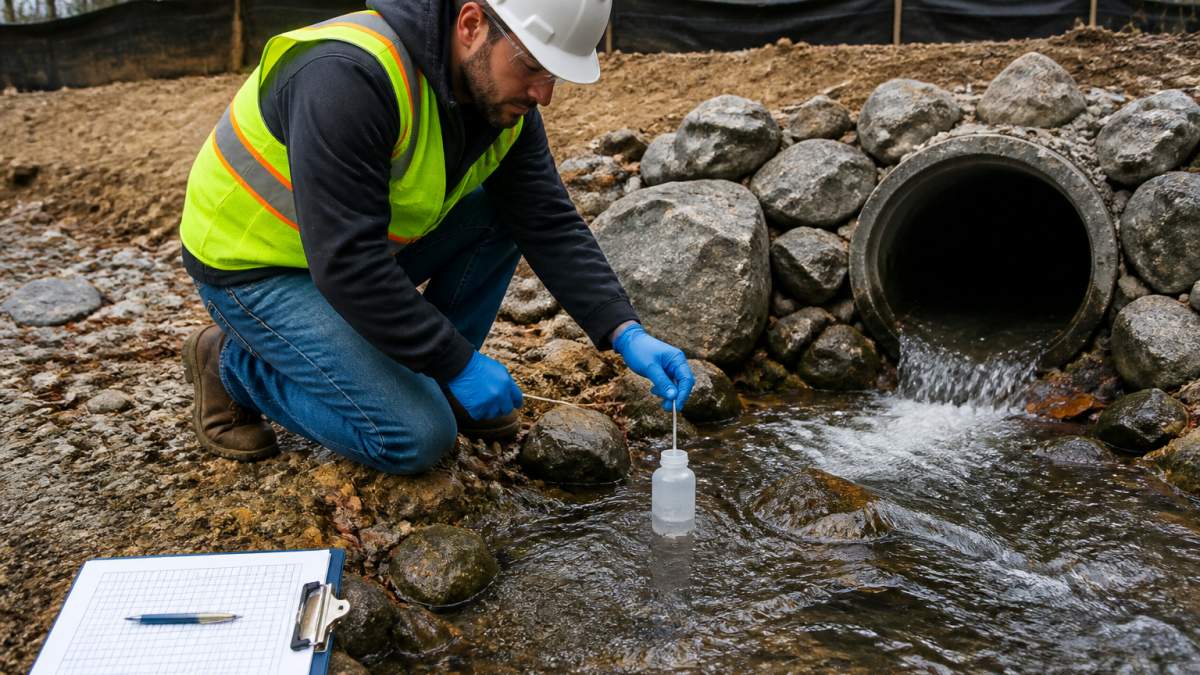
- Confirm flow. Sample only where discharge is moving. Stagnant water in a ditch or a sediment basin is not a representative sample of your discharge.
- Pick the right location. Sample at the designated outfall, downstream of your stormwater BMPs, so the sample reflects what leaves the site after controls.
- Face upstream and reach from the side. Do not stand in the flow or disturb the sediment ahead of the container.
- Collect a grab sample by submerging the container and letting it fill, then cap it immediately.
- Label the container before it leaves your hand: site, outfall, date, time, parameters.
- Preserve and cool. Place the sample on ice and record the temperature.
- Complete chain of custody with every transfer signed and timed.
- Ship or deliver to the lab within the holding time for each parameter.
For the step-by-step field method, the How to Conduct Industrial Stormwater Sampling article details the collection technique.
Sampling directly below an active earthwork area because the water looks dirtier is a common mistake, since that sample does not represent the discharge as a whole.
Follow the same collection sequence every time, from confirming flow to shipping within holding time.
| Step | What to do | Key detail |
|---|---|---|
| 1 | Confirm flow | Sample only where discharge is moving |
| 2 | Pick the right location | Designated outfall, downstream of stormwater BMPs |
| 3 | Face upstream and reach from the side | Do not stand in flow or disturb sediment |
| 4 | Collect a grab sample | Submerge container, let it fill, cap immediately |
| 5 | Label the container | Site, outfall, date, time, parameters |
| 6 | Preserve and cool | Place on ice and record temperature |
| 7 | Complete chain of custody | Every transfer signed and timed |
| 8 | Ship or deliver | Within holding time for each parameter |
Reading Results, Responding to Exceedances, and the Next Inspection
Lab results are a compliance signal, not a verdict on the whole program. When a result exceeds a benchmark or limit, the response is procedural: investigate, document, correct, and re-evaluate.
Know What You Are Comparing Against
Construction permits use two different kinds of numbers, and confusing them is a common error:
- Effluent limits are enforceable numeric limits in your permit. An exceedance is a permit violation and may trigger reporting.
- Benchmarks or action levels are screening values that tell you to investigate and possibly adjust your controls. They are not always violations, but they still require a documented response.
Read your permit to confirm which applies to each parameter. Compare each result to the correct number, and record the comparison in the file.
The Exceedance Response, Step by Step
Work through it in this order:
- Compare each result to the applicable limit or benchmark in your permit, and note whether it is an effluent limit or a benchmark.
- Review the field log for collection problems, a missed holding time, a warm cooler, or a contaminated container, before assuming a site problem.
- Inspect the outfall and the BMPs upstream of it to find the source of the elevated parameter.
- Document corrective actions taken, the date they were completed, and who verified them.
- Re-sample if your permit requires follow-up sampling after an exceedance, and follow the permit’s timing rule for when that sample is due.
- Report to the permitting authority if the permit requires notification within a set number of days for an effluent limit exceedance.
- Adjust the sampling plan or the site controls if the exceedance traces back to procedure or to a failing BMP.
Keep the lab report, the field log, the comparison worksheet, and the corrective-action record together in one file per event. An inspector who can follow the chain from rainfall to result to response in a single folder is far less likely to find a gap.
Fold Results Into the Inspection Cycle
Fold the whole record into your inspection cycle. Stormwater compliance is a loop: rainfall monitoring feeds sampling, sampling feeds results, results feed corrective action, and corrective action feeds the next site inspection. Break any link and the next inspection finds the gap.
What to Do Before the Next Rain Event
The hardest part of stormwater sampling is not the lab work. It is having a written, tested procedure ready before the first qualifying storm arrives, when the site is muddy, the crew is tired, and nobody wants to hunt for a cooler.
Michael Karl McNeil works on stormwater and environmental compliance, and holds a Qualified SWPPP Developer credential registered with the California State Water Resources Control Board.
Visit the Michael Karl McNeil website for current information on stormwater sampling support.
Frequently Asked Questions
How do you collect a stormwater sample at a construction site?
Collect the sample from flowing water at a designated outfall, not from a puddle or standing water. Use clean, permit-specified containers, fill them without leaving headspace if the lab requires it, and cap them immediately. Record the time, location, and rainfall conditions in your field log before the sample leaves your hands. Most permits call for grab samples taken during the discharge, and the sample must reach the laboratory within the holding time stated on the chain of custody form.
When should construction site stormwater samples be collected?
Timing depends on your permit’s definition of a qualifying storm event, which typically involves a minimum rainfall amount and an antecedent dry period. Once that threshold is met and discharge begins, sample as soon as practicable, generally within the first hours of discharge. Sampling too late misses the first flush, which carries the highest pollutant load. Track rainfall on site so you can document when the event qualified and when discharge started.
What equipment is needed for stormwater sampling?
A basic field kit includes clean sample containers supplied by the laboratory, a cooler with ice, a dipper or sampling pole for reaching flowing water, disposable gloves, a rainfall gauge, a calibrated pH and conductivity meter if your permit requires field parameters, and a bound field log. Add chain of custody forms, custody seals, and a camera or phone for site photos. Keep the kit stocked and inspect it before each rainy season so nothing is missing when an event qualifies.
What should a site operator do if a sample cannot be collected?
Document why. Note the qualifying event, the time discharge began, and the specific reason no sample was taken, such as unsafe conditions, no discharge from the outfall, or equipment failure. Record the corrective action you took and notify the appropriate contact per your permit. Most permits require this written explanation in the field log or an associated report. Missing a sample without documentation is treated far more harshly than a documented, justified miss.


Leave a Reply