Last Updated: November 13, 2026
Quick Summary
Choosing the right hearing protection starts with measuring the noise exposure, not browsing product specs. Match the device to the task and duration, derate the NRR before comparing it to the exposure limit, then verify the fit on each worker.
- The OSHA action level is an 8-hour time-weighted average of 85 decibels.
- Derate the candidate NRR before comparing the protector to the measured exposure.
- Earmuffs suit intermittent exposure and are easier to don correctly.
- Foam earplugs work well for long, hot shifts with continuous noise.
- Fit testing measures the protection an individual worker actually receives.
Table of Contents
- Start With Noise Measurements, Not Product Specs
- Earplugs vs. Earmuffs: Matching the Device to the Job Task
- Understanding the Noise Reduction Rating for Hearing Protection
- Hearing Protection Fit and Comfort Decide Real Attenuation
- How to Maintain Earmuffs and Earplugs So They Keep Working
- Hearing Protection for Workers With Hearing Aids or Hearing Loss
- Common Selection Mistakes That Undermine a Hearing Conservation Program
- Build Your Written Hearing Conservation Program With Expert Review
- Frequently Asked Questions
Start With Noise Measurements, Not Product Specs
Choosing the right hearing protection devices starts with a number, not a catalog. You cannot pick a protector until you know the noise level and how long workers stay in it.
Hearing protection is personal protective equipment worn to reduce sound reaching the ear. It only works when the rated reduction matches the actual hazard.
A common mistake is buying a box of earplugs before anyone has run a noise measurement. That reverses the process.
Reading Decibels and Exposure Duration Against OSHA Limits
The OSHA hearing conservation standard, 29 CFR 1910.95, sets the action level at an 8-hour time-weighted average of 85 decibels. Above that, a written program and audiometric testing are required. At 90 decibels, feasible engineering controls come first.
Two things drive risk: how loud, and how long. A 100-decibel area for 15 minutes is not the same exposure as 100 decibels for 8 hours. The NIOSH recommended exposure limit is stricter than OSHA’s, at 85 decibels over 8 hours with a 3-decibel exchange rate.
- Measure before you buy
- Record duration, not just peak level
- Note impulse noise separately from continuous noise
For the step-by-step procedure, see how to conduct workplace noise dosimetry. If you are still comparing instruments, our guide to noise dosimeters for industrial safety covers the options.
Earplugs vs. Earmuffs: Matching the Device to the Job Task
Earplugs seal inside the ear canal; earmuffs cap the outside of the ear. The right choice depends on the job task, the worksite, and how long the device stays in.
| Device | Best For | Watch Out For |
|---|---|---|
| Foam earplugs | Long shifts, hot environments | Poor insertion kills attenuation |
| Reusable earplugs | Frequent on/off, dirty hands | Cleaning and replacement needed |
| Earmuffs | Intermittent exposure, easy donning | Breaks the seal around safety glasses |
| Canal caps | Short tasks, quick access | Low protection, loose fit |
| Electronic protectors | Communication needed | Higher cost, battery care |
| Custom-molded earplugs | Steady crews, comfort priority | Lead time, fitting cost |
Earplugs vs. earmuffs is not a ranking question. It is a fit question. Earmuffs are easier to put on correctly. Earplugs, inserted well, often deliver more attenuation in heat and confined spaces.
A Step-by-Step Device Selection Workflow
Selection often goes wrong when it starts with a product rather than a number. Use this sequence to move from exposure measurement to a defensible device choice.
- Confirm the measured exposure. Use the dosimetry or area-sampling result, including duration and any impulse noise, not a guess from the shop floor.
- Derate the candidate NRR. Apply the NIOSH or OSHA derating factor before comparing the protector to the exposure. A label number is not a protected level.
- Check the protected level against the limit. If the derated device does not bring exposure under the applicable limit, move up in class or add engineering controls before adding protection.
- Screen for task constraints. Heat, humidity, confined space, glove use, and how often the device comes on and off all narrow the field.
- Screen for PPE compatibility. Safety glasses, hard hats, face shields, and respirators can break an earmuff seal or interfere with earplug handling.
- Screen for communication needs. If the worker must hear speech, alarms, or backup signals, a level-dependent or electronic protector may beat a passive plug.
- Verify the fit on the individual. A device that passes every earlier step can still fail on a specific ear canal or head shape.
Watch out: skipping step 2 is the most common failure. A crew that compares the raw NRR to the exposure will systematically overestimate protection and under-specify the device.
Matching Device Class to Task and Worksite
- Long, hot shifts with continuous noise: foam earplugs, because they stay comfortable and do not trap heat the way earmuff cushions can.
- Intermittent exposure with frequent donning: earmuffs, because they go on and off quickly and correctly without dirty hands in the ear canal.
- Tasks that require hearing speech or alarms: level-dependent electronic protectors, which pass low-level sound while cutting peaks.
When Dual Protection Makes Sense
Dual protection means wearing earplugs and earmuffs together. Even when dual protection is needed for the loudest tasks, reusable earplugs can be a practical choice for quieter work where comfort and repeated use matter.
Do not simply add the two NRRs. It is a tool for extreme exposure, not a default. A common pattern is to reserve dual protection for specific tasks or areas and document where it is required, rather than issuing it site-wide.
Understanding the Noise Reduction Rating for Hearing Protection
The Noise Reduction Rating is a single-number estimate of a protector’s attenuation, measured in a lab. The noise reduction rating for hearing protection is a starting point, not a guarantee of what a worker receives.
The label number assumes a perfect fit in a lab. Real workers get less. That gap is why derating matters.
Derating NRR the Way NIOSH and OSHA Expect
Worked example: an NRR of 25 on foam earplugs, derated 50 percent, gives about 12.5 decibels of real-world protection. Subtract that from the measured exposure to see if you are under the limit.
- Lab NRR: 25
- Derated (50%): 12.5 dB
- Measured exposure: 98 dB
If the protected level still sits above the limit, move to a higher-rated device or add controls.
Hearing Protection Fit and Comfort Decide Real Attenuation
Fit decides everything. A protector with a high rating that sits loose delivers less protection than a lower-rated one worn correctly. Comfort matters too, because uncomfortable devices come out.
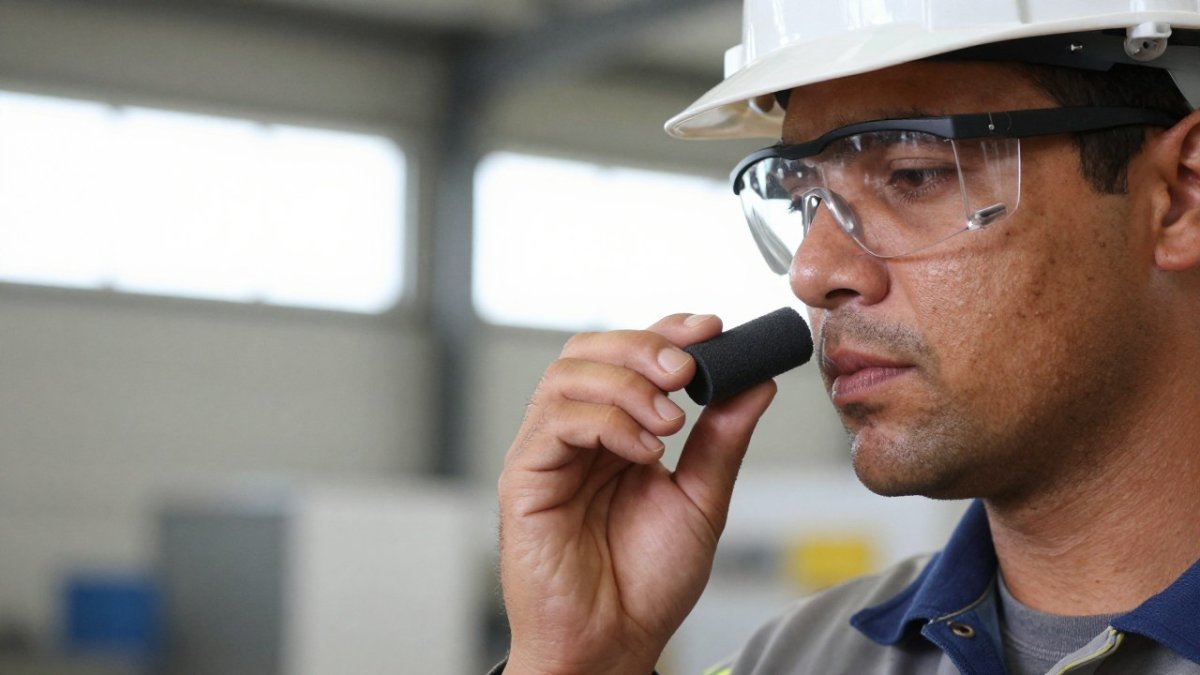
Proper insertion for foam earplugs:
- Roll the plug into a thin cylinder
- Pull the ear up and back to open the canal
- Insert and hold until it expands
- Check the seal by cupping your hands over your ears
Watch out: earmuff seals break around thick safety glasses temples and hard hat straps. That gap lets noise in, and the label rating no longer applies.
Why the Label Rating Is Not the Protection a Worker Receives
The NRR is measured in a lab under controlled insertion. Real workers insert plugs in a noisy, rushed environment, often with dirty hands and a hard hat in the way. The result is that actual attenuation can fall well below the label, which is why derating exists and why fit matters more than the number on the box.
Verifying Real-World Attenuation With Fit Testing
Fit testing measures the protection an individual worker actually receives in a given device, rather than the protection the lab says the device can provide.
- Test the worker in the device they will actually wear, not a stand-in.
- Test after training, so the result reflects corrected technique.
- Retest when the device model, the worker’s ear canals, or the task changes.
Watch out: a passing fit test on one day does not guarantee a correct fit on the next shift. Fit testing verifies technique and device match at a point in time; it does not replace ongoing observation and refresher training.
Comfort, Wear Time, and the Cost of Taking It Out
Comfort is not a soft criterion. A device that irritates the ear canal or presses under a hard hat gets removed, and a removed protector provides no attenuation. When comparing candidates, weigh how long the device stays comfortable against the shift length, not just against the NRR.
- Foam plugs can irritate with repeated reinsertion; reusable plugs may suit frequent on/off tasks.
- Earmuff cushions can trap heat and pressure; vented or electronic models may help in hot environments.
- Custom-molded plugs can improve comfort for steady crews but require lead time and fitting.
PPE Compatibility Checks Before Issue
Before issuing a device, confirm it works with the rest of the worker’s PPE. Safety glasses with thick temples, hard hat straps, face shields, and respirators can all interfere with an earmuff seal or with earplug handling. A device that fits alone but fails with the full PPE load is not a valid selection.
How to Maintain Earmuffs and Earplugs So They Keep Working
Cleaning and replacement keep protection levels where they should be. Worn cushions, cracked plugs, and dirty seals all leak sound.
- Wipe earmuff cushions with mild soap and water; replace when stiff or cracked
- Wash reusable earplugs per the maker’s instructions; replace when they lose shape
- Discard disposable foam plugs once they are soiled or won’t re-expand
A simple rule: if the seal feels loose or the material looks worn, replace it. Maintenance is cheap compared with a failed audiogram.
Hearing Protection for Workers With Hearing Aids or Hearing Loss
Workers with hearing aids or existing hearing loss need a different approach. Standard earplugs can block speech and safety cues, and hearing aids do not fit under every earmuff.
- Use level-dependent electronic protectors that pass speech but cut loud noise
- Consider custom-molded protectors made to fit around the worker’s needs
- Confirm the device works with the worker’s hearing aids before issue
Match the device to the individual, and document the choice.
Common Selection Mistakes That Undermine a Hearing Conservation Program
The biggest mistakes are predictable. Most come from skipping the measurement step or trusting the label over the fit.
- Picking a device before measuring the noise level
- Using the full NRR without derating
- Ignoring wear time and comfort
Each gap weakens the program. For the broader picture of preventing occupational illness on site, see how to prevent occupational illnesses in industrial settings.
Build Your Written Hearing Conservation Program With Expert Review
A selection workflow only holds up when it sits inside a written program.
If you want outside help, learn how to hire an industrial hygienist for a small business. To see what an expert review includes, explore industrial hygiene consultant services and how to choose the right expert.
At Michael Karl McNeil, we bring a fire service and industrial hygiene background to written safety programs, exposure monitoring, and Cal/OSHA citation defense.
The gap between a label rating and real protection is where most programs fail. Close it with measurement, correct fit, and a documented program.
Frequently Asked Questions
How do I know what noise reduction rating I need?
Start with a noise measurement, not a product label. Measure the sound level at the worker’s ear, then subtract the derated NRR from that level to estimate the protected exposure. Derate the NRR before comparing it to the measured exposure, and compare the result against the applicable exposure limit. If the measured level is 100 dBA, a device with a 25 NRR derated to 12.5 leaves roughly 87.5 dBA, which is still too high, so move to a higher-rated device or add dual protection.
Are earplugs or earmuffs better for hearing protection?
Neither wins across the board. Earplugs suit hot, cramped, or long-shift work and pair well with hard hats, safety glasses, and respirators because they sit inside the ear canal. Earmuffs are faster to don and doff, easier to supervise, and better for intermittent noise and cold weather. In the earplugs vs. earmuffs decision, weigh the job task, the measured noise level, helmet compatibility, and how long the worker wears the device each shift. A protector that gets removed for 30 minutes of an 8-hour shift loses much of its effective protection.
Can you wear earplugs and earmuffs together?
Yes. The combined attenuation is not the sum of the two ratings, so verify the protection achieved in practice. Use well-inserted earplugs as the base layer and earmuffs over them, and verify the seal of the earmuff is not broken by safety glasses or a hard hat strap.
How should hearing protectors fit, and when should they be replaced?
A correct fit means a full seal with no gaps, no pressure hot spots, and no need to lift the device to hear a coworker. Foam earplugs should be rolled and inserted deep enough that the flange sits at the canal opening. Replace foam earplugs when they no longer expand or look soiled, and replace earmuff cushions when they harden, crack, or lose their seal, . Clean earmuffs with mild soap and water, never solvent, and store them away from heat.


Leave a Reply