Table of Contents
- Why Industrial Hygiene Monitoring Is Critical for Safety
- Workplace Exposure Monitoring: How It Works
- Industrial Hygiene Sampling Methods: Air, Noise, and More
- OSHA Industrial Hygiene Requirements: What You Need to Know
- Interpreting Results Against Exposure Limits
- Building an Industrial Hygiene Monitoring Plan
- From Data to Action: Corrective Measures and Worker Protection
- Frequently Asked Questions
Last Updated: October 5, 2026
Why Industrial Hygiene Monitoring Is Critical for Safety
Industrial hygiene monitoring is the practice of measuring workplace exposures to hazards like chemicals, noise, dust, and heat so you can control them before they harm workers.
The stakes are simple. A worker who breathes silica dust or stands in 95-decibel noise for years may not feel it today; the damage shows up a decade later as lung disease or hearing loss.
Workplace Exposure Monitoring: How It Works
Workplace exposure monitoring measures how much of a hazard actually reaches a worker during a normal shift, producing a number you can compare against a legal exposure limit.
The process follows a steady sequence:
- Identify the hazard and who is exposed
- Pick a sampling method that fits the hazard
- Collect samples during real work conditions
- Send samples to a lab or read them on site
- Compare results against exposure limits
- Fix what fails and re-test to confirm
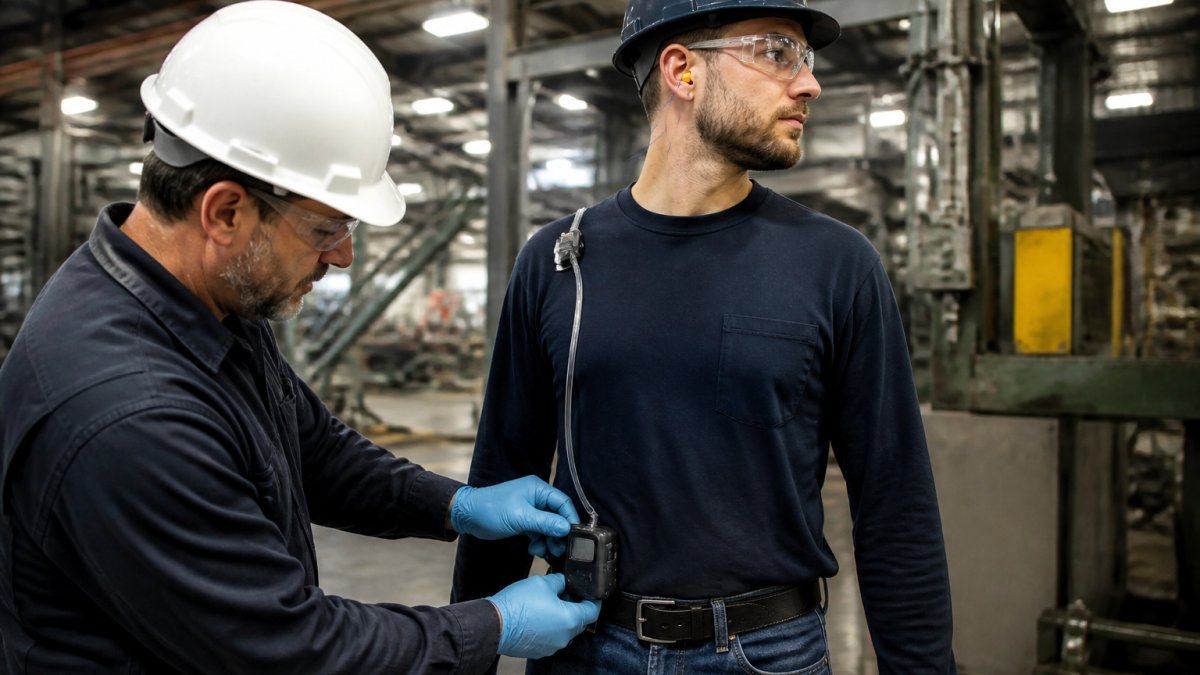
Personal Sampling vs. Area Sampling
Personal sampling places a device on the worker, usually a pump clipped to the belt with a filter near the breathing zone.
Area sampling places instruments at fixed points in the room. It shows whether a process is leaking or an area needs better ventilation, but cannot tell you what any single worker inhaled.
Use both when you can. Area sampling finds the source. Personal sampling proves the exposure.
Industrial Hygiene Sampling Methods: Air, Noise, and More
Industrial hygiene sampling methods fall into a few families, and each hazard needs its own approach.
- Air sampling: pumps and filters capture dust, fumes, vapors, and airborne contaminants for lab analysis
- Noise monitoring: dosimeters worn by workers measure full-shift noise exposure
- Heat stress: wet bulb globe temperature meters track heat load in hot operations
- Direct-reading instruments: gas detectors and real-time monitors give instant readings for gases and vapors
Direct-Reading Instruments vs. Laboratory Analysis
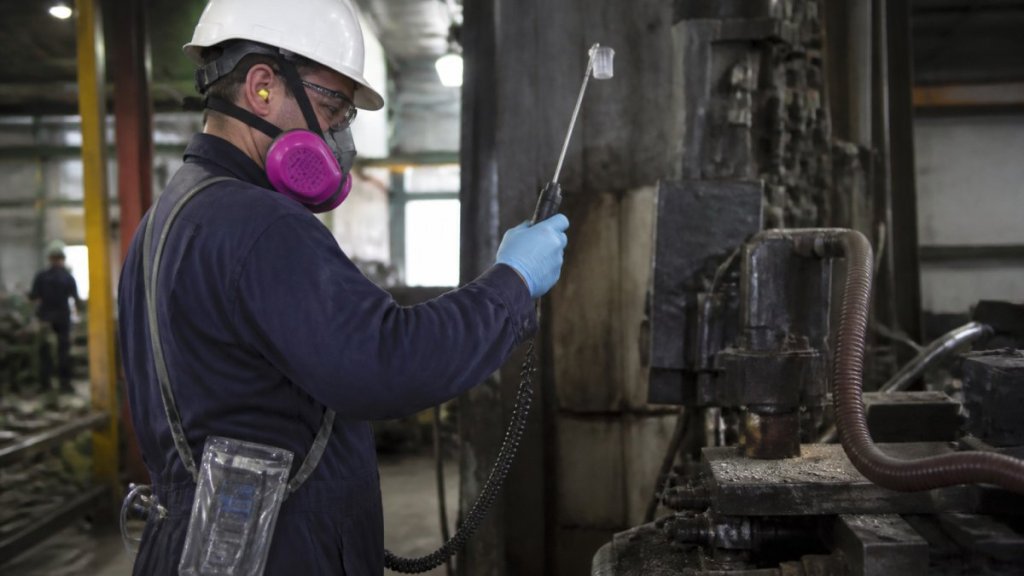
Direct-reading instruments give you an answer in seconds, ideal for confined spaces, leak checks, and any task where you need to know right now whether it is safe to proceed.
Laboratory analysis is slower but defensible. A certified lab follows published analytical methods, and the report holds up in an OSHA inspection or citation appeal, usually what you want for compliance sampling.
A common mistake is running only direct-reading instruments and calling it compliance monitoring. Use real-time meters to screen and to protect workers in the moment, then confirm with lab-analyzed samples when you need a defensible record.
OSHA Industrial Hygiene Requirements: What You Need to Know
OSHA industrial hygiene requirements are not one single rule but a set of standards, each tied to a specific hazard, telling employers what to measure and when.
The general duty clause requires a workplace free of recognized hazards that could cause death or serious harm.
What that means in practice:
- Know which standards apply to your operations
- Monitor when a hazard may exceed an action level
- Notify workers of results and any overexposure
- Provide medical surveillance where a standard requires it
The OSHA employer responsibilities and standards lay out the specific rules for each substance and hazard, and they are the source to check for your industry.
Interpreting Results Against Exposure Limits
Interpreting results means turning a lab report or dosimeter download into a decision: is this exposure acceptable, does it need more sampling, or does it require immediate corrective action? That rests on matching your measurement to the right limit and understanding what the number does and does not prove.
Match the Limit to the Measurement
OSHA standards use several limit types, and comparing the wrong one to your sample is a common error:
- Permissible exposure limit (PEL): the legal ceiling for a full-shift exposure, usually expressed as an 8-hour time-weighted average (TWA).
- Action level: typically half the PEL for many substance-specific standards. Crossing it triggers monitoring, notification, and sometimes medical surveillance obligations, even though it is not itself an overexposure.
- Short-term exposure limit (STEL): a 15-minute TWA that caps brief high spikes.
- Ceiling limit: a concentration that must never be exceeded, even instantaneously.
- Excursion limits: for substances without a STEL, OSHA may apply a formula-based cap on how far and how long exposure can drift above the PEL.
A full-shift sample answers the PEL question. It does not answer the STEL or ceiling question, because a 15-minute spike can disappear inside an 8-hour average. If a task produces brief high exposures, pouring a solvent, opening a reactor, dry sweeping silica dust, you need short-term or real-time sampling to evaluate those limits.
The TWA Calculation in Plain Language
An 8-hour TWA weights each measured concentration by how long the worker was actually exposed. If a worker spends two hours at a higher concentration and six at a lower one, the average reflects that split, not a simple mean. That is why a sample from the worst two hours of a shift cannot be compared directly to an 8-hour PEL without adjustment, and why sampling duration and task timing matter as much as the concentration itself.
Reading a Result Near the Limit
When a result lands close to a limit, sampling and analytical error becomes the deciding factor. Every method carries uncertainty from pump flow, collection efficiency, and lab analysis. A result at 90% of the PEL is not a comfortable pass; the next process change, hot day, or new worker could push it over.
A practical way to sort results:
- Well below the action level: low priority, but keep the record and re-check on your normal schedule.
- At or above the action level: this is a trigger, not a violation. Confirm the result, review controls, and plan follow-up sampling.
- Above the PEL: treat as an overexposure. Notify the affected worker, investigate the cause, apply controls, and re-sample to verify.
- Above a STEL or ceiling: stop the task if you can, and correct the condition before work resumes.
What a Single Sample Cannot Tell You
One sample is a snapshot of one worker on one day under one set of conditions. It does not represent seasonal variation, a different shift, a faster line speed, or a different task rotation.
The NIOSH guidance on occupational exposure sampling explains how sampling strategy and analytical error affect what a number really tells you, and it is worth reading before you treat any single result as final.
Document the reasoning behind every interpretation, not just the number. If an inspector asks why you accepted a result at 85% of the PEL, a written rationale about controls, task duration, and follow-up sampling is far stronger than a bare lab report.
Building an Industrial Hygiene Monitoring Plan
An industrial hygiene monitoring plan is a written roadmap for what you sample, how often, who does it, and what happens with the results. It turns scattered testing into a repeatable program that survives staff turnover and holds up in an inspection.
A solid plan includes:
- A hazard inventory by area and job task, tied to the specific standards that apply
- The sampling method, lab, and analytical method for each hazard
- Who is responsible for sampling, chain of custody, and recordkeeping
- How results get communicated to workers and where records are kept
- A baseline schedule, plus written triggers that force extra sampling
Setting Monitoring Frequency
Frequency is not guesswork or a fixed calendar. Base it on three things: how high the exposure is relative to the limit, how variable the work is, and how much the process changes over time.
A common pattern practitioners use:
- Initial or baseline sampling: every job task and work area with a recognized hazard, before you assume controls are adequate.
- Periodic re-sampling: on a schedule driven by the ratio of measured exposure to the limit, closer to the limit means more frequent sampling.
- Trigger-based sampling: whenever an event occurs that could change exposure, regardless of where you are on the calendar.
Trigger Events That Force Re-Sampling
Sample more often, or immediately, when any of these occur:
- A process, chemical, equipment, or raw material changes
- A worker reports symptoms, an illness, or a near-miss
- Ventilation, enclosures, or other controls are modified, damaged, or fail
- Prior results were at or above an action level or close to a limit
- New workers, new tasks, or new shifts enter a monitored area
Skipping re-sampling after a process change is one of the most common compliance gaps. A new chemical or a faster line speed can push exposures over a limit you already cleared, and the old data will not protect you in an inspection.
Verifying the Program Works
A monitoring plan is only as good as its follow-through. Track measurable indicators to show leadership the program is functioning:
- Number of exposure-limit exceedances per period, and whether they are trending down
- Time from a finding to a closed corrective action
- Re-test results after controls are applied, did the exposure actually drop?
- Repeat findings in the same area or task, which signal that a control is not holding
- Percentage of required sampling completed on schedule
If exceedances recur in the same spot, the control is not working, and more sampling alone will not fix it. Go back to the hierarchy of controls, change the engineering solution, and verify again.
Worker Participation and Records
Worker participation matters. The people doing the task often spot the leak, shortcut, or changed work practice that sampling alone misses. Communicate results in plain language, explain what the numbers mean, and keep individual health data private. Maintain monitoring records for the period each standard requires and make them accessible to workers and their representatives as the rules provide.
A monitoring plan is a living document. Set the baseline, define your triggers, verify every fix with a re-test, and update the plan when the work changes, not when the inspector arrives.
From Data to Action: Corrective Measures and Worker Protection
Corrective action is where monitoring pays off. Data that sits in a binder protects no one.
Follow the hierarchy of controls, in order:
- Elimination or substitution: remove the hazard or swap to a safer material
- Engineering controls: ventilation, enclosures, sound barriers, process changes
- Administrative controls: rotate workers, limit exposure time, adjust schedules
- Personal protective equipment (PPE): respirators, hearing protection, gloves as the last line
Engineering controls fix the source and protect everyone in the area. PPE depends on fit, training, and daily use, so it is the weakest link.
Monitoring is not a one-time test. It is a cycle: recognize, sample, compare, control, and verify. The verification step is what separates a real program from a stack of lab reports.
If your team needs help building that cycle, Michael Karl McNeil brings industrial hygiene monitoring, Cal/OSHA citation defense, and written safety programs to manufacturers and contractors.
Industrial hygiene monitoring only works when someone turns the numbers into action, and that takes experience on the floor, not just in a lab.
Frequently Asked Questions
What are five reasons why industrial hygiene is important?
Industrial hygiene protects worker health by identifying hazards before they cause harm. Five key reasons: it prevents occupational illness from chemical, physical, and biological exposures; it ensures regulatory compliance with OSHA standards; it reduces absenteeism and turnover by maintaining a safe work environment; it lowers long-term costs tied to workers’ compensation claims; and it provides documented evidence that an employer acted responsibly, which matters during inspections or litigation.
What is industrial hygiene monitoring?
Industrial hygiene monitoring is the systematic process of measuring workplace exposures to hazards such as airborne contaminants, noise, heat, and vibration. It involves collecting samples through personal or area sampling, analyzing results against established exposure limits, and determining whether controls are adequate. The goal is to understand what workers are actually exposed to during a typical shift, not just what hazards might be present.
How often should workplace exposure monitoring be conducted?
Monitoring frequency depends on the hazard, exposure levels, and regulatory requirements. OSHA may require periodic monitoring for specific substances like lead or silica. Beyond compliance, repeat monitoring whenever processes change, new chemicals are introduced, ventilation systems are modified, or a worker reports symptoms. Many safety programs schedule annual or biennial monitoring as a baseline, with more frequent sampling in high-risk areas.
What happens after industrial hygiene monitoring identifies an exposure concern?
When monitoring shows exposures above acceptable limits, the next step is implementing controls following the hierarchy of controls. Engineering controls like ventilation or enclosure come first, followed by administrative controls such as rotating workers or adjusting schedules. Personal protective equipment is the last line of defense. After controls are in place, re-monitoring verifies their effectiveness and confirms exposures have dropped to safe levels.


Leave a Reply