Table of Contents
- What Industrial Hygiene Air Quality Testing Covers
- OSHA Air Contaminant Standards You Need to Know
- Step-by-Step Industrial Hygiene Air Quality Testing Procedures
- Industrial Hygiene Air Sampling Equipment: DIY vs. Professional Calibration
- How to Determine Air Quality Testing Frequency
- Building a Workplace Air Quality Monitoring Plan
- Post-Testing Remediation Strategies
- Conclusion
- Frequently Asked Questions
Last Updated: October 1, 2026
What Industrial Hygiene Air Quality Testing Covers
Industrial hygiene air quality testing procedures are the steps a qualified professional follows to measure what workers actually breathe, compare those results against OSHA limits, and decide whether controls are needed. This guide from Michael Karl McNeil walks through the full process, from hazard identification to lab results. The core idea is simple: test the air where people work, not the air somewhere across the room.
At its heart, industrial hygiene is the science of anticipating, recognizing, evaluating, and controlling workplace conditions that can cause injury or illness. Air sampling sits in the “evaluate” stage. It turns a suspicion into a number you can act on.
The OSHA Safety and Health Topics page on industrial hygiene frames the same four-step logic: anticipate, recognize, evaluate, control.
Indoor Air Quality vs. Industrial Hygiene Air Sampling
Indoor air quality focuses on comfort and general building conditions, such as temperature, humidity, and odors. Industrial hygiene air sampling focuses on worker exposure to specific contaminants at specific concentrations over a set time.
The two overlap but answer different questions:
- IAQ asks, “Is this building comfortable and safe to occupy?”
- IH sampling asks, “Is this worker overexposed to a regulated substance?”
A stuffy office and a welding bay are not the same problem.
Common Airborne Contaminants in the Workplace
Airborne contaminants fall into a few broad families, and each one needs a different sampling method.
- Particulate matter: dust, fumes, and mist, including respirable crystalline silica
- Chemical vapors: solvents, degreasers, and other volatile organic compounds, or VOCs
- Gases: carbon monoxide, hydrogen sulfide, and similar hazards
- Aerosols: fine liquid droplets suspended in air
- Bioaerosols: mold spores, bacteria, and other biological agents
- Metals: hexavalent chromium and other metal fumes from welding or plating
OSHA Air Contaminant Standards You Need to Know
OSHA sets legal exposure limits for hundreds of airborne substances. The main table lives in OSHA’s annotated Table Z-1 air contaminants standard, and it lists a permissible exposure limit, or PEL, for each one.
Permissible Exposure Limits and Action Levels
PELs are usually written as an 8-hour time-weighted average (TWA). Some substances also carry a short-term exposure limit (STEL) or a ceiling value that must never be exceeded.
A result below the PEL is not automatically “safe.” If it sits above the action level, you still have regulatory duties. Read the standard for that specific substance.
Step-by-Step Industrial Hygiene Air Quality Testing Procedures
The four steps below are the backbone of any credible air quality testing effort. Skip one and your results will not hold up in an OSHA inspection or a legal challenge.
Step 1: Hazard Identification and Exposure Assessment
Start with a walkthrough. Note the chemicals in use, the processes, the work schedule, and who stands where. Review safety data sheets and talk to the workers doing the job.
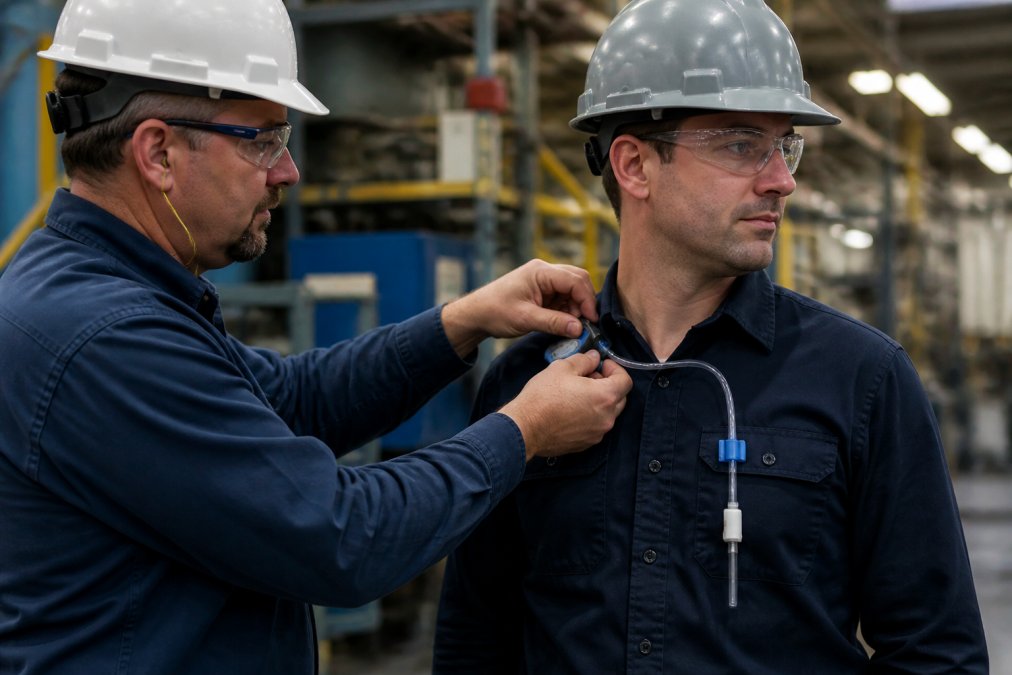
Step 2: Personal Breathing Zone Sampling Setup
The personal breathing zone is the air within roughly 6 to 9 inches of a worker’s nose and mouth. Sampling there captures what the worker actually inhales, not what floats near a wall.
Step 3: Calibration, Flow Rate, and Sampling Media
Calibrate the pump before and after every sample. A pump that drifts mid-shift produces a number you cannot defend. Set the flow rate to match the method for that contaminant, and choose the right sampling media, such as a filter cassette for particulates or a sorbent tube for vapors.
Step 4: Interpreting Lab Results Against PELs
The lab reports a mass of contaminant collected. You convert that into a concentration using the sample volume, then compare it to the PEL and action level for that substance.
Industrial Hygiene Air Sampling Equipment: DIY vs. Professional Calibration
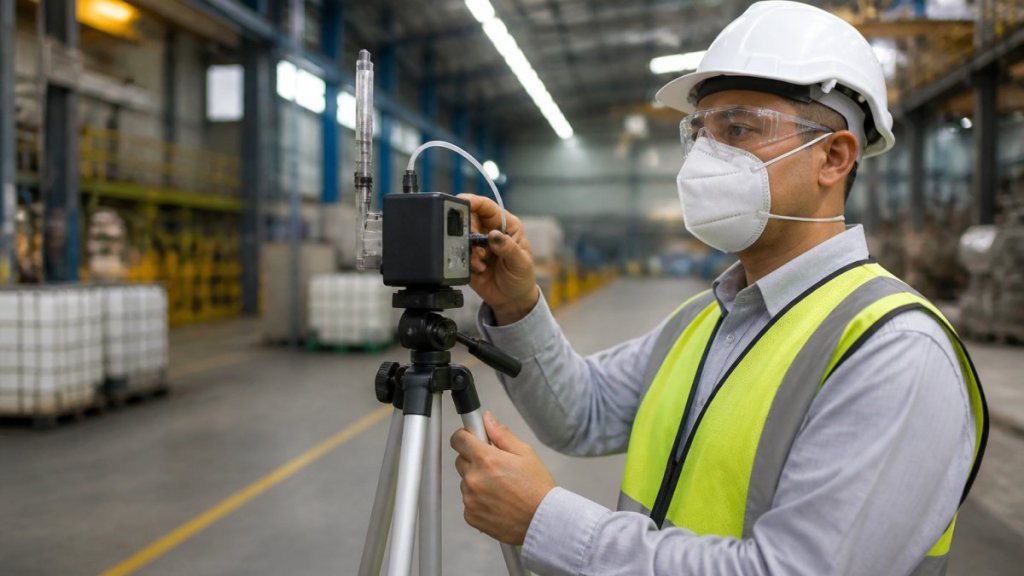
Here is where most in-house programs fall apart. The pump is not the hard part; the calibration is. A sampling pump is only as good as the flow rate you can prove it held, and that proof is what separates defensible data from a number someone wrote on a clipboard.
What Calibration Actually Does
Calibration sets and verifies the pump’s flow rate against a known reference before and after every sample. The mechanics are straightforward:
- Pre-calibration: Connect the pump to the sampling media (filter cassette, sorbent tube, or impinger) through a primary flow calibrator, such as a soap-bubble buret or a electronic primary standard. Adjust the pump until the calibrator reads the target flow rate for your method.
- Post-calibration: Repeat the same check immediately after sampling, with the same media still in line. The two readings bracket the sample.
- Acceptance criteria: Most methods allow the post-calibration flow to drift no more than 5% from the pre-calibration value. If it drifts more, the sample is generally considered invalid and must be repeated.
Why Traceability Is the Whole Point
A calibration is only as credible as the reference it was checked against. Traceable calibration means the primary standard itself has a documented chain back to a national metrology institute, such as NIST. A borrowed rotameter with no calibration sticker does not give you traceability, no matter how carefully you read it.
An uncalibrated or drifting pump can read 20% off or more. That error can turn a passing result into a citation, or hide a real overexposure. Document every calibration, pre and post, with the calibrator’s ID and calibration due date, or the data means nothing.
DIY vs. Professional Calibration: A Realistic Comparison
| Approach | What It Involves | Best For | Main Risk |
|---|---|---|---|
| In-house pump with a primary standard | Safety staff own a soap-bubble or electronic calibrator, calibrate before and after each sample, log results | Routine compliance sampling where staff are trained and records are maintained | Drift goes unnoticed if post-calibration is skipped; calibrator itself falls out of date |
| Professional calibration service | Pumps and calibrators are serviced and certified on a schedule, with documentation provided | High-stakes sampling, litigation, or programs without trained staff | Higher setup time and coordination |
The Documentation That Survives Scrutiny
If the results may end up in front of an inspector or a judge, the calibration record is often the first thing they ask for. A defensible record typically includes:
- Pump serial number and the media used
- Pre- and post-sample flow readings with the calibrator’s ID
- The calibrator’s most recent calibration date and due date
- The sampler’s name, date, and sample start/stop times
- The method number the sampling followed
Treat the calibration log as part of the sample, not as an afterthought. If the log is incomplete, the sample is incomplete.
How to Determine Air Quality Testing Frequency
Testing is not a one-time event. Frequency depends on what you found and what changed.
Common triggers for re-testing:
- A process change, new chemical, or new equipment
- A new or relocated worker in an exposed area
- A prior result near or above the action level
- A complaint, symptom, or near-miss
- Routine periodic monitoring required by the substance’s standard
Building a Workplace Air Quality Monitoring Plan
A workplace air quality monitoring plan is a written document that says what you sample, how often, who does it, and what happens with the results. It turns scattered tests into a repeatable program.
A solid plan includes:
- The contaminants of concern and their PELs and action levels
- Which job roles and areas get sampled
- The sampling methods, media, and flow rates
- Calibration and documentation requirements
- Who reviews results and how fast
- The controls you will apply if limits are exceeded
Post-Testing Remediation Strategies
Results are only useful if they drive action. When a sample exceeds a limit, OSHA expects a hierarchy of controls, in this order:
- Elimination or substitution: remove the hazard or swap to a safer chemical
- Engineering controls: local exhaust ventilation, enclosures, or process changes
- Administrative controls: rotate workers or limit exposure time
- Respiratory protection: the last line of defense, not the first
Document the “before” and “after” samples side by side. When an inspector or a lawyer asks whether your controls work, that comparison answers the question in one page.
Conclusion
Air sampling only matters if the numbers hold up. A drifting pump, the wrong media, or a missing calibration record can sink an otherwise sound program, and that risk lands hardest on the safety managers and facility teams who own the results.
Frequently Asked Questions
What are the OSHA guidelines for air quality in the workplace?
OSHA enforces air quality through permissible exposure limits (PELs) found in 29 CFR 1910.1000 and substance-specific standards like those for respirable crystalline silica and hexavalent chromium. Employers must ensure worker exposures stay below these limits, conduct air monitoring when contamination is suspected, and provide respiratory protection when engineering controls cannot reduce exposures enough. The general duty clause also requires a workplace free from recognized hazards.
What is the difference between industrial hygiene air sampling and general IAQ testing?
Industrial hygiene air sampling measures worker exposure to specific airborne contaminants using personal breathing zone samples, calibrated pumps, and laboratory analysis against OSHA PELs. General indoor air quality testing focuses on comfort factors like carbon dioxide, temperature, humidity, and ventilation rates. IAQ testing addresses building occupant comfort, while industrial hygiene sampling determines regulatory compliance and health risk for workers exposed to chemical vapors, particulate matter, or bioaerosols.
What equipment is used for industrial hygiene air monitoring?
Industrial hygiene air sampling equipment includes personal sampling pumps with adjustable flow rates, sampling media such as filter cassettes for particulate matter and sorbent tubes for VOCs, and calibrated flow meters. Direct-reading instruments like photoionization detectors provide real-time readings for chemical vapors. All pumps require pre- and post-sampling calibration, and samples are sent to an accredited laboratory for analysis. The specific media depends on the contaminant being measured.
When is air sampling required by OSHA standards?
OSHA requires air sampling when employees may be exposed to airborne contaminants at or above action levels, when there is a reasonable possibility of exposure above a PEL, or after a workplace change that could increase exposure. Substance-specific standards, such as those for respirable crystalline silica and hexavalent chromium, mandate initial monitoring and periodic follow-up. Air monitoring is also required when respiratory protection is used or when workers report symptoms linked to airborne exposures.


Leave a Reply