Table of Contents
- What a Film Production Safety Compliance Officer Actually Does
- When a Production Needs to Hire a Safety Officer
- Building a Film Set Risk Assessment That Holds Up
- The Film Safety Checklist: Documents to Keep On Set
- Film Crew Safety Training and Briefings That Stick
- Writing an On-Set Emergency Action Plan
- Measuring Safety Performance and Documenting Compliance
- Frequently Asked Questions
Last Updated: October 17, 2026
What a Film Production Safety Compliance Officer Actually Does
A film production safety compliance officer identifies hazards, builds the written safety plan, trains cast and crew, and keeps the paperwork proving the production followed the rules. On most sets, that work falls to a designated safety advisor or safety manager answering to the line producer and production manager.
At Michael Karl McNeil, we approach this role from the fire prevention and industrial hygiene side.
The role carries real legal weight and spans every phase of a production.
Core Duties Across Prep, Shoot, and Strike
- Prep: Review scripts for stunts, weapons, vehicles, and minors. Walk each location. Build the risk assessment and the safety plan. Confirm permits and insurance.
- Shoot: Run the daily safety briefing. Monitor high-risk activities in real time. Stop work when conditions change. Log incidents and near misses.
- Strike: Supervise rigging removal, cable pulls, and equipment teardown. Confirm the location is returned to a safe condition. Close out the safety file.
Prep carries the most weight: decisions made before the first shooting day determine how much risk the crew faces later.
Where the Role Ends and Other Departments Begin
Role boundaries cause more friction on set than almost anything else. The safety officer advises, documents, and can stop work; the first assistant director runs the set and schedule; the line producer controls budget and contracts.
A common mistake is letting the safety officer absorb accountability that belongs to production management. If the line producer approves a stunt without required planning, a safety review does not transfer that liability.
When a Production Needs to Hire a Safety Officer
A production needs a dedicated safety officer when it involves stunts, firearms, water work, aerial work, minors, or heavy machinery, or when the insurer or location requires one. Smaller shoots with simple setups can assign safety duties to a trained existing crew member. The harder question is scoping the engagement so the officer’s authority matches the responsibility.
The decision usually comes down to four triggers:
- High-risk activities. Stunts, pyrotechnics, weapons, vehicle chases, and work at height all call for a dedicated officer.
- Regulatory exposure. Productions in states with active workplace safety enforcement face inspection risk on any set with employees.
- Insurance requirements. Many carriers now require a named safety advisor and a written plan before they will bind coverage.
- Scale. Larger crews and longer schedules mean more moving parts and more chances for something to go wrong.
Credentials to Look For
There is no single federal license for a film safety compliance officer, so credentials are a patchwork. A credible candidate typically holds:
- Occupational safety training. Completion of OSHA‘s 30-hour General Industry or Construction course is a common baseline; the 10-hour course is a floor, not a ceiling.
- Recognized certifications. The Board of Certified Safety Professionals awards the Certified Safety Professional (CSP) and the Associate Safety Professional (ASP) designations. The American Board of Industrial Hygiene awards the Certified Industrial Hygienist (CIH) credential, which matters on sets with chemical, fume, or air-quality exposure.
- First aid and CPR. Current certification from the American Red Cross or American Heart Association, plus stop-the-bleed training where firearms or power tools are present.
Ask for documentation of each. A resume claim is not a credential.
Scope of Engagement
Safety officers are engaged in three common shapes, matched to risk:
- Full-time embedded. The officer is on payroll for the run of the production, attends prep, and is on set every shooting day. Appropriate for features, episodic television, and any production with stunts, firearms, or water work.
- Part-time or day-rate. The officer covers high-risk days only, stunt days, weapons days, rigging days, and is on call otherwise. Common on commercials and short-form work.
- Consulting only. The officer builds the plan and risk assessments during prep and hands them to production to execute. This works only when someone on the production team has the training and authority to enforce the plan on set. Consulting-only engagements are the most common source of gaps, because the plan is only as good as the person enforcing it.
Production-Size Considerations
The smaller the crew and simpler the setup, the more safety duties can fold into an existing role. A two-person documentary crew in a controlled location may need only a written assessment and a designated point person; a union feature with vehicles, stunts, and multiple locations needs a named officer with stop-work authority in the deal memo. Mid-size commercials and music videos most often under-hire, because the schedule is short and the hazards are compressed.
Engage the safety officer during prep, not on the first shooting day. A walkthrough of each location before the crew arrives costs a fraction of the cost of redesigning a shot after a hazard is found.
If you hire a consulting-only officer, name the on-set person who will enforce the plan and put that authority in writing. A plan with no enforcer is a document, not a control.
Building a Film Set Risk Assessment That Holds Up
A film set risk assessment is a written record that names each hazard, rates its likelihood and severity, lists the controls, and assigns a responsible person to each.
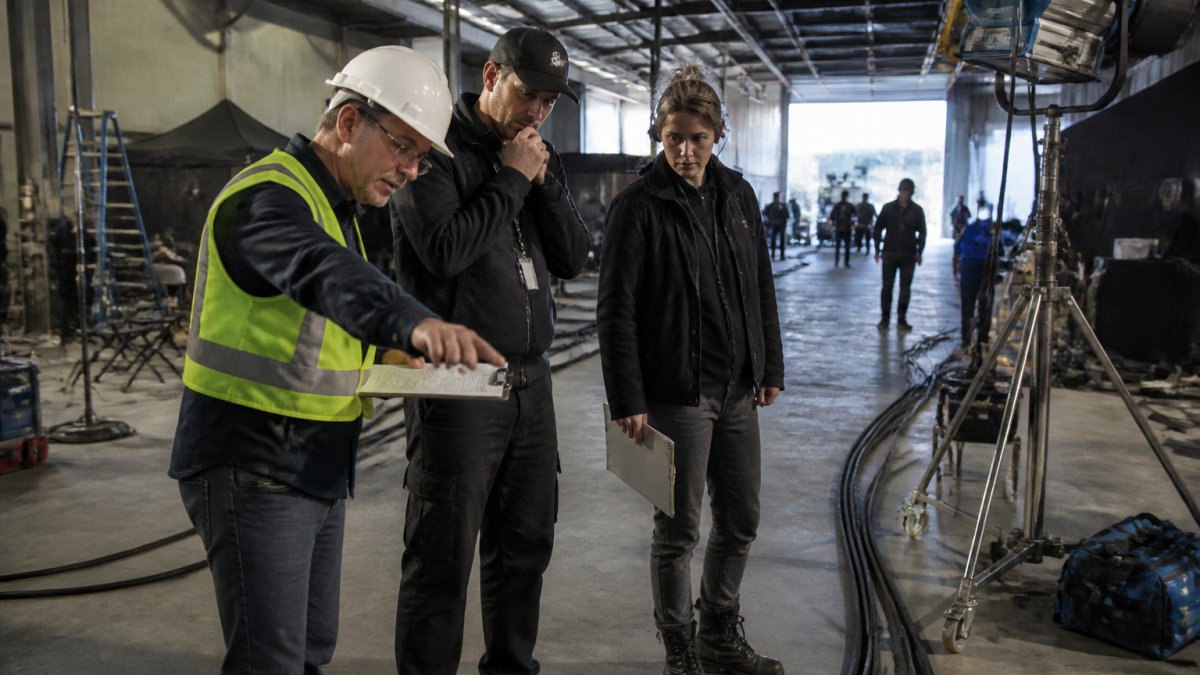
Generic templates fail on two fronts: they miss location-specific hazards and cannot show anyone reviewed them.
Build the assessment in five steps:
- List the tasks for each scene, not each day.
- Identify hazards for each task: falls, electrical, chemical, traffic, noise, heat, confined space.
- Rate each hazard by likelihood and severity on a simple scale.
- Assign controls using the hierarchy: eliminate, substitute, engineer, administrate, then personal protective equipment.
- Name an owner and a review date for every control.
Review the assessment whenever the schedule, location, or weather changes. A risk assessment unchanged for a three-week shoot is a red flag to any inspector.
Production-Specific Hazards and Controls
The five-step method only works if the hazard list is specific to film work. The table below maps the hazards that most often cause set injuries to the controls that reduce them.
| Hazard | Typical Controls |
|---|---|
| Stunts and falls | Rehearsal with stunt coordinator; padded landing areas; rigging inspected by a qualified rigger; exclusion zones for non-essential crew; medical standby on high-fall days. |
| Firearms and weapons | Licensed armorer on set; weapons locked and checked in and out; blank and live ammunition stored separately; muzzle discipline briefed before every take; eye and ear protection for all present. |
| Vehicles and process trailers | Trained drivers only; spotters for reverse and tight moves; speed limits on set; pedestrian routes marked; seat belts and restraints for picture vehicles. |
| Electrical and lighting | Ground-fault protection; cable ramps and matting over walkways; lockout procedures for tie-ins; qualified electricians for distribution; arc-flash awareness for high-amperage work. |
| Work at height | Guardrails and fall arrest for platforms and scaffolding; inspected ladders; tie-off points rated and marked; no work at height in high wind. |
| Special effects and pyrotechnics | Licensed pyrotechnician; burn zones cleared and briefed; fire watch with extinguishers; wind and humidity checks before each effect. |
| Weather and heat | Heat-illness prevention plan with water, shade, and rest cycles; lightning detection and evacuation thresholds; cold-weather and rain contingencies. |
| Locations and confined space | Site walk with the location manager; egress and muster points mapped; air-quality checks for basements, tanks, and tunnels; permit-required confined-space procedures where applicable. |
Each row in that table should appear in the written assessment with a named owner and a review date. A control with no owner is a suggestion.
Making the Assessment Hold Up
An assessment survives scrutiny when it shows the hazard was identified before work started, the control was in place on the day, and someone checked. Attach supporting documents, rigging inspection logs, armorer sign-in sheets, electrical tie-in permits, so the paper trail is continuous. When an inspector or insurer asks, the answer should be a folder, not a memory.
The strongest risk assessment is not the longest one. It is the one where every hazard has a named control, every control has a named owner, and every owner can show the record that the control was in place.
The Film Safety Checklist: Documents to Keep On Set
The film safety checklist is the paper trail proving the production planned for safety and acted on it. Keep it in one binder, physical or digital, reachable by the first assistant director and line producer within minutes.
The core documents to keep on set:
- Current risk assessments for every location and high-risk activity
- Written safety plan with roles and escalation contacts
- Crew safety training records and sign-in sheets
Missing documentation is the most common finding in a post-incident review. If it was not written down, it did not happen.
Film Crew Safety Training and Briefings That Stick
Film crew safety training works when it is short, specific to the day’s work, and repeated.
The daily safety briefing should take five to ten minutes: cover the day’s high-risk activities, location hazards, weather, emergency exits, and who to notify for what.
Training records should show a name, a date, a topic, and a signature. A short refresher before each new location prevents the most common injuries.
Skipping the briefing log because “everyone was there” leaves you with no proof. If an incident occurs, the log is often the first document an investigator asks for.
Writing an On-Set Emergency Action Plan
An on-set emergency action plan tells cast and crew exactly what to do when someone is hurt, a fire starts, or the weather turns. It names emergency contacts, evacuation routes, the muster point, and the person in charge until responders arrive.
Every plan needs these parts:
- Emergency contacts: local fire, EMS, police, poison control, and the production’s designated safety lead.
- Muster point: a specific, safe location with a backup.
- Evacuation routes: mapped for each location, posted at entrances.
Rehearse the plan at least once per location. A plan nobody has walked through is a document, not a plan.
Measuring Safety Performance and Documenting Compliance
Safety performance is measured with leading indicators, not just injury counts. Track near misses, briefing completion, inspection findings, and training hours. Injury rates tell you what already went wrong.
Documentation should follow a simple cycle: plan, do, check, act.
The Occupational Safety and Health Administration publishes general industry and construction standards that most film set hazards map onto. The California Division of Occupational Safety and Health enforces its own set of rules for productions in that state, including specific requirements for film and television work. For a management-system framework, the ISO 45001 standard gives an internationally recognized structure for occupational health and safety.
We recommend a monthly compliance review for any production running longer than a few weeks.
Safety compliance on a film set is not a form you sign once.
If your production needs a written safety plan, a risk assessment that holds up under scrutiny, or an emergency action plan built by someone with fire prevention and industrial hygiene experience, Michael Karl McNeil can help.
Frequently Asked Questions
What does a film production safety compliance officer do?
A film safety officer identifies hazards, runs the film set risk assessment, writes and maintains the safety documentation, and monitors the set during shooting. They brief cast and crew, coordinate with the first assistant director and line producer, and handle incident reporting. On high-risk days involving stunts, weapons, water, or elevated work, they are on set for the duration and have the authority to pause a shot when conditions change.
When should a film production hire a safety officer?
Hire one when the production involves high-risk activities: stunts, firearms, pyrotechnics, water work, aerial work, vehicle chases, or construction on set. Smaller productions with limited hazard exposure can fold the duties into an existing role, but someone must own the film safety checklist and the on-set emergency action plan. Bring the officer in during pre-production so the film set risk assessment shapes the schedule rather than reacting after the first setup.
Who is responsible for safety on a film set?
Everyone shares responsibility, but accountability sits with production management. The line producer and production manager fund and enforce the safety plan, the first assistant director runs the set day to day, and the safety officer provides the technical judgment. Department heads own the hazards in their own area, from electrical to rigging. Clear role boundaries prevent the gap where each person assumes someone else has signed off.
What training do film crew members need for set safety?
Baseline film crew safety training covers hazard awareness, evacuation routes, incident reporting, and equipment safety for the department. Specialized work needs specialized credentials: forklift and aerial lift operators, riggers, armorers, and stunt performers each need documented training. Pair formal training with a daily safety briefing that names the day’s specific hazards. Keep training records with the rest of the safety documentation so a compliance review has something to check.


Leave a Reply