Table of Contents
- What Drives Industrial Hygiene Monitoring Cost Estimates
- How OSHA Compliance Monitoring Requirements Shape Your Budget
- The Workplace Exposure Assessment Process and Its Cost Drivers
- Industrial Hygiene Consulting Scope of Work: What You’re Paying For
- Cost Breakdown by Industry Sector and Regional Variance
- DIY vs. Professional Outsourcing: Hidden Costs of Non-Compliance
- Frequently Asked Questions
Last Updated: September 19, 2026
What Drives Industrial Hygiene Monitoring Cost Estimates
Industrial hygiene monitoring cost estimates are shaped by three variables: the number of workers sampled, the number of agents tested, and whether the work is driven by a scheduled survey or an active OSHA inspection. This guide breaks down where the money actually goes, using a cost structure applicable to scoping industrial hygiene monitoring for manufacturing and construction clients.
Most published pricing advice on this topic is useless.
Labor, Laboratory Analysis, and Equipment Fees
Labor is usually the largest line item. An industrial hygienist’s time covers the site survey, sampling setup, chain-of-custody paperwork, and the written report. Complex facilities with multiple process areas take longer to walk and document, and that time is billed.
Ask for the sampling plan before the proposal. A consultant who cannot tell you how many samples, which methods, and which lab will run them is guessing at your scope, and you will pay for that guesswork later.
How OSHA Compliance Monitoring Requirements Shape Your Budget
OSHA compliance monitoring is not a fixed requirement with a fixed price. The agency’s substance-specific standards, such as those for lead, silica, and noise, set permissible exposure limits and define when an employer must monitor. The OSHA permissible exposure limits table lists the enforceable limits that determine whether sampling is triggered at all.
When Monitoring Is Required vs. Recommended
Monitoring is required when a substance-specific standard applies and workers may be exposed above an action level, or when a compliance officer requests it during an inspection. It is recommended, but not mandated, when a hazard is suspected but no standard threshold clearly applies.
The Workplace Exposure Assessment Process and Its Cost Drivers
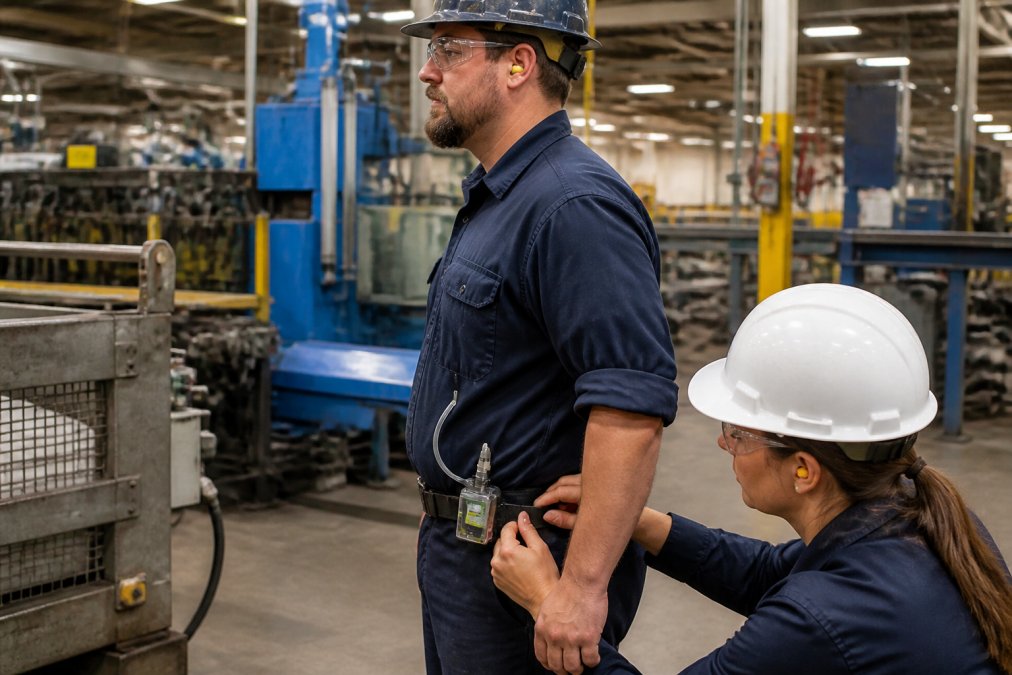
A workplace exposure assessment follows a defined sequence, and each step adds cost. The process starts with hazard identification, moves through sampling and laboratory analysis, and ends with data interpretation and a written report.
The cost drivers are straightforward:
- Scope of the site survey – square footage, number of process areas, and shift patterns
- Number of workers sampled – representative sampling requires enough participants to be defensible
- Sampling methodology – passive badges versus active pumps, and the analytical method required
- Laboratory turnaround time – standard turnaround costs less than expedited analysis
- Reporting depth – a compliance letter costs less than a full mitigation strategy with recommendations
Industrial Hygiene Consulting Scope of Work: What You’re Paying For
The industrial hygiene consulting scope of work defines what you actually receive, and it is the single most important document in the engagement. A narrow scope covers sampling and a results memo. A broad scope covers hazard identification, exposure monitoring, data interpretation, mitigation strategies, and compliance reporting.
| Scope Level | What It Covers | Typical Cost Driver |
|---|---|---|
| Sampling only | Lab analysis plus a results summary | Number of samples and methods |
| Assessment | Site survey, sampling, written interpretation | Facility size and sampling duration |
| Program | Assessment plus mitigation plan and compliance reporting | Number of hazards and control recommendations |
| Ongoing | Scheduled re-monitoring and program maintenance | Monitoring frequency and staffing |
A sampling-only proposal with no data interpretation is a common trap. You receive lab results with no context on whether exposures exceed permissible exposure limits, and you have paid for data you cannot act on.
Cost Breakdown by Industry Sector and Regional Variance
A single blended price per facility tells you almost nothing, because the cost of an industrial hygiene monitoring program is driven by the hazard profile of the sector, not by square footage alone. The table below shows how the same four-stage cost chain (labor, laboratory analysis, equipment, reporting) shifts by sector.
| Sector | Typical Agents Sampled | Sampling Approach | What Drives the Cost |
|---|---|---|---|
| Construction | Respirable crystalline silica, noise, welding fumes, lead on renovation | Personal air sampling on moving crews, noise dosimetry, task-based sampling | Crew turnover, changing site conditions, and the need to re-sample as phases change |
| Manufacturing | Solvents, metalworking fluids, particulates, noise | Fixed-location personal and area sampling tied to process areas | Number of process areas, number of shifts, and multi-agent analysis per sample |
| Healthcare | Formaldehyde, glutaraldehyde, waste anesthetic gases, biological hazards | Area and personal sampling in procedure rooms and sterile processing | Ventilation verification, low exposure limits, and documentation depth for accreditation |
| Warehousing and Logistics | Dust, diesel exhaust, noise, carbon monoxide from equipment | Area sampling and dosimetry across large open floor plates | Travel time between sampling points and the number of powered industrial trucks in service |
Why Regional Variance Is Smaller Than Most Buyers Expect
Geographic location affects industrial hygiene monitoring cost estimates through three channels, and only one of them is large:
- Labor rates. Industrial hygienist billing rates track local professional-services wages, so rates in high-cost metro areas run above rates in lower-cost regions. This is the most visible difference and the one most often quoted.
- Travel time. For remote or multi-site operations, travel is billed and can exceed the sampling time itself. A facility two hours from the nearest qualified hygienist pays for four hours of driving on a single-visit scope.
- Laboratory logistics. Accredited laboratories are concentrated in certain regions. Facilities far from a lab pay more in shipping, and expedited turnaround becomes impractical, which pushes schedules out rather than raising the per-sample fee.
Sector determines how many samples and which methods; geography determines labor and travel. Separate the two before you judge whether a proposal is high or low.
DIY vs. Professional Outsourcing: Hidden Costs of Non-Compliance
Most cost guides stop at the consultant’s invoice. The more useful comparison is total cost of ownership: what you spend to run monitoring in-house versus what you spend when the data does not hold up. The SERP rarely covers this, so it is worth walking through the mechanics.
What In-House Monitoring Actually Requires
DIY monitoring is not just buying a pump. To produce defensible exposure data, an in-house program needs:
- Calibration. Sampling pumps must be calibrated before and after each sampling event with a primary standard (typically a soap-bubble or electronic calibrator), and the pre- and post-calibration results must be documented. Pumps that drift invalidate the sample.
- Accredited laboratory analysis. Results are only defensible if the lab is accredited for the specific method. Sending samples to a general-purpose lab that is not accredited for the method weakens the data if a citation is contested.
- Chain of custody. Every sample needs a documented chain from collection through analysis, including unique sample IDs, dates, times, and signatures. Gaps in the chain are a common reason results are challenged.
- Method selection. The analytical method must match the agent and the exposure limit. Choosing the wrong method produces a number that cannot be compared to the permissible exposure limit.
- Data interpretation. Someone has to compare results to the applicable OSHA permissible exposure limit, account for sampling and analytical error, and decide whether exposure is controlled.
- Recordkeeping. Exposure monitoring records must be maintained and, for many substances, made available to affected employees.
How OSHA Penalties Actually Work
OSHA civil penalties are set by statute and adjusted annually for inflation, and they are categorized by severity:
- Serious, willful, and repeated violations carry the highest per-violation maximums.
- Other-than-serious violations carry lower maximums.
- Failure to abate carries a per-day maximum until the hazard is corrected.
Beyond penalties, the cost of non-compliance includes:
- Abatement. Controls (ventilation, substitution, administrative changes) cost more the longer an uncontrolled exposure continues, because remediation scope grows with the exposure history.
- Legal and defense costs. Contesting a citation or defending an injury claim involves attorney time, expert review, and lost staff time.
- Production disruption. A compliance officer can require a process to stop until the hazard is controlled, and downtime is often the largest single line item.
- Insurance and workers’ compensation. Uncontrolled exposures can affect experience modification rates and premiums over time.
The Break-Even Question
The right question is not “is DIY cheaper?” but “at what volume does DIY become defensible?” A facility with a single stable process, one agent, and a trained safety professional who can calibrate pumps and manage chain of custody may run monitoring in-house at a lower direct cost. A facility with multiple agents, changing processes, or any history of citations is usually better served by outsourcing, because the cost of a single invalidated sample or a single willful citation can exceed the entire annual monitoring budget.
If your in-house program cannot produce pre- and post-calibration records, accredited lab results, and a complete chain of custody, the data will not survive a challenge. Budget for outsourcing the parts you cannot document.
Frequently Asked Questions
What factors influence the cost of industrial hygiene monitoring?
The main cost drivers are the number of workers sampled, the types of hazards present, and the laboratory analysis required. A simple noise dosimetry survey costs less than a multi-agent chemical exposure assessment with specialized lab work. Site size, travel distance, and the frequency of monitoring also affect the total. Professional industrial hygiene monitoring cost estimates typically bundle labor, equipment rental, laboratory fees, and reporting into one project quote.
Does OSHA require industrial hygiene monitoring for all workplaces?
No. OSHA requires monitoring when workers may be exposed to hazardous substances or noise at or above specific action levels. For example, employers must monitor noise exposure when workers may be exposed at or above 85 dBA as an 8-hour time-weighted average. Chemical monitoring is triggered when exposure may exceed permissible exposure limits. A workplace exposure assessment determines whether monitoring is needed for your specific operations.
How often should a facility conduct industrial hygiene monitoring?
Frequency depends on the hazard and regulatory requirements. OSHA requires periodic monitoring when exposures are at or above action levels, and repeat monitoring whenever processes, equipment, or controls change. Many facilities monitor annually or every two years as part of routine OSHA compliance monitoring. High-hazard operations may need quarterly or semi-annual testing. Your industrial hygiene consultant can recommend a schedule based on your exposure data.
What is the difference between air quality testing and industrial hygiene monitoring?
Air quality testing usually measures general indoor air parameters like temperature, humidity, carbon dioxide, and particulates for comfort or building issues. Industrial hygiene monitoring is a broader, worker-focused practice that measures personal exposure to specific hazards such as chemicals, noise, and dust against OSHA permissible exposure limits. It includes sampling methodology, laboratory analysis, data interpretation, and compliance reporting.


Leave a Reply