Table of Contents
- What Industrial Hygiene Monitoring Covers on a Manufacturing Floor
- How an Industrial Hygiene Risk Assessment Prioritizes Exposure
- OSHA Industrial Hygiene Requirements Manufacturers Must Meet
- Instruments and Sampling Methods for Air, Noise, and Heat
- Controls That Follow the Data: Engineering, Administrative, and PPE
- When to Bring In an Industrial Hygiene Consultant
- IoT Sensors, Remediation Workflows, and What Monitoring Costs
- Frequently Asked Questions
Last Updated: September 10, 2026
What Industrial Hygiene Monitoring Covers on a Manufacturing Floor
Industrial hygiene monitoring is the systematic process of measuring worker exposure to workplace hazards, including airborne contaminants, noise, and heat, to determine whether conditions meet OSHA permissible exposure limits (osha.gov). On a manufacturing floor, that means sampling the air a press operator breathes, the noise a grinder operator hears, and the heat a furnace tender works in.
This guide covers how a monitoring program is built, what regulators expect, and what you do with the numbers once you have them.
A monitoring program answers three questions. Is there a hazard? How much of it reaches the worker? Does that level comply?
The Five Principles Behind Every Monitoring Program
Five principles anchor any defensible program:
- Anticipation. Identify hazards before a process starts, not after a complaint.
- Recognition. Confirm what the hazard actually is through a site survey.
- Evaluation. Compare measured exposure against permissible exposure limits.
- Control. Apply engineering, administrative, or PPE measures in that order.
- Confirmation. Re-sample to verify controls worked.
Most programs fail at anticipation: a new coating line gets installed, nobody reviews the safety data sheets, and the first air sample happens six months later after a worker reports headaches. Each step feeds the next.
How an Industrial Hygiene Risk Assessment Prioritizes Exposure
An industrial hygiene risk assessment ranks every job task by exposure severity and likelihood, so sampling dollars go to the highest-risk workers first.
The process typically runs in five steps:
- Walk the floor and inventory every process, chemical, and energy source.
- Group workers into similar exposure groups by task and location.
- Rank each group by hazard toxicity and exposure potential.
- Sample the top-ranked groups first.
- Re-rank annually or whenever a process changes.
Group workers by task, not by job title. Two machine operators on the same line can have wildly different exposures if one runs the solvent wash station and the other does not.
Building the Site Survey and Sampling Plan
A site survey documents what exists before any instrument is opened: process flow, chemical inventory, ventilation layout, work schedules, and existing controls. Sampling methodology flows directly from it, which contaminant, which workers, how long, and what analytical method.
The sampling plan should specify the number of samples, the duration of each, the analytical laboratory, and the acceptance criteria. Without a written plan, results are hard to defend in a citation hearing.
OSHA Industrial Hygiene Requirements Manufacturers Must Meet
OSHA industrial hygiene requirements are built on the General Duty Clause and substance-specific standards. The General Duty Clause requires employers to furnish a workplace free from recognized hazards likely to cause death or serious harm (osha.gov). Standards for respirable crystalline silica and noise add explicit exposure limits and monitoring obligations.
Manufacturers must also comply with the Hazard Communication Standard, written programs, labeling, and safety data sheet access for every hazardous chemical on site. Where monitoring is conducted, affected workers must be notified of results and given access to their records.
Permissible Exposure Limits and Threshold Limit Values
Permissible exposure limits (PELs) are the legal airborne concentrations OSHA enforces, expressed as time-weighted averages over an eight-hour shift. Threshold limit values (TLVs) are non-enforceable recommendations published by the American Conference of Governmental Industrial Hygienists, and they are frequently lower than PELs (acgih.org).
That gap matters: a process can be fully compliant with the OSHA PEL and still sit above the TLV, meaning the exposure is legal but poorly controlled. Many safety managers treat the TLV as the working target and the PEL as the legal floor.
Instruments and Sampling Methods for Air, Noise, and Heat
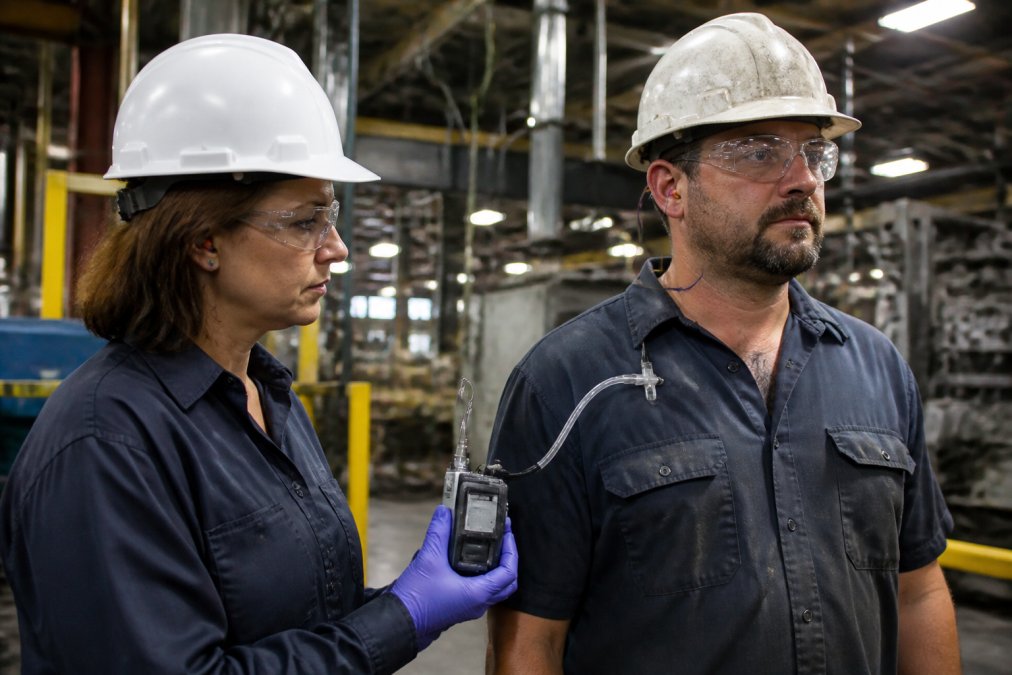
Air sampling uses calibrated pumps that pull a known volume of air through a filter or sorbent tube, which is then sent to a laboratory for analysis. The sampling train has four parts: the inlet, the pump, the flow calibrator, and the tubing connecting them. A pinched tube or a pump that drifts below its calibrated flow rate produces a sample volume that will not survive scrutiny.
Direct-reading instruments, such as photoionization detectors, give instant readings for volatile organic compounds but are less precise for compliance documentation. The practical rule most industrial hygienists follow: use direct-reading instruments for screening and trend detection, and use lab-analyzed samples for the compliance file.
Calibration and Flow Rate Verification
Pumps must be calibrated before and after every sampling event using a primary standard such as a bubble burette or a traceably calibrated secondary standard. Pre- and post-calibration flow rates should agree within 5 percent; if they do not, the sample is flagged and often discarded. This is the most common reason a compliance sample gets rejected.
Sorbent tubes and filter cassettes must be handled per the analytical method. NIOSH Manual of Analytical Methods (NMAM) and OSHA Technical Manual (OTM) methods specify the media, flow rate range, sample volume, and analytical finish. Respirable crystalline silica is typically collected on a 5-micron PVC filter at 2.5 L/min and analyzed by X-ray diffraction or infrared spectroscopy; welding fume metals go on a mixed cellulose ester filter for inductively coupled plasma analysis. The wrong media invalidates the result no matter how carefully the pump ran.
Noise Monitoring Methods
Noise monitoring uses a sound level meter for area readings and a dosimeter for personal exposure across a full shift. Sound level meters should meet ANSI S1.4 Type 1 or Type 2 specifications. Dosimeters are worn on the shoulder, within the hearing zone, and calibrated with an acoustic calibrator before and after each shift. The output is a time-weighted average in dBA, compared against the OSHA action level of 85 dBA and the permissible exposure limit of 90 dBA. Impulse noise, such as from a stamping press, requires a meter that captures peak levels against the 140 dB peak limit.
Heat Stress Assessment
Heat stress assessment relies on wet bulb globe temperature measurements combined with metabolic workload estimates. WBGT is calculated from three readings, natural wet bulb, globe temperature, and dry bulb, then adjusted for metabolic rate and compared against ACGIH threshold limit values or the NIOSH Recommended Exposure Limit. With radiant heat sources such as furnaces, the globe temperature dominates the calculation, which is why a simple dry-bulb reading is useless for heat stress evaluation.
| Hazard | Primary Instrument | Sampling Duration | Output |
|---|---|---|---|
| Airborne chemicals | Calibrated sampling pump | Full shift or task-based | Lab analysis vs. PEL |
| Particulate matter | Filter cassette + pump | Full shift | Mass concentration |
| Noise | Personal dosimeter | Full shift | TWA in dBA |
| Heat | WBGT meter | Peak exposure periods | WBGT index |
| VOCs (screening) | Photoionization detector | Instant reading | ppm reading |
Label every sample with the worker ID, task, start and end time, pump serial number, and pre/post calibration flow rates. A sample without that chain of custody is a number without a defense.
Controls That Follow the Data: Engineering, Administrative, and PPE
Controls are applied in a fixed hierarchy. Engineering controls come first because they remove the hazard at the source: local exhaust ventilation, enclosure, process substitution, and sound-dampening barriers.
Administrative controls come second, changing how work is scheduled or performed, rotating workers out of high-exposure zones or restricting access during certain operations. They reduce exposure duration but leave the hazard in place.
Respiratory protection and hearing protection sit at the bottom. They depend entirely on fit testing, medical evaluation, and consistent worker behavior, which is why they are the least reliable layer. A program that leads with PPE is a program that will eventually fail an audit.
Skipping straight to respirators because engineering controls are expensive is the single most common compliance mistake. It also creates a written record that you identified a hazard and chose not to eliminate it.
When to Bring In an Industrial Hygiene Consultant
Bring in an industrial hygiene consultant when you need defensible sampling data, a written program, or representation during a Cal/OSHA inspection or citation appeal. In-house staff can handle routine monitoring, but interpretation, laboratory coordination, and legal defensibility usually require a credentialed professional.
Michael Karl McNeil holds a Master of Science in Environmental Health and is a Registered Industrial Hygiene Professional and Registered Environmental Professional. His background includes twenty-five years in the federal and state fire service, most of it in fire prevention, and current practice in Cal/OSHA citation defense, written safety programs, and industrial hygiene monitoring across California and the Western states.
A consultant earns their fee in three places: knowing which samples to take, knowing how to defend the results, and knowing what the inspector will ask next.
IoT Sensors, Remediation Workflows, and What Monitoring Costs
Most competing content stops at the sample result. The two areas where a monitoring program earns its keep are continuous sensing and post-exposure remediation.
Continuous Sensing and Industry 4.0 Integration
IoT sensors are changing the cadence of industrial hygiene monitoring. Continuous fixed sensors for particulates, VOCs, and noise stream data to a dashboard that flags a rising trend before a full-shift sample would catch it. In a smart factory, those sensors can tie into the network that runs production scheduling and maintenance, so a rising particulate reading triggers a ventilation inspection automatically rather than waiting for the next quarterly survey.
The tradeoff is data validation. Sensor readings drift and still need periodic calibration against reference methods to hold up in a compliance file. The common pattern: use continuous sensors for trend detection and worker notification, then confirm any exceedance with a lab-analyzed sample before formal compliance action. That hybrid gives you real-time speed and reference-method defensibility.
When evaluating sensors, ask three questions: What is the detection range and resolution? How often does the unit need calibration, and against what reference? Does the manufacturer publish a correction algorithm for temperature and humidity interference? Sensors that cannot answer those are screening tools, not compliance instruments.
Post-Monitoring Remediation Workflow
Remediation workflows pick up where monitoring ends. Once a sample exceeds a limit: notify affected workers, implement interim controls, engineer a permanent fix, re-sample to confirm, and document the whole chain. The documentation is what protects you later.
A workable remediation sequence looks like this:
- Notify. Affected workers must be informed of monitoring results within the timeframe required by the applicable substance-specific standard. Document who was notified and when.
- Interim controls. Immediately reduce exposure through administrative measures, rotating workers, restricting access, or providing temporary ventilation, while the permanent fix is designed.
- Root cause. Identify whether the exceedance came from a process change, a failed control, a work practice deviation, or an inaccurate prior assessment. The fix depends on the cause.
- Engineering fix. Apply the highest feasible control in the hierarchy. For airborne contaminants, that usually means local exhaust ventilation, enclosure, or substitution.
- Verification sampling. Re-sample under the same conditions that produced the original exceedance. If the new result is below the limit, the control is verified. If not, iterate.
- Close the loop. Update the written program, the exposure assessment, and the training records. File the entire chain, original result, notification, interim controls, fix, verification, in one place.
Monitoring data is only as valuable as the remediation workflow behind it. A file full of sample results with no follow-up action is evidence of a known, unaddressed hazard.
Building the Cost Case for Small and Mid-Size Manufacturers
Pricing depends on facility size, the number of similar exposure groups, and the analytical methods required. Rather than quote a number that will not apply to your floor, here is the framework most safety managers use to justify the spend:
- Direct cost of the program. Sampling labor, laboratory analysis per sample, instrument rental or purchase, and consultant time if used.
- Cost of an uncorrected exposure. OSHA penalties for serious and willful violations, workers’ compensation claims, lost production during an investigation, and the legal cost of contesting a citation.
- Cost of over-control. Installing ventilation or PPE based on a guess rather than data may mean spending on controls the exposure does not require. Monitoring tells you where to spend and where not to.
- Cost of a failed inspection. A citation for a hazard you already identified but did not control is materially worse than a citation for a hazard you had not yet found. The paper trail matters.
For a scope and quote specific to your floor, contact Michael Karl McNeil directly.
Frequently Asked Questions
What is industrial hygiene monitoring?
Industrial hygiene monitoring is the process of measuring workplace exposures, such as airborne chemicals, particulate matter, and noise, to determine whether workers face health risks. It starts with a site survey and hazard identification, moves into air quality monitoring and sampling methodology, and ends with data validation against permissible exposure limits. Results drive engineering controls, administrative controls, respiratory protection, and other safety protocols. In manufacturing, monitoring turns a general concern about workplace safety into specific numbers you can act on.
What are the OSHA standards for industrial hygiene?
OSHA sets permissible exposure limits for hundreds of substances and requires employers to protect workers from recognized hazards under the General Duty Clause. Substance-specific standards cover chemicals like lead, silica, and solvents, while others address noise and respiratory protection. Meeting OSHA industrial hygiene requirements means knowing which standards apply to your processes, conducting exposure assessment, providing controls and protective equipment, and keeping compliance reporting records. A qualified industrial hygiene consultant can map your operations to the standards that actually apply.
Why is industrial hygiene monitoring critical in manufacturing?
Manufacturing concentrates hazards: volatile organic compounds from solvents, particulate matter from cutting and grinding, and continuous noise from machinery. Without monitoring, exposure goes undetected until workers show symptoms, and by then the harm may be permanent. Monitoring also protects the business. It creates documentation for compliance reporting, supports worker wellness programs, and gives you evidence if an inspector or attorney questions your safety protocols. Regular air quality monitoring and noise monitoring keep occupational exposure visible and manageable.
How do you identify health hazards in a manufacturing environment?
Start with a site survey that walks every process, material, and work area. Review safety data sheets, observe how chemicals are used, and note where dust, fumes, or noise are generated. Then rank hazards through an industrial hygiene risk assessment, comparing exposure potential against threshold limit values. The final step is confirmatory sampling: personal air sampling, noise dosimetry, and surface wipe tests. Hazard identification is not a one-time event. Processes change, materials change, and the assessment should be repeated after any significant change.
What is the difference between engineering controls and administrative controls?
Engineering controls change the workplace itself: ventilation systems, enclosure of processes, sound barriers, and substitution with less hazardous materials. They are the preferred first line because they protect every worker without relying on individual behavior. Administrative controls change how work is done: rotating staff to limit exposure time, adjusting schedules, and written safety protocols. Personal protective equipment, such as respiratory protection, is the last line of defense. Effective industrial hygiene monitoring programs apply these in order, so PPE covers only what engineering and administrative controls cannot eliminate.
When should a manufacturing facility hire an industrial hygiene consultant?
Bring in an industrial hygiene consultant when you lack in-house expertise to run sampling, when an OSHA inspection or citation is pending, after a near-miss or worker illness, or before expanding a process that introduces new chemicals or equipment. A consultant also helps when you need defensible data for legal counsel or for an insurance review. Look for credentials such as CIH, RIH, or REP, and direct experience on manufacturing floors, not just textbook knowledge of toxicology and exposure assessment.
 Michael Karl McNeil
Leave a comment