
Table of Contents
- What Is a Hazardous Material Business Plan?
- Program Overview and Regulatory Requirements
- HMBP Reporting Requirements and Thresholds
- Creating Your Hazardous Material Inventory Statement
- Building an Emergency Response Plan Template
- Submission Deadlines, Frequency, and Electronic Reporting
- Common Compliance Pitfalls and Audit Triggers
- Frequently Asked Questions
Last Updated: September 18, 2026
What Is a Hazardous Material Business Plan?
A hazardous material business plan is a written document that tells local emergency officials what hazardous chemicals your facility stores and handles. It’s a required filing for most businesses that keep certain amounts of hazardous substances on site.
The plan gives first responders the information they need to respond safely to chemical spills, fires, or leaks.
Program Overview and Regulatory Requirements
Most states require facilities to report hazardous materials through a statewide reporting program overseen by your state’s environmental agency or fire marshal’s office.
If you store or use chemicals above certain thresholds, you must report them to protect public health and give emergency responders critical information (the EPA).
Key regulatory drivers include:
- State environmental protection laws that mandate chemical inventory reporting
- Local fire codes that require emergency planning documents
- Facility-specific ordinances that may have stricter thresholds than state rules
- Annual certification requirements that verify your information stays current
Before you file, contact your local fire department or environmental health agency to confirm which thresholds apply to your facility.
Check with your local fire marshal’s office first. They can tell you exactly what your facility must report and which electronic system to use. Many jurisdictions now require digital submission rather than paper forms.
HMBP Reporting Requirements and Thresholds
HMBP reporting requirements depend on the quantities of hazardous materials you keep on hand. If you store more than the threshold amount of any listed chemical, you must file.
Common threshold chemicals include:
- Ammonia (500 lbs)
- Chlorine gas (10 lbs)
- Propane (10,000 lbs)
- Diesel fuel (above certain volumes)
- Flammable liquids (aggregate totals)
Your facility may store chemicals that fall below individual thresholds but exceed aggregate limits when combined.
The reporting deadline is usually annual, often March 1st. Check your local rules to confirm the exact date.
You must report the chemical name, CAS number, physical form, quantity stored, storage location, and maximum daily use amount.
Missing a deadline or providing false information can result in citations. Some jurisdictions impose daily fines for late or incomplete filings. Start your filing process at least 60 days before the deadline to avoid pressure.
Creating Your Hazardous Material Inventory Statement
Your hazardous material inventory statement lists every hazardous chemical at your facility that meets reporting thresholds.
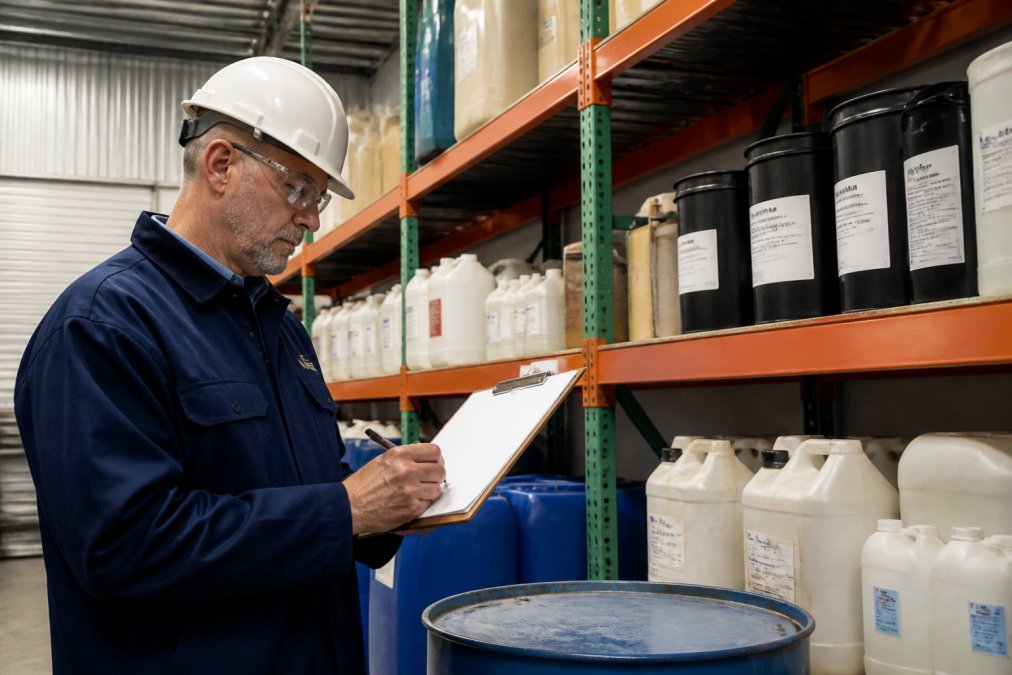
Walk your facility and identify every chemical in use: storage areas (closets, warehouses, loading docks), in-process chemicals, emergency supplies, and waste streams.
For each chemical, gather the safety data sheet (SDS). The SDS contains the CAS number, hazard classification, and physical properties you need for the inventory statement.
Common mistakes: forgetting secondary storage locations, underestimating quantities, missing seasonal materials, and omitting waste streams.
Your inventory statement should include:
| Item | Detail |
|---|---|
| Chemical name | As listed on the SDS and label |
| CAS number | The unique chemical identifier |
| Physical form | Liquid, solid, gas, or mixture |
| Quantity | Weight or volume in standard units |
| Storage location | Building, room, or area within facility |
| Maximum daily use | Highest amount used in a single day |
Verify your inventory against purchasing records for the past 12 months to catch forgotten chemicals and validate quantities.
Building an Emergency Response Plan Template
An emergency response plan outlines how your facility responds to chemical releases, fires, or hazmat incidents. Your plan should be practical and specific to your operation, not a generic template.
Essential Sections for Any Emergency Response Plan
Every emergency response plan should include: facility description, hazard summary, emergency contacts, evacuation procedures, spill response procedures, training schedule, and post-incident reporting requirements.
Industry-Specific Emergency Response Plans
The details of your plan depend heavily on what type of business you operate. Here’s how to tailor your approach:
Manufacturing Facilities: Map chemical storage and production lines, identify high-risk chemicals, include equipment shutdown procedures, designate a spill response team, and address customer notification if needed.
Distribution and Warehouse Operations: Create a chemical storage map by hazard class, describe how you update inventory with new shipments, include procedures for unknown containers, manage chemical incompatibilities, and specify evacuation routes.
Retail Operations: Identify all chemical storage areas, account for customers during business hours, include evacuation procedures for non-employees, and specify that employees direct customers to exits rather than attempt cleanup.
Maintenance and Service Facilities: Identify chemical use and storage areas, address how to notify off-site employees of incidents, include waste management procedures, and specify how to handle incidents at customer locations.
Building a Practical Emergency Response Plan
A practical emergency response plan includes: a site diagram, emergency equipment list, contact information, fire department notification procedures, and post-incident reporting requirements.
Keeping Your Plan Current
Update your plan whenever you add chemicals, change storage locations, modify facility layout, hire employees, or change your emergency coordinator. Document when you last reviewed it, a plan reviewed annually is more useful than one outdated for years.
Your emergency response plan is only useful if employees know it exists and understand their role in it. Conduct a brief review with your team at least once a year. Walk through evacuation routes, show employees where the spill kit is located, and confirm that everyone knows who the emergency coordinator is. A plan that sits in a drawer is a liability; a plan that’s practiced is an asset.
Submission Deadlines, Frequency, and Electronic Reporting
Most states require annual submission by March 1st, though dates vary. Check your local agency to confirm. Electronic reporting systems have replaced paper forms in most states.
Understanding Your State’s Reporting Portal
Before you begin, contact your local fire marshal’s office or environmental health department to get the portal URL, login instructions, and confirm whether you need a new account or if one exists from a previous filing.
Step-by-Step Digital Submission Walkthrough
The typical submission process: (1) Log in and verify facility information; (2) Enter each chemical with its name, CAS number, physical form, quantity, storage location, and maximum daily use; (3) Attach or reference your emergency response plan; (4) Review the submission summary and cross-check against your inventory; (5) Submit and save the confirmation number.
Common Portal Issues and How to Resolve Them
Common portal issues: CAS number errors (try removing dashes or searching by chemical name); unit conversion problems (convert to pounds or gallons before entering); system timeouts (save your list in a spreadsheet first); missing upload buttons (check the FAQ or call the agency).
Submission Timeline and Planning
Inventory compilation takes 2-4 weeks, form completion 1-2 hours, and agency processing 1-2 weeks. Submit early to allow time for corrections if the system rejects your filing.
After Submission: What Happens Next
Your filing is usually public record accessible to emergency responders. Keep your confirmation email or letter. Annual recertification is required even if chemicals don’t change. Mark your calendar three months before the deadline.
Create a filing checklist and save it for next year. Document which chemicals you reported, where you found that information, and any portal quirks you discovered. Next year’s filing will be faster and more accurate.
Common Compliance Pitfalls and Audit Triggers
Common mistakes: incomplete inventory (forgotten secondary locations), inaccurate quantities (estimating instead of measuring), missing safety data sheets, outdated emergency plans, and late submissions. Walk your entire facility, weigh chemicals, keep current SDSs, update your plan when operations change, and mark the deadline three months in advance.
Audits are triggered by complaints, incident reports, routine inspections, facility changes, or late submissions. Most violations result from incomplete information or missed deadlines, not willful negligence.
If you discover an error in a previously submitted filing, don’t wait for an audit. Contact your local agency, explain the error, and submit a corrected filing. Proactive correction usually results in a warning rather than a citation.
A hazardous material business plan requires attention to detail and timely submission to protect your employees, community, and facility. Start by contacting your local fire marshal or environmental health agency for specific requirements, the electronic system to use, and the exact deadline.
Frequently Asked Questions
What is a Hazardous Material Business Plan (HMBP)?
A Hazardous Material Business Plan is a regulatory document required by state and local agencies that demonstrates how your business stores, handles, and manages hazardous materials safely. It includes your chemical inventory, facility maps, emergency response procedures, and employee training records. The HMBP serves as both a compliance tool and a safety management system that protects your workforce, community, and environment. Most facilities storing hazardous substances above threshold quantities must file an HMBP with their local Unified Program Agency.
Which businesses must submit an HMBP?
Any business that stores hazardous materials above threshold planning quantities must submit an HMBP. This includes manufacturers, laboratories, construction firms, automotive shops, printing facilities, and retail operations with large quantities of hazardous substances. Thresholds vary by chemical type, some trigger at 55 gallons, others at lower volumes. Your local Unified Program Agency can confirm whether your facility’s inventory requires filing. Even if you’re below the threshold now, you must update your plan if quantities increase.
What should be included in a hazardous material inventory statement?
Your inventory statement must list every hazardous substance stored on-site, including the chemical name, quantity, storage location, and container type. Include safety data sheets for each material. Organize the inventory by storage area and update it whenever you add or remove chemicals. The statement should clearly show which materials exceed threshold planning quantities and which are below. Accuracy is critical, discrepancies between your reported inventory and an inspection can trigger enforcement action or citations.
How often should I update my hazardous material business plan?
You must submit an annual certification to your local Unified Program Agency confirming that your plan remains accurate. Update the plan itself whenever your chemical inventory changes, facility layout shifts, emergency procedures are revised, or staff turnover affects trained personnel. Some jurisdictions require updates within 30 days of significant changes. Keep records of all revisions and maintain dated versions. Post-submission maintenance ensures your plan reflects current operations and prevents compliance gaps during inspections.


Leave a Reply