
Table of Contents
- Why Professional Industrial Hygiene Audits Matter More Than Ever
- Meeting OSHA Industrial Hygiene Requirements With Confidence
- Benefit 1: Identifying Hidden Workplace Hazards Before They Become Incidents
- Benefit 2: Building a Healthier, More Productive Workforce
- Benefit 3: Reducing Liability and Workers’ Compensation Costs
- The Benefits of Hiring a CIH for Your Audit
- How to Use an Industrial Hygiene Audit Checklist for Continuous Improvement
- Calculating the ROI of a Professional Audit
- Frequently Asked Questions
Last Updated: September 6, 2026
Why Professional Industrial Hygiene Audits Matter More Than Ever
A single missed exposure reading can lead to a chronic illness claim that surfaces years later, long after the work shift that caused it. That is why the benefits of professional industrial hygiene audits extend far beyond passing an inspection; they protect your people and your balance sheet. An industrial hygiene audit is a systematic evaluation of workplace conditions to identify, measure, and control environmental stressors like chemical exposure, noise, and poor indoor air quality. A thorough audit can uncover issues that routine safety checks miss entirely.
The gap between “we have a safety program” and “we have a defensible safety program” is where most facilities get into trouble. Many companies believe compliance means having the right posters on the wall and a binder of policies. Professional audits dig deeper, measuring actual conditions against established exposure limits. Below, we will break down the specific benefits, show you how to calculate the return on investment, and explain what a certified professional brings to the process.
OSHA’s industrial hygiene technical manual defines the core principles that govern how workplace hazards should be anticipated, recognized, evaluated, and controlled.
Meeting OSHA Industrial Hygiene Requirements With Confidence
OSHA industrial hygiene requirements are not a single regulation but a framework of standards covering specific hazards, from airborne contaminants to noise exposure. Compliance means knowing which standards apply to your operations and proving that your exposure levels fall within permissible limits. The OSHA permissible exposure limits table lists the legal ceilings for hundreds of substances, and exceeding any of them can trigger citations and penalties.
A professional audit maps your specific processes to the applicable standards. This matters because a general safety inspection rarely includes the quantitative sampling needed to demonstrate compliance. Without sampling data, you cannot prove that your controls are working. An audit closes that gap by producing documented evidence that your facility meets regulatory requirements.
Benefit 1: Identifying Hidden Workplace Hazards Before They Become Incidents
The most valuable outcome of an audit is discovering problems that have not yet caused harm. Chemical exposure often builds gradually, and noise-induced hearing loss develops over years, not days. By the time symptoms appear, the damage is done and the workers’ compensation claim is on your desk.
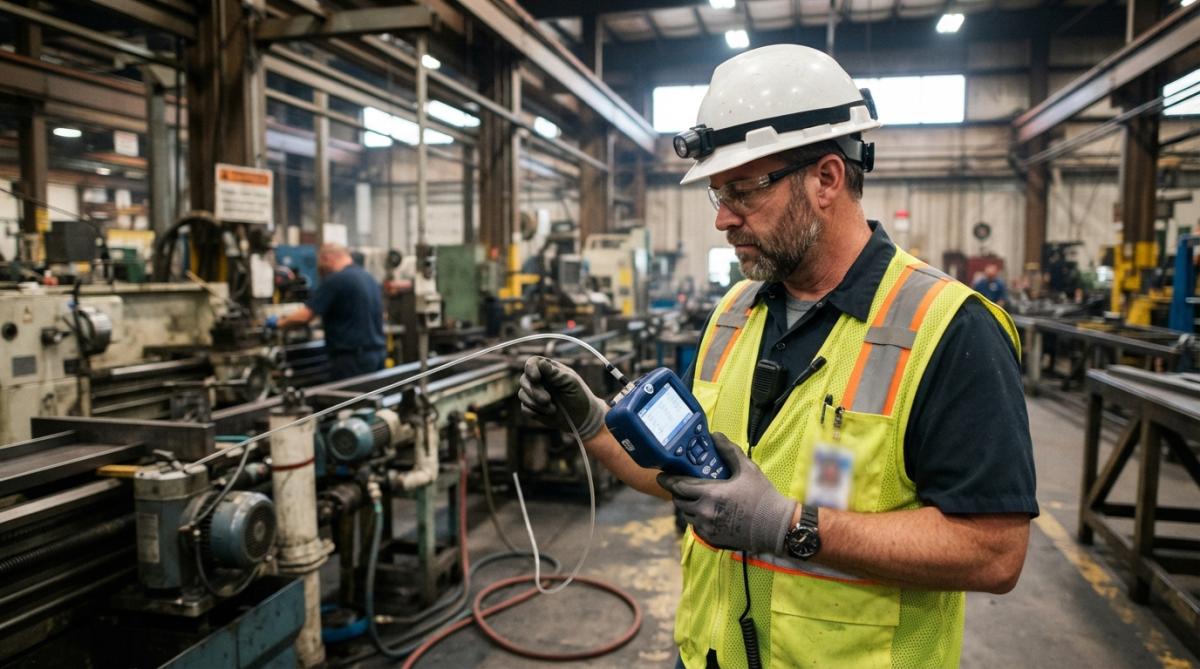
A professional audit uses air sampling, noise dosimetry, and surface wipe testing to find hazards that are invisible to the naked eye. These measurements are compared against established occupational exposure limits to determine whether current controls are adequate. When readings approach those limits, you have the opportunity to implement corrective actions before a regulatory citation or a health incident occurs. This proactive approach to hazard identification is the single biggest advantage of bringing in an outside expert who knows what to look for and where.
Benefit 2: Building a Healthier, More Productive Workforce
Workplace hazards do not just threaten physical health; they affect morale, attendance, and productivity. Employees who worry about the air they are breathing or the noise levels on the floor are less focused and more likely to call in sick. A facility that demonstrably invests in occupational health sends a clear signal that management values its people.
Healthier employees mean fewer sick days, lower turnover, and steadier output. Ergonomic assessments, a standard part of many audits, can reduce musculoskeletal strain that leads to repetitive injury claims. Improved indoor air quality reduces respiratory complaints and the headaches that drive afternoon absenteeism. These gains show up in productivity metrics over time, making the audit a contributor to operational performance, not just a compliance cost. When employees see concrete action taken on audit findings, safety culture strengthens and incident reporting improves.
Benefit 3: Reducing Liability and Workers’ Compensation Costs
Workers’ compensation premiums are calculated on your claims history and your industry classification. Every preventable injury that slips through becomes a data point that raises your rates for years. Professional audits help break that cycle by identifying the conditions that lead to claims before they happen.
Skipping an audit to save money in the short term often backfires. A single serious citation for regulatory non-compliance can cost more than a decade of annual audits, and it does not include the hidden costs of increased premiums and legal fees.
The documentation produced during an audit also matters if a claim does occur. Having defensible exposure data and a clear record of your safety management system demonstrates that you took reasonable steps to protect workers. In litigation, that evidence can be the difference between a quick resolution and a prolonged dispute over liability.
The Benefits of Hiring a CIH for Your Audit
Not all auditors bring the same depth of expertise. A Certified Industrial Hygienist, or CIH, has passed rigorous exams and met experience requirements that demonstrate mastery of exposure assessment, toxicology, and risk mitigation. Hiring a CIH ensures your audit is conducted against the highest professional standard.
The benefits of hiring a CIH go beyond the credential itself. These professionals have typically worked across multiple industries, so they bring perspective on what effective controls look like in practice. They understand the nuances of sampling methodology, know how to interpret borderline results, and can distinguish between a minor deviation and a serious compliance gap. Their professional judgment is backed by a code of ethics, and their findings carry weight with regulators, insurers, and courts. For complex operations with multiple chemical or physical hazards, the CIH credential is not a luxury; it is a necessity.
How to Use an Industrial Hygiene Audit Checklist for Continuous Improvement
An audit is only as good as the action it drives. The most common failure is not in the data collection, but in the follow-through. A checklist is the tool that turns a one-time assessment into an ongoing program, but its true power lies in how it is used to prioritize and implement findings. This is the post-audit roadmap that most guides miss.
Step 1: Categorize and Prioritize Findings
Do not treat every finding equally. Immediately after the audit report is delivered, sort every item into one of three buckets based on risk and urgency:
- Life Safety (Act Now): Any reading at or above an OSHA permissible exposure limit (PEL) or an imminent danger hazard. This requires immediate action, such as removing workers from the area, implementing engineering controls, or providing respiratory protection. Your first step is to shut down the exposure pathway.
- High Risk (Fix This Quarter): Exposures that are above the action level but below the PEL, or conditions that are likely to cause a recordable injury or illness. These should be assigned an owner and a deadline within 90 days.
- Continuous Improvement (Schedule It): Lower-risk items, such as outdated training records or minor ventilation inefficiencies. These should be added to your regular maintenance and safety calendar.
Step 2: Build Your 30-60-90 Day Action Plan
A practical roadmap looks like this:
- Days 1-30: Implement all ‘Life Safety’ controls. Verify that any immediate over-exposures are mitigated. Communicate initial findings to the workforce.
- Days 31-60: Begin engineering controls for ‘High Risk’ items. This is the time to order new ventilation parts, schedule noise barrier installation, or revise a chemical handling procedure. Simultaneously, start the administrative controls, like updating training materials.
- Days 61-90: Complete ‘High Risk’ fixes and re-test to verify their effectiveness. This re-testing is critical; it closes the loop and provides the data that proves your control is working. Finally, schedule the ‘Continuous Improvement’ items for the next planning cycle.
Step 3: Use the Checklist to Drive the Next Cycle
The checklist is not a static document. After each audit cycle, review the checklist itself. Did it miss a new chemical introduced to the floor? Did a new process create a noise issue that wasn’t previously relevant? Update the checklist to reflect your facility’s evolving risk profile. This transforms the audit from a point-in-time snapshot into a dynamic tool for continuous improvement.
A practical checklist covers more than just chemical exposure. It should include noise monitoring, indoor air quality, ventilation system performance, ergonomic risk factors, biological monitoring where relevant, and the proper use of respiratory protection. It should also verify that written programs are current and that training records are complete. The table below summarizes the core areas and what each one addresses.
| Audit Area | What It Evaluates | Why It Matters |
|---|---|---|
| Chemical Exposure | Airborne contaminant levels | Prevents overexposure and illness |
| Noise Levels | Sound dosimetry readings | Protects hearing and avoids citations |
| Indoor Air Quality | Ventilation and air contaminants | Reduces respiratory complaints |
| Ergonomics | Workstation and task design | Lowers musculoskeletal injury risk |
| Hazard Communication | Labeling and training records | Ensures workers know the risks |
Using the checklist annually, and after any major process change, creates a cycle of continuous improvement. Each audit builds on the last, and the data trend shows whether your controls are getting better or slipping.
Calculating the ROI of a Professional Audit
Executives want numbers, not just assurances. The return on investment for an audit can be calculated with a straightforward framework that moves beyond vague ‘cost savings’ to a defensible financial model. Here is a practical approach to build that business case.
Step 1: Quantify the Cost of a Single Incident (C)
Start with the direct costs. According to the National Safety Council, the 2021 average cost per medically consulted injury was around $42,000, and the average cost per death was $1.19 million (nsc.org). For a more specific estimate, use the National Council on Compensation Insurance (NCCI) loss costs for your state and industry class code. A single lost-time workers’ compensation claim can easily cost between $50,000 and $100,000 when you factor in medical expenses, indemnity payments, and settlement costs.
Step 2: Estimate the Probability of an Incident (P)
This is the most subjective part, but you can ground it in data. If your audit finds a noise level of 88 dBA over an 8-hour TWA (the PEL is 90 dBA, the action level is 85 dBA), you have a high probability of a future hearing loss claim. A common pattern is to assign a probability of 10-25% for a serious incident occurring over the next 5 years if a significant uncontrolled hazard is identified. If the audit finds no major issues, the probability drops to 1-2%.
Step 3: Calculate the Expected Annual Risk (R)
Use the formula: R = (C x P) / 5 years. For example, if you estimate a moderate injury could cost $75,000 (C) and there is a 20% chance (P) of it occurring over the next 5 years, your expected annual risk is ($75,000 x 0.20) / 5 = $3,000 per year. This is the ‘cost of doing nothing’ for that single hazard.
Step 4: Compare Against the Audit Fee (A)
Now, compare that expected annual risk against the annualized cost of the audit. If a professional audit costs $8,000 and is recommended every 2 years, the annualized cost is $4,000. In this scenario, the audit fee is slightly higher than the risk for one hazard. But the audit typically identifies multiple hazards. If the audit uncovers two more issues with similar risk profiles, your total expected annual risk becomes $9,000, making the $4,000 audit a clear win.
Step 5: Add the Intangible and Indirect Savings
This framework only covers direct claim costs. Add the potential savings from lower insurance premiums (a single claim can raise your Experience Modification Rate (EMR) for 3 years), reduced regulatory fines (OSHA penalties can reach up to $15,625 per serious violation as of 2024), and improved productivity from a healthier workforce. When presenting the business case, frame the audit as insurance against a known, quantified risk, not as an optional expense. The cost of an audit is predictable and finite; the cost of an incident is neither.
Frequently Asked Questions
What is the primary purpose of an industrial hygiene audit?
The primary purpose is to systematically evaluate workplace conditions to identify and measure potential health hazards like chemical exposure, noise, and poor air quality. The goal is to find issues before they cause employee illness or regulatory violations, allowing you to implement controls proactively rather than reactively.
How do professional audits help with OSHA compliance?
Professional audits help ensure your operations meet OSHA industrial hygiene requirements. An expert auditor, especially a Certified Industrial Hygienist, knows exactly what inspectors look for and can identify gaps in your safety program, exposure monitoring, and documentation. This proactive approach helps you avoid citations, fines, and the disruption of an unannounced inspection.
What are the long-term benefits of regular industrial hygiene monitoring?
Regular monitoring provides trend data that shows whether your control measures are actually working over time. This leads to fewer employee health claims, lower workers’ compensation costs, and reduced turnover. It also demonstrates a commitment to employee wellness, which strengthens your safety culture and improves productivity by reducing absenteeism related to workplace conditions.
When should a business schedule a professional industrial hygiene audit?
Schedule a baseline audit if you have never had one, and repeat it whenever you introduce new processes, chemicals, or equipment that could change the exposure profile. It is also critical to audit after a near-miss incident or an employee complaint about health symptoms. Regular audits, such as annually or every two years, are a best practice for maintaining compliance.
 Michael Karl McNeil
Leave a comment