
Table of Contents
- What Professional IIPP Development Actually Includes
- The Real Cost Drivers Behind IIPP Development
- DIY vs. Professional IIPP Development: A Cost-Benefit Comparison
- Why a Generic IIPP Template Often Costs More in the Long Run
- Measuring ROI: How to Tell If Your IIPP Is Worth the Investment
- Your IIPP Implementation Checklist: What to Expect From a Professional Engagement
- IIPP Review and Update Frequency: The Hidden Ongoing Cost
- What Effective IIPP Examples Look Like in Practice
- Frequently Asked Questions
Last Updated: October 13, 2026
What Professional IIPP Development Actually Includes
Whether professional IIPP development is worth the cost depends on what you’re actually buying. An Injury and Illness Prevention Program is a written workplace safety and health program required of California employers under Cal/OSHA rules, and a professionally developed version is built around your specific operations rather than adapted from a generic document.
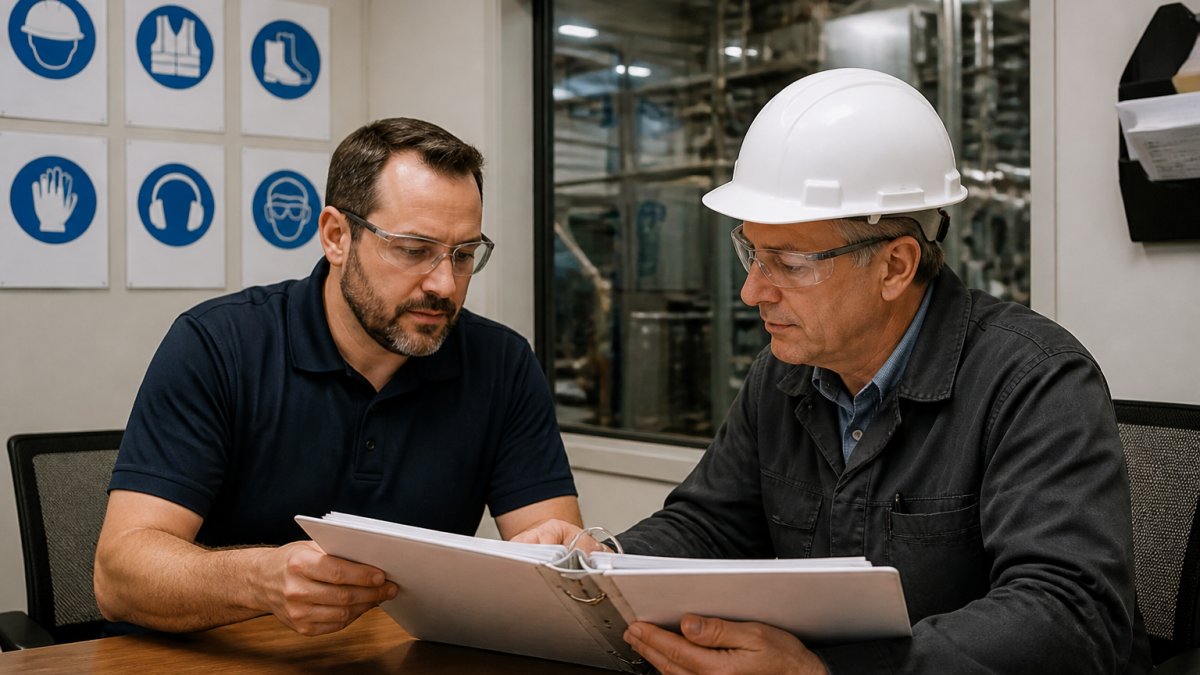
The core elements are consistent across every compliant program:
- Named roles and responsibilities for program administration
- A system for employees to report safety concerns without fear of retaliation
- Hazard identification, assessment, and correction procedures
What separates a real program from a binder on a shelf is whether each element maps to how your facility actually runs.
Beyond the Template: Customization and Site-Specific Hazard Analysis
A template gives you headings. A site-specific hazard analysis gives you a defensible program. The difference shows up in the details: which machine guarding gaps exist on your floor, which chemicals your team handles and at what exposure levels, and which job classifications carry the highest injury risk. Professional development starts with a walkthrough and interviews, not a download.
The Real Cost Drivers Behind IIPP Development
Most guides answer the cost question with a shrug. The honest answer is that professional IIPP development is priced by scope, not by a flat rate, and the scope is driven by variables you can measure before you ever request a proposal. Understanding those variables lets you compare quotes on equal footing and predict which end of the range you land on.
How Providers Typically Price the Work
Three pricing models dominate the market, and each shifts risk differently:
- Fixed-fee project. One price for a defined scope: hazard assessment, written program, training materials, and handoff. Predictable, but change orders for anything outside the scope.
- Hourly or time-and-materials. You pay for hours worked. Cheaper on simple sites, riskier when the scope is unclear.
- Retainer or subscription. A recurring fee covers development plus ongoing reviews, training refreshes, and updates. Spreads cost across the year and keeps the program current.
Ask which model a provider uses before you compare numbers. A low fixed fee and a low hourly rate are not the same offer.
What Pushes Professional IIPP Costs Higher
- Multiple locations. Each site needs its own hazard assessment, inspection schedule, and often its own written procedures. Site count is usually the single largest multiplier.
- High-hazard operations. Construction, manufacturing, chemical handling, and warehousing carry more hazards to identify, more procedures to write, and more training to document.
- Industrial hygiene monitoring. Where workplace exposure sampling is required, the assessment expands into air monitoring, noise dosimetry, or similar testing, each with its own labor and lab costs.
A single-site, low-hazard operation with a cooperative management team sits at the other end of the range. So does a company that already has documentation, injury logs, and training records to build from.
What Should Be Included in Any Quote
Scope is where quotes diverge most. A complete engagement should specify:
- A site walkthrough and supervisor interviews, not a phone questionnaire
- A written hazard log with risk ranking
- The written program itself, customized to your operations
Ask any provider what deliverables you receive at the end: a written program, training record templates, an inspection schedule, and a hazard log. If the answer is vague, you’re paying for a document, not a program.
The Internal Cost You Also Pay
Professional development does not eliminate internal time; it redirects it. Budget for walkthrough access, supervisor interviews, draft reviews, and training attendance. For most employers this is measured in days, not weeks, but it is real and should be planned before kickoff.
DIY vs. Professional IIPP Development: A Cost-Benefit Comparison
The honest answer is that DIY works for some employers and fails for others. A small, low-hazard office can often build an adequate program from a state template and internal staff time. A manufacturer with rotating shifts, forklifts, and chemical storage usually cannot, not because the template is wrong, but because the hazard analysis underneath it is missing.
| Factor | DIY Approach | Professional Development |
|---|---|---|
| Upfront effort | High internal staff hours | Moderate internal time for interviews and walkthroughs |
| Site-specific hazard analysis | Often generic or incomplete | Built from your actual operations |
| Cal/OSHA audit readiness | Depends on who wrote it | Structured for inspection |
| Ongoing maintenance | Falls to whoever has time | Defined review schedule |
| Best for | Low-hazard, single-site employers | High-hazard or multi-site operations |
The hidden cost of DIY is the time your safety manager or HR lead spends learning program requirements instead of running them.
Why a Generic IIPP Template Often Costs More in the Long Run
A generic IIPP template is the most expensive free option available. It looks complete, so nobody questions it until an inspector does. When a citation follows a serious injury, the written program becomes evidence, and a program that doesn’t match your operations is difficult to defend.
Cal/OSHA Injury and Illness Prevention Program requirements
That’s the part most guides skip. The question isn’t whether a template satisfies a checklist. It’s whether the program reflects what actually happens on your floor at 6 a.m. on a Tuesday.
If your written program lists hazards your facility doesn’t have and omits the ones it does, you’ve created documentation that works against you in an investigation. Corrective action starts with an accurate hazard log.
Measuring ROI: How to Tell If Your IIPP Is Worth the Investment
Return on investment in safety programs shows up in claim frequency, incident severity, and avoided penalties. No provider can hand you a guaranteed percentage, because outcomes vary by industry, baseline conditions, and how consistently the program is followed. What you can do is build a simple model using your own numbers, label your assumptions, and track whether reality matches them.
A Framework You Can Run Yourself
Start with your baseline. Pull the last two to three years of:
- Workers’ compensation claim counts and total incurred costs
- OSHA-recordable injury and illness rates
- Lost workday cases and days away
Then estimate the change you expect. A common planning assumption is a meaningful reduction in claim frequency and severity once hazards are identified and corrected and reporting culture improves, but the size of that reduction depends on your starting point. If your injury rate is already low, the ceiling is low. If you have recurring claims in one job classification, the opportunity is concentrated there.
Metrics That Show Whether Your IIPP Is Working
- Workers’ compensation claim frequency, tracked quarter over quarter
- Near-miss reports filed, which should rise as reporting culture improves before claim frequency falls
- Inspection findings and corrective actions closed on schedule
Where the Savings Actually Come From
Savings rarely arrive as a single line item. They accumulate across:
- Fewer and less severe claims, which lowers incurred costs and can improve your experience modification factor over time
- Reduced lost time, which protects productivity and avoids backfill and overtime costs
- Avoided penalties, since a documented, site-specific program is the first thing an inspector reviews
Label every assumption in your model. If you assume a 20 percent reduction in claims, write it down and revisit it at renewal. A model with stated assumptions is a management tool; a model with hidden ones is wishful thinking.
A Simple Payback Check
Divide the total cost of development and first-year maintenance by your estimated annual savings. If the result is less than one year, the investment pays back within the first year under your assumptions. If it is two to three years, the case is weaker and you should revisit scope, or consider a phased approach that starts with the highest-risk area.
A program that reduces serious incidents and keeps citations off the books pays for itself. A program that sits unread does not.
Your IIPP Implementation Checklist: What to Expect From a Professional Engagement
A professional engagement follows a predictable sequence. Here’s what a well-run IIPP implementation checklist looks like from kickoff to handoff:
- Kickoff and document review. We collect existing programs, injury logs, and prior inspection history.
- Site walkthrough. We observe actual work processes, not the version described in a meeting.
- Hazard identification and assessment. Findings go into a hazard log with risk ranking.
- Program drafting. Written safety procedures, roles, and training requirements are assembled around your operations.
- Training delivery and documentation. Employees are trained, and records are created that satisfy Cal/OSHA training requirements.
- Inspection schedule setup. You get a defined frequency and format for workplace inspections.
- Handoff and review cadence. We agree on who maintains the program and when it gets reviewed.
Expect your internal time commitment to be modest but real: walkthrough access, interviews with supervisors, and review of draft documents.
IIPP Review and Update Frequency: The Hidden Ongoing Cost
IIPP review and update frequency is where budgets quietly break. A program written once and filed away stops being compliant the moment your operations change. New equipment, new chemicals, a new shift pattern, or a new location all create hazards the old document doesn’t address.
Most employers should review their program annually at minimum, and update it whenever there’s a significant operational change, a serious injury, or a new regulatory requirement. OSHA guidance on safety and health program management frames this as continuous improvement rather than a one-time project, which matches what we see in practice.
Budget for maintenance, not just creation. The review itself is usually a fraction of the original development effort, but skipping it undoes the value of everything before it.
The cost question has two parts: what you pay to build the program, and what you pay to keep it current. Employers who plan for both get more from the investment than those who treat it as a one-time purchase.
What Effective IIPP Examples Look Like in Practice
Effective IIPP examples share a few traits. The program fits on a shelf but gets used at the crew level. Supervisors can explain the hazard reporting process without looking it up.
OSHA’s recommended practices for safety and health programs
The programs that hold up under a Cal/OSHA audit aren’t the longest documents. They’re the ones where the written program, the training records, and the conditions on the floor tell the same story.
That’s the standard we build to at Michael Karl McNeil. Our work includes written safety programs, industrial hygiene monitoring, Cal/OSHA citation defense, and expert witness support for counsel, across California and the Western states.
Frequently Asked Questions
How often must an IIPP be reviewed and updated?
California requires employers to review their IIPP at least annually, but the program should also be updated whenever workplace conditions, operations, or equipment change. After a serious incident or a near miss, a review is warranted regardless of the calendar. Many safety professionals recommend treating the IIPP as a living document, with updates triggered by new hazards, process changes, or inspection findings rather than waiting for the annual deadline.
Can an employer develop an IIPP without outside help?
Yes, an employer can build an IIPP in-house, and many small businesses do. The challenge is that a do-it-yourself approach often relies on a generic IIPP template that does not reflect the actual hazards on your site. If your operations are low-hazard and stable, that may be sufficient. If you run manufacturing, construction, or industrial work, the gap between a template and a site-specific program is where citations and injuries tend to occur.
When should a business hire a professional to develop an IIPP?
Hiring a professional makes sense when your operations involve high-hazard work, when you have multiple locations or shifting job sites, when you have received a Cal/OSHA citation, or when your internal team lacks the time and EHS background to build and maintain the program. Companies preparing for an audit or recovering from a near miss often find that professional IIPP development closes compliance gaps faster than an internal effort.
What are the risks of using a generic safety program template?
A generic IIPP template can leave out the hazards specific to your site, which is exactly what inspectors look for during an audit. It may also miss required elements such as documented training, hazard correction records, or employee participation procedures. When an incident occurs, a program that does not match your actual operations offers little protection in a Cal/OSHA investigation or in workers’ compensation proceedings.
If a serious injury or a near-miss has you wondering whether your written program would survive an inspection, that uncertainty is the real cost. Michael Karl McNeil builds site-specific Injury and Illness Prevention Programs, delivers the training and recordkeeping structure that goes with them, and stands behind the work through Cal/OSHA matters when they arise. Get started with Michael Karl McNeil and build a safety program that matches how your operation actually runs.


Leave a Reply