
Last Updated: November 5, 2026
Quick Summary
Cal/OSHA inspectors open with a document request, so your safety records must be complete and instantly retrievable. Keep your IIPP, OSHA 300 Log, 300A summary, 301 reports, training documentation, and hazard communication records in one indexed file with a named owner.
- Enter a recordable incident on the OSHA 300 Log within seven calendar days of learning about it.
- Post the 300A summary from February 1 through April 30 each year.
- Keep the 300 Log, 300A, and 301 reports for five years after the calendar year.
- Retain employee exposure records for 30 years and medical records for employment plus 30 years.
- Write privacy case in the name field and keep a separate confidential list linking case numbers.
Table of Contents
- What Cal/OSHA Inspectors Ask For First
- Your Cal/OSHA Inspection Checklist: The Master Document List
- Cal/OSHA 300 Log Requirements and the Annual 300A Summary
- Cal/OSHA Employee Training Records and Written Programs
- Cal/OSHA Injury and Illness Record Retention: How Long to Keep What
- Inspection Procedures, Employer Rights, and Post-Inspection Remediation Records
- Digital Recordkeeping and Employee Privacy in Safety Logs
- Building an Audit-Ready Records System with McNeil Safety Consulting
- Frequently Asked Questions
What Cal/OSHA Inspectors Ask For First
An unannounced Cal/OSHA inspection usually begins with a request for your safety records, not a walk through the plant. Under the Cal/OSHA inspection procedures in Title 8, the compliance officer opens with a conference, explains the scope, and asks for the written programs and logs that govern the operation.
Inspectors are not fishing; they follow a standard sequence, and the employers who fare best are the ones who can produce a complete, current file without scrambling.
The Opening Conference and Document Request
The opening conference is where the compliance officer states the reason for the visit, whether it stems from a complaint, a referral, a programmed inspection, or a fatality.
Then comes the request. Expect the officer to ask for your Injury and Illness Prevention Program, your OSHA 300 Log and 300A summary, training documentation, and hazard communication records. Have a named person who owns that handoff.
Your Cal/OSHA Inspection Checklist: The Master Document List
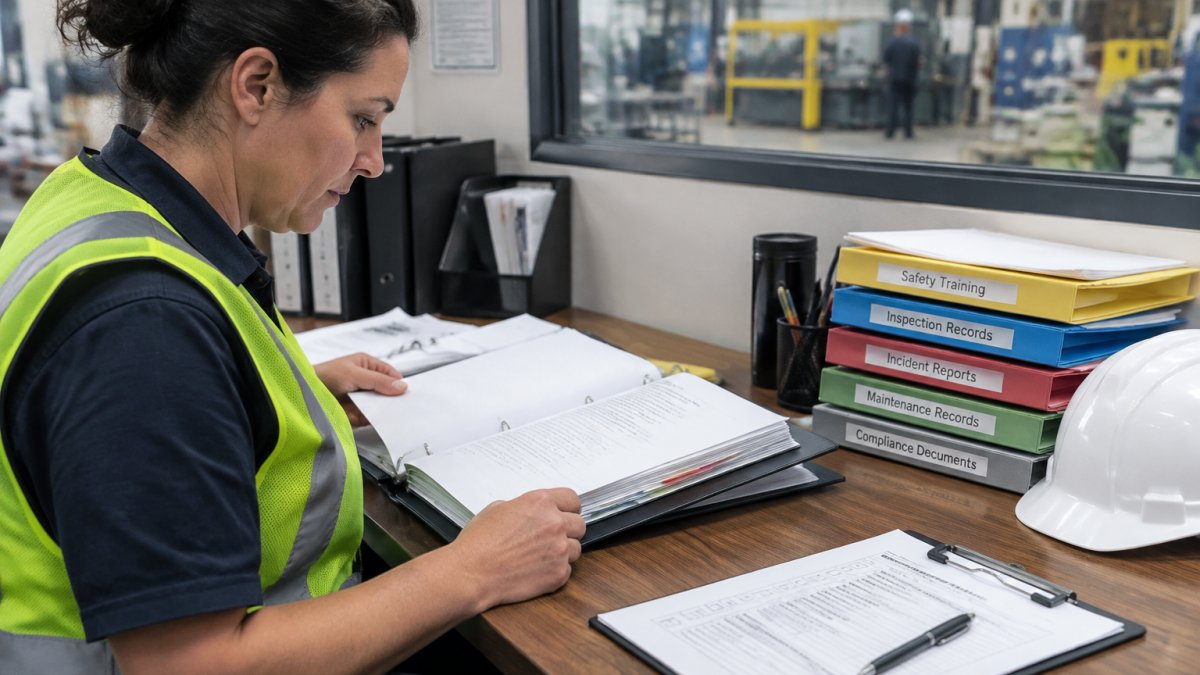
A Cal/OSHA inspection checklist is a single index of every record an inspector may request, mapped to where it lives and who maintains it. Build the index first, then fill the gaps it exposes.
Records Every Employer Should Have Ready
Keep one binder or shared drive with these, current and signed:
- Written Injury and Illness Prevention Program with documented training
- OSHA 300 Log, 300A annual summary, and 301 incident reports
- Hazard communication program, safety data sheets, and chemical inventory
- Emergency action plan and evacuation records
- Equipment inspection and maintenance logs
- Training rosters with dates, topics, and attendee signatures
- Respiratory protection, hearing conservation, and exposure records where applicable
- Sharps injury log for healthcare settings
The master list is only as good as its weakest entry. Review it quarterly and note the date of the last update on the cover.
Industry-Specific Records Most Checklists Miss
A single master list hides the fact that record obligations shift sharply by operation. A construction site and a dental office both need an IIPP and a 300 Log, but the supporting records diverge.
- Construction: crane and rigging inspection certificates, scaffold inspection records, excavation and trenching daily inspections, fall protection training rosters, and competent-person designations for each site.
- Healthcare and dental: sharps injury log, bloodborne pathogens exposure control plan, hepatitis B vaccination declination forms, and sterilization and autoclave logs.
- Manufacturing and warehousing: lockout/tagout energy control procedures and periodic inspections, powered industrial truck operator evaluations every three years, machine guarding assessments, and confined space entry permits.
- Laboratories: chemical hygiene plan, fume hood certification records, and hazardous waste manifests.
- Office and low-hazard settings: emergency action plan, ergonomics assessments where required, and the standard IIPP and 300 series.
A common pattern is an employer who buys a generic checklist, passes a programmed inspection, then gets cited on a specialty record the checklist never mentioned. Match the list to your North American Industry Classification System code and your actual processes, not to a template.
Retrieval Mechanics: The Part Inspectors Actually Test
An inspector does not grade your filing system; the inspector grades how fast you can produce a document. Inspectors expect requested safety records to be produced promptly. That means the index has to point to a location a second person can navigate without calling the safety manager. A clear index also helps distinguish workplace inspection files from other compliance records, such as lead safe documentation maintained for rental properties.
- Name a primary and a backup owner for every record type, so the handoff does not stall when one person is out.
- Keep the current year’s 300 Log, 300A, and 301 reports in a single labeled location that any supervisor can reach.
- Store archived years in a separate, labeled archive with a printed index taped to the outside.
- For digital files, use a folder structure that mirrors the index and a naming convention that includes the year and record type.
Cal/OSHA 300 Log Requirements and the Annual 300A Summary
The OSHA 300 Log records every work-related injury and illness that meets the recording criteria.
The 300 Log is the single most-requested document in a Cal/OSHA inspection. Inspectors compare it against your 301 reports, your first aid inventory, and payroll to spot underreporting. A log with too few entries for the operation’s size draws attention as quickly as one with errors.
Form 301 Incident Reports and Recordable Determinations
Form 301 is the incident report behind each log entry. It captures what happened, how it happened, and the treatment provided. The judgment call is whether an injury is recordable under the applicable recording criteria.
Document your reasoning. When you decide an incident is not recordable, write a short note explaining why and keep it with the file. That note is your defense if an inspector later questions the omission.
Cal/OSHA Employee Training Records and Written Programs
Cal/OSHA employee training records prove that workers received the instruction your written programs promise. A program without training documentation is a paper shell, and inspectors know it.
Each record should show the employee name, training date, topic, trainer, and a signature or acknowledgment. Retain training records for the duration of employment plus the retention period your program specifies.
The written program itself must match what actually happens on the floor. Our guidance on developing effective injury and illness prevention programs covers how to build a program the paperwork can honestly document.
Cal/OSHA Injury and Illness Record Retention: How Long to Keep What
Retention periods differ by record type, and mixing them up is a common error. Retention periods vary by record type and must be confirmed against the current governing standard before records are discarded.
| Record | Retention Period | Who Keeps It |
|---|---|---|
| OSHA 300 Log and 300A | 5 years after the calendar year | Employer |
| OSHA 301 incident reports | 5 years after the calendar year | Employer |
| Employee exposure records | 30 years | Employer |
| Employee medical records | Employment plus 30 years | Employer |
| Training records | Per program, typically employment plus | Employer |
Inspection Procedures, Employer Rights, and Post-Inspection Remediation Records
You have rights during a Cal/OSHA inspection: to accompany the officer, to receive a copy of the citations, to request an informal conference, and to contest citations within the statutory period. Exercise them calmly and in writing.
After the visit, the remediation records matter as much as the inspection itself. If citations do follow, our guide on how to mitigate Cal/OSHA penalty costs explains how the records you keep affect the exposure.
Digital Recordkeeping and Employee Privacy in Safety Logs
Electronic recordkeeping is allowed and, for most employers, preferable. Digital logs are searchable, backed up, and easy to produce on request. But the rules that make an electronic record compliant are specific, and the privacy handling on the 300 Log is where most employers get caught.
What Makes an Electronic Record Compliant
Electronic records must be kept in a form an inspector can review. Check the current requirements with the official source before relying on any electronic system. In practice, a compliant system generally needs to meet these conditions:
- The record is legible and complete, with the same fields a paper form would carry.
- The system can produce a printed or exported copy on request, including for employee access requests.
- Access controls limit editing so entries are not silently altered after the fact.
- Backups exist, and the employer can restore a record if the primary system fails.
A spreadsheet saved on one laptop fails the backup and access-control conditions. A cloud platform with role-based permissions, an audit trail, and scheduled exports satisfies them.
Redacting Privacy Cases from the 300 Log
The 300 Log is a record employees and their representatives can view, but it is not a public document in the way some employers assume.
The confidential list is not optional. It is what lets you answer an employee access request, respond to an inspector’s follow-up, and reconcile the log against your 301 reports. Keep it in a locked file or a permission-restricted folder, separate from the log itself.
Handling Employee Access Requests
Employees, former employees, and their representatives have a right to view the 300 Log and, in some cases, the 301 reports. Set up a written process before a request arrives: who receives it, how you verify identity, how you redact privacy cases, and how you document that you provided access. A one-page procedure kept with the log is enough, and it prevents the improvised response that creates liability.
Electronic vs. Hard Copy: The Trade-Off
Hard copy is simple and needs no training, but it is slow to search, easy to lose, and hard to back up. Electronic is faster and more auditable, but it requires disciplined access controls and a backup routine. A workable middle path is to keep the current year’s log in both formats, electronic for search and reporting, printed and signed for the posting period, and archive prior years electronically with a printed index.
Building an Audit-Ready Records System with McNeil Safety Consulting
A records system that survives an inspection is built before the inspector arrives. It starts with a gap analysis: compare what you have against the master list, note what is missing or stale, and fix the gaps in priority order. Then assign an owner to each record type and set a review cadence.
McNeil Safety Consulting works on Cal/OSHA citation defense, industrial hygiene monitoring, and written safety programs. Our gap-analysis framework and audit checklist is where most engagements begin. For healthcare and similar settings, the specifics of the sharps injury log and its fourteen-working-day clock are worth reviewing separately in Michael Karl McNeil’s work on Section 5193. If your inspection involves exposure records, our walkthrough on preparing for industrial hygiene inspections goes deeper.
Frequently Asked Questions
What documents are required for a Cal/OSHA inspection?
Inspectors typically request the OSHA 300 Log, 300A annual summary, and 301 incident reports, plus your written Injury and Illness Prevention Program, training documentation, hazard communication records, and emergency action plan. Keep everything organized in one master file so you can produce documents during the opening conference rather than scrambling mid-inspection.
How long must employers keep Cal/OSHA injury and illness records?
Retention periods vary by record type. Confirm the current requirement for each record against the governing standard before discarding anything.
What are the requirements for the Cal/OSHA 300 Log?
The 300 Log records work-related injuries and illnesses that meet the applicable recording criteria. Confirm the current entry deadlines and access requirements with the governing standard.
Which employee training records may an inspector request?
Inspectors can ask for documentation of hazard communication training, forklift and powered industrial truck certification, respiratory protection fit testing and training, lockout/tagout training, and emergency action plan drills. Each record should show the employee name, training date, trainer identity, and topics covered. Keep training records for the duration the applicable standard requires.
Does Cal/OSHA require employers to maintain a written Injury and Illness Prevention Program?
Yes. California employers are required to maintain a written Injury and Illness Prevention Program. Keep a current signed copy in your master compliance file.
What happens during a Cal/OSHA workplace inspection?
A Cal/OSHA inspection begins with an opening conference where the inspector explains the scope and requests documents, followed by a walkaround of the workplace and employee interviews. The inspector may review records and conduct interviews. At the closing conference, the inspector discusses findings and possible violations.
The records an inspector asks for are not busywork. They are the evidence that your safety program exists in practice, not just on paper. If you are not certain your file would hold up under an unannounced visit, start with a gap analysis before the knock comes. Get started with Michael Karl McNeil and build a records system that answers the first request without hesitation.


Leave a Reply