Table of Contents
- Step 1: Hazard Identification and Chemical Inventory
- Step 2: Workplace Exposure Assessment and Exposure Pathways
- Step 3: Review Safety Data Sheets and Toxicological Profiles
- Step 4: Qualitative vs Quantitative Exposure Assessment Methods
- Step 5: Establish Similar Exposure Groups and Air Sampling
- Step 6: Risk Characterization and OSHA Chemical Exposure Limits
- Step 7: Control Measures, Documentation, and Industrial Hygiene Risk Assessment Tools
- Frequently Asked Questions
Last Updated: September 27, 2026
A chemical exposure assessment is the systematic process of identifying, evaluating, and controlling worker exposure to hazardous substances in the workplace. For safety managers, operations directors, and facility leaders, getting this right means protecting your team and staying compliant with regulatory requirements. This guide walks through the 7 steps for chemical exposure assessment methodology that form the foundation of any industrial hygiene risk assessment program.
Step 1: Hazard Identification and Chemical Inventory
Start by knowing exactly what chemicals are in your facility and what they can do.
Create a complete chemical inventory: product names, manufacturers, quantities stored, locations, and how each chemical is used. Pull the Safety Data Sheets (SDS) for everything on that list.
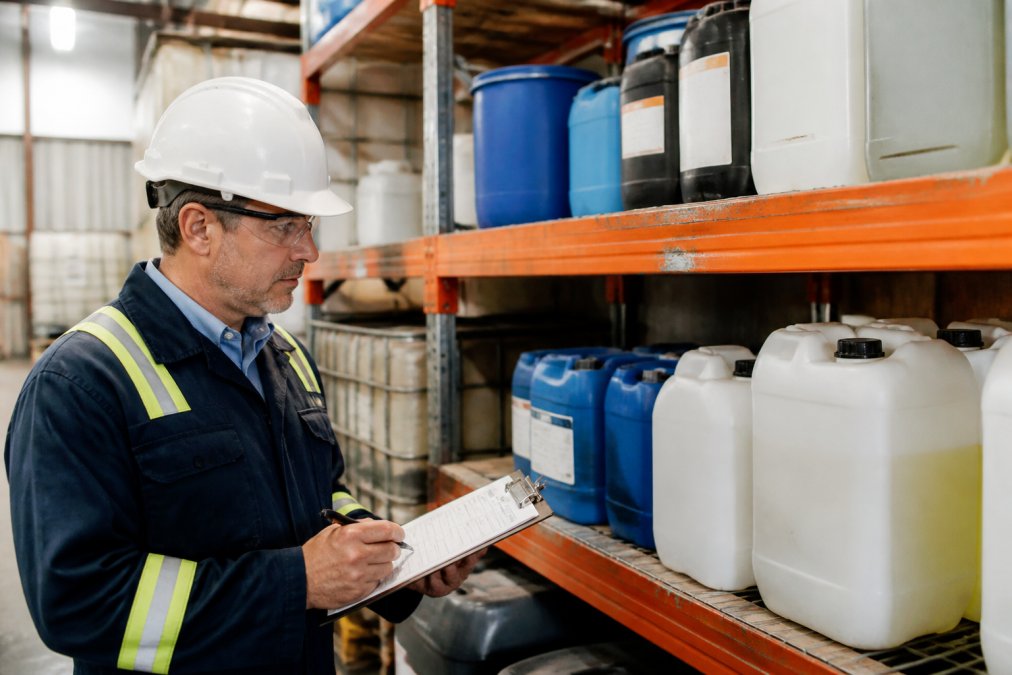
Review the SDS for physical hazards (flammable, corrosive, reactive), health hazards (respiratory, skin, carcinogenic), routes of entry (inhalation, dermal, ingestion), and acute versus chronic effects. A solvent used 30 minutes daily carries different risk than one used continuously. Document the hazard profile before deciding on controls.
Cross-reference your chemical inventory against your process hazard analysis. Workers often use chemicals not listed in the original inventory. Weekly walk-throughs catch these gaps before they become compliance issues.
Step 2: Workplace Exposure Assessment and Exposure Pathways
Now identify how workers actually encounter these hazards.
Exposure pathways are inhalation (breathing), dermal (skin contact), and ingestion (swallowing). Most industrial exposures occur through inhalation and dermal contact. Your workplace evaluation must account for all three.
Walk your facility and observe: Where is the chemical used? How long? How often? Is the container open or closed? Do workers wear gloves, respirators, or protective equipment? Is there ventilation? Document exposure scenarios for each task: who does the work, what chemical is involved, how long it takes, what PPE is available and used, and environmental conditions. A worker spraying adhesive in a booth with local exhaust ventilation faces different exposure than one applying it by hand in an open space.
Assuming workers follow procedures is a common pitfall. They often don’t. Watch what they actually do, not what the manual says. Exposure assessment must reflect real behavior, not ideal behavior.
Step 3: Review Safety Data Sheets and Toxicological Profiles
The SDS contains critical information about health effects and safe handling.
Review the SDS for hazard classification, exposure limits, first aid measures, handling precautions, PPE requirements, and waste disposal. The toxicological profile indicates whether the chemical causes harm from a single exposure or only from repeated, long-term exposure. Some substances accumulate in the body; others are metabolized quickly. Compare the manufacturer’s recommendations to your actual workplace conditions. If the SDS says “use only in well-ventilated areas” but your facility has limited ventilation, you have a gap that drives your control measures.
Step 4: Qualitative vs Quantitative Exposure Assessment Methods
You need both approaches to build a complete picture, and knowing when to deploy each one is critical to efficient assessment.
Qualitative assessment uses observation and professional judgment to estimate risk based on hazard severity and exposure frequency. It answers: “Is there potential for exposure?” It is faster and cheaper than sampling. Quantitative assessment uses air sampling and lab analysis to measure airborne concentrations in parts per million (ppm) or milligrams per cubic meter (mg/m³). It answers: “How much exposure is happening, and does it exceed regulatory limits?”
When to use qualitative assessment alone:
- The chemical is used in a closed system with no potential for worker contact
- Engineering controls (local exhaust ventilation, enclosure) are in place and functioning
- The hazard is low-toxicity and exposure frequency is minimal
- You have documented evidence of effective controls
When to move to quantitative assessment:
- Qualitative assessment suggests potential for significant inhalation or dermal exposure
- The chemical is used for more than 2 hours per day or multiple times per week
- Workers report symptoms (headache, respiratory irritation, skin rash) that correlate with chemical use
- The SDS lists a PEL or STEL that is relatively low (below 50 ppm for volatile organics)
- Engineering controls are absent or their effectiveness is uncertain
- Regulatory inspection or worker complaint has raised questions about exposure
- You are establishing a baseline for a new process or chemical
Air sampling methods and when to use each:
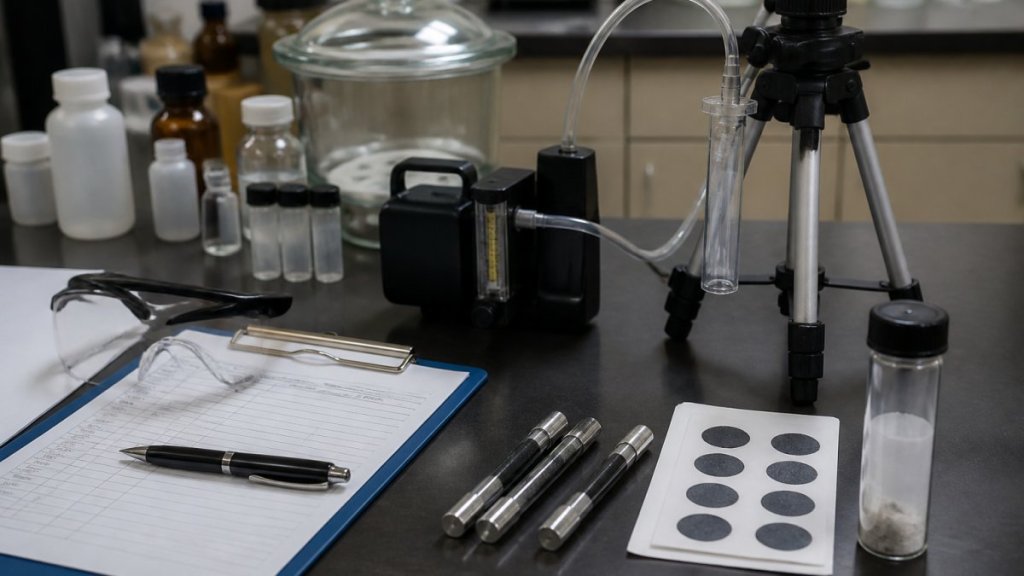
Personal sampling measures what a worker actually breathes. A worker wears a pump connected to a collection device positioned in the breathing zone. This is the gold standard for compliance documentation. Use it when you need defensible data for regulatory purposes or when exposure varies significantly by worker behavior.
Area sampling uses a stationary pump in a work zone to measure ambient air concentration.
Decision tree for assessment approach:
- Start with qualitative assessment. Document hazard, exposure pathways, and controls in place.
- If qualitative assessment indicates low risk, document your reasoning and move to Step 5.
- If qualitative assessment indicates potential for significant exposure, conduct quantitative assessment. Select personal or area sampling based on your SEG definition and the variability of the work.
- Collect samples according to the appropriate OSHA method. Send to an accredited lab (ISO 17025 certified).
- Compare results to OSHA PEL, STEL, or ceiling limit. If below the limit, exposure is controlled. If at or above, implement additional controls and re-sample.
Qualitative assessment is your screening tool; quantitative assessment is your verification tool. Together, they create an exposure assessment that regulators and your team can trust. The decision to sample should be driven by evidence from your qualitative walk-through, not by routine or habit.
Step 5: Establish Similar Exposure Groups and Air Sampling
Group workers by exposure profile, then sample strategically.
Similar Exposure Groups (SEGs) are clusters of workers who face comparable exposure to the same hazards under similar conditions. Grouping by SEG makes air sampling efficient: sample one representative from each SEG. If exposure is controlled for that worker, it is controlled for the group. Select sampling media based on the chemical and send samples to an accredited lab for analysis.
Step 6: Risk Characterization and OSHA Chemical Exposure Limits
Compare your findings to regulatory standards to determine actual risk.
OSHA limits are minimum standards, not safety targets. Many facilities set internal exposure goals lower than the PEL. This provides a safety margin and shows regulators you take exposure control seriously.
Step 7: Control Measures, Documentation, and Industrial Hygiene Risk Assessment Tools
Implement controls, document everything for compliance, and establish a review cycle to keep your assessment current as conditions change.
Selecting and implementing controls:
-
Elimination: Remove the hazardous chemical entirely. Replace a toxic solvent with a non-toxic alternative, or redesign the process to eliminate the step that requires the chemical. This is the most effective control but often the most expensive and disruptive.
-
Substitution: Replace the hazardous chemical with a less hazardous one. Use a water-based adhesive instead of a solvent-based one, or switch to a lower-volatility solvent. Substitution is often practical and highly effective.
-
Engineering controls: Redesign the process or equipment to reduce exposure at the source. Local exhaust ventilation (LEV) captures fumes at the point of generation. Closed systems prevent vapors from escaping. Enclosures isolate the hazard. Automation removes workers from the exposure area. Engineering controls are strong and do not rely on worker behavior.
-
Administrative controls: Change work practices to reduce the time or frequency of exposure. Job rotation limits how long any one worker is exposed. Scheduling maintenance during off-hours reduces exposure to other workers. Training ensures workers understand the hazard and use controls correctly. Administrative controls are less effective than engineering controls because they depend on worker compliance.
-
Personal protective equipment (PPE): Provide respirators, gloves, protective clothing, or eye protection. PPE is the last resort, used when other controls are not feasible. PPE is only effective if workers wear it correctly and consistently, and it requires fit testing, training, and maintenance.
Documenting your control strategy:
- The hazard being controlled (e.g., “inhalation of toluene vapor during spray application”)
- The control measure selected (e.g., “local exhaust ventilation in spray booth”)
- Why this control was chosen (e.g., “engineering control is most effective; substitution not feasible due to product performance requirements”)
- Expected outcome (e.g., “reduce airborne toluene concentration to below 50 ppm PEL”)
- Responsibility for implementation and maintenance (e.g., “Facilities Manager to install and inspect quarterly”)
- Inspection and testing schedule (e.g., “LEV function tested quarterly; filter changed every 6 months”)
- Date implemented
- Verification method (e.g., “air sampling conducted 30 days post-implementation”)
The cycle, identify, assess, control, document, review, is the foundation of occupational health and safety and of regulatory compliance. When an OSHA inspector or a legal team reviews your exposure assessment, they are looking for evidence of this cycle. If you can demonstrate systematic hazard identification, exposure assessment, control implementation, and ongoing review, you show due diligence and significantly reduce your organization’s liability.
Frequently Asked Questions
What are the key differences between qualitative and quantitative chemical exposure assessment?
Qualitative assessment uses professional judgment, historical data, and hazard classification to estimate exposure risk without precise measurements. Quantitative assessment involves actual air sampling and monitoring to measure chemical concentrations in the workplace. Qualitative methods work well for initial screening and low-hazard operations; quantitative assessment is required when exposure limits are unclear or when regulatory compliance demands documented proof of control effectiveness.
How do OSHA chemical exposure limits determine if my workplace is compliant?
OSHA establishes Permissible Exposure Limits (PELs) and references ACGIH Threshold Limit Values (TLVs) to define safe exposure levels for specific chemicals. Your chemical exposure assessment must measure actual workplace concentrations and compare them against these limits. If measured levels exceed the PEL, you must implement control measures immediately. Regular monitoring ensures ongoing compliance and protects worker health.
What industrial hygiene risk assessment tools should I use to streamline this process?
Common tools include calibrated air sampling equipment, direct-read monitors for real-time chemical detection, and documentation software to track exposure data and control effectiveness. Many facilities use hazard matrices to prioritize risks and standard operating procedures to ensure consistent methodology. Your choice depends on the chemicals present, workplace size, and regulatory requirements. Professional industrial hygienists can recommend tools specific to your operation.
How often should I repeat a chemical exposure assessment?
Conduct a baseline assessment when operations change, new chemicals are introduced, or after control measures are implemented. Repeat monitoring annually or whenever workplace conditions shift, such as equipment upgrades, staffing changes, or process modifications. If initial results show exposure below action levels, less frequent monitoring may be acceptable under OSHA guidelines, but document the rationale. Post-assessment review cycles help identify whether controls remain effective over time.


Leave a Reply