Table of Contents
- What Professional Air Quality Testing Actually Measures
- Common Indoor Air Pollutants and Their Health Effects
- Signs of Poor Indoor Air Quality You Should Not Ignore
- Consumer vs Professional Air Quality Monitors: What the Data Shows
- Pros and Cons of Hiring a Professional Air Quality Tester
- How to Read Your Air Quality Test Results
- After the Test: A Remediation Roadmap
- Frequently Asked Questions
Last Updated: September 25, 2026
What Professional Air Quality Testing Actually Measures
Whether professional air quality testing is worth it depends entirely on what you’re trying to learn, and most building occupants never find out until something goes wrong. A professional assessment moves beyond the readings a wall-mounted gadget gives you and captures the specific contaminants, concentrations, and sources that shape indoor environmental quality.
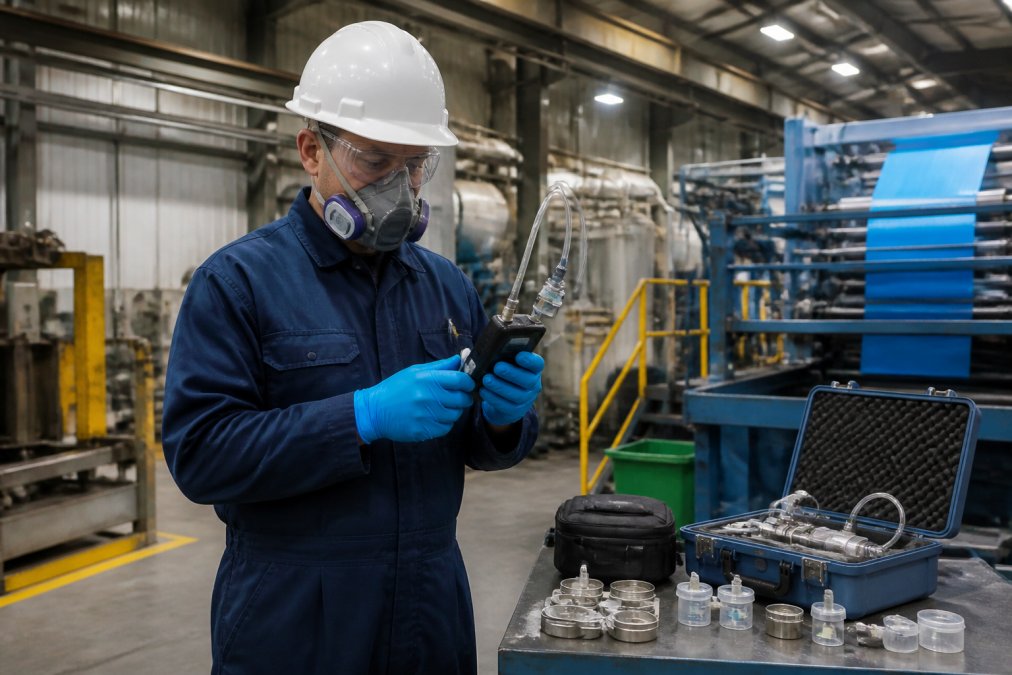
Air quality testing is the systematic collection and laboratory analysis of air samples to identify and quantify airborne contaminants, including particulates, gases, and biological agents.
A full assessment typically covers several categories:
- Particulate matter, including PM2.5 and PM10, measured by size fraction
- Volatile organic compounds (VOCs) such as formaldehyde and solvents
- Carbon monoxide and carbon dioxide levels, which indicate combustion problems or poor ventilation
- Mold spores and airborne allergens, captured through spore trap or culture sampling
- Radon, a radioactive gas that requires dedicated testing methods
Common Indoor Air Pollutants and Their Health Effects
Pollutants indoors rarely arrive alone. A single space can carry combustion byproducts, biological agents, and chemical vapors at the same time, and their combined effect on occupant health is often greater than any one substance in isolation.
The most frequently encountered categories include:
- Combustion gases: carbon monoxide from faulty heating equipment, nitrogen dioxide from gas appliances
- Volatile organic compounds: formaldehyde from pressed-wood products, benzene from stored fuels and solvents
- Particulate matter: fine dust from construction, printing, and manufacturing processes
- Biological contaminants: mold spores, bacteria, and airborne pathogens that thrive in damp conditions
- Radon: a naturally occurring gas that seeps through foundations and is a leading cause of lung cancer among nonsmokers, according to EPA radon resources
Signs of Poor Indoor Air Quality You Should Not Ignore
Recognizing the signs of poor indoor air quality early prevents small ventilation problems from becoming expensive remediation projects. Most occupants notice symptoms before they notice the cause.
Watch for these signals:
- Persistent headaches, fatigue, or eye and throat irritation that ease when you leave the building
- Visible mold growth or musty odors near HVAC vents, ceilings, or plumbing
- Condensation on windows and cold surfaces, which points to excess humidity
- Stale or stuffy air in rooms with limited air exchange
- Increased frequency of respiratory complaints among occupants in the same area
Consumer vs Professional Air Quality Monitors: What the Data Shows
Consumer monitors and professional testing instruments answer different questions, and confusing the two leads to bad decisions. A consumer monitor gives you a continuous, low-cost trend line. A professional assessment gives you a defensible measurement.
| Feature | Consumer Monitor | Professional Testing |
|---|---|---|
| Cost | Low, one-time purchase | Higher, per-project |
| Accuracy | General trend indication | Laboratory-verified |
| Contaminants covered | PM2.5, CO2, VOCs (varies) | Full spectrum, including mold and radon |
| Reporting | Real-time app readings | Written report with lab analysis |
| Best for | Ongoing awareness | Diagnosis, compliance, remediation planning |
Place consumer monitors in occupied zones at breathing height, roughly 1 to 1.8 meters off the floor, and away from direct sunlight or vents. Readings taken next to a supply diffuser will mislead you about what occupants actually breathe.
Pros and Cons of Hiring a Professional Air Quality Tester
Hiring a professional air quality tester makes sense when you need defensible data, a clear source identification, or documentation for compliance. It makes less sense when you simply want general awareness of trends in a healthy building. Specialized diagnostic tools remain essential when the scope of your investigation shifts toward structural hazards like checking for asbestos in older construction materials.
Pros:
- Laboratory-grade accuracy and chain-of-custody documentation
- Identification of pollutant sources, not just concentrations
- Reports that support regulatory compliance and remediation planning
- Access to diagnostic tools and methods a consumer device cannot replicate
Cons:
- Higher upfront cost than a consumer monitor
- Results reflect conditions during sampling, so seasonal or operational changes may require retesting
- Interpretation requires expertise, which is why the report matters as much as the numbers
Skipping a follow-up test after remediation is one of the most common and costly mistakes. Without post-remediation verification, you have no proof the fix worked, and the same problem can resurface months later with no baseline to compare against.
How to Read Your Air Quality Test Results
Test results only create value when someone interprets them against the right benchmark. A number without context tells you almost nothing about whether occupants are actually at risk. This is the step most guides skip, and it is the step that decides whether your testing dollars produced an answer or just a spreadsheet.
- Carbon monoxide is compared against occupational exposure limits. The relevant federal benchmarks are the OSHA permissible exposure limit (PEL) of 50 parts per million (ppm) as an 8-hour time-weighted average and the NIOSH recommended exposure limit (REL) of 35 ppm over 8 hours, with a 200 ppm ceiling. A reading of 9 ppm is the EPA’s guideline for ambient indoor air over 8 hours. A single elevated spot reading means something different than a sustained one, so ask how long the condition lasted.
- Carbon dioxide is not usually a direct health hazard at indoor levels, but it is a ventilation proxy. Outdoor air runs roughly 400 to 450 ppm. Indoor readings below about 800 ppm generally indicate good ventilation; sustained readings above 1,000 ppm suggest outdoor air is not replacing stale indoor air fast enough, and complaints tend to cluster in that range.
- Mold spores are not judged against a fixed number. The standard practice is to compare indoor spore counts and species to an outdoor sample collected the same day under similar conditions. If indoor types and counts resemble outdoor, the space is likely normal. If a species that is rare outdoors dominates indoors, or if counts indoors exceed outdoors, that points to an indoor amplification site.
- VOCs are weighed against published exposure guidelines rather than one universal threshold, because formaldehyde, benzene, and solvents each carry their own limits. Total VOC readings are a screening number, not a verdict; the specific compound matters more than the sum.
- Radon is measured in picocuries per liter (pCi/L). The EPA action level is 4 pCi/L, and it recommends considering mitigation between 2 and 4 pCi/L. Because radon varies by season and by weather, a single short-term test is a starting point, not a final answer.
- PM2.5 is compared against the EPA’s National Ambient Air Quality Standards, which set an annual level of 9 micrograms per cubic meter and a 24-hour level of 35 micrograms per cubic meter. Indoor readings are best judged against what is happening outdoors at the same time.
Then ask three questions of every result:
- Is the concentration above the applicable limit or guideline, and which one applies to this space?
- Does the indoor reading differ meaningfully from the outdoor baseline taken the same day?
- Does the pattern point to a specific source, such as one room, one system, or one process?
When you receive a lab report, read the method and detection-limit columns before the results columns. A number you cannot tie to a sampling method and averaging time cannot be compared to any standard.
After the Test: A Remediation Roadmap
Remediation follows a sequence, and skipping steps usually means paying for the same fix twice. The order below reflects how a professional assessment translates into action, and each step is tied to the pollutant it actually addresses.
- Control the source. Remove or repair whatever is generating the contaminant. This is pollutant-specific: a leaking roof or plumbing line feeding mold needs the water intrusion stopped, not just the visible growth cleaned; an off-gassing pressed-wood cabinet needs removal or sealing; a cracked heat exchanger on a furnace needs repair or replacement before any air treatment matters. Source control is the only step that stops the problem from regenerating.
- Improve ventilation and air exchange. Adjust HVAC settings, increase outdoor air intake, and confirm the system is actually delivering the designed air exchange rate. This is the primary fix for elevated carbon dioxide and a supporting fix for VOCs and combustion gases. Verify with a flow measurement or a CO2 trend, not by assumption.
- Add filtration where it fits. Upgrading to a higher MERV-rated filter or adding air purification addresses remaining airborne particulates and some VOCs, but it does not replace source control. A filter captures what is already airborne; it does not stop a source from producing more.
- Manage humidity. Keep indoor relative humidity in the range that discourages mold spores and dust mites from thriving, commonly cited as roughly 30 to 50 percent. This is the step that prevents a cleaned mold problem from returning.
- Verify with retesting. Sample again under similar conditions to confirm the fix worked. Post-remediation verification is what turns a repair into documented proof.
- Document everything. Keep the before-and-after reports together; they protect you in compliance reviews and property transactions.
Source control beats filtration every time. Filtration manages what is already airborne; removing the source stops the problem from regenerating.
Frequently Asked Questions
Is it worth getting a professional air quality test?
Yes, if you suspect a specific problem like mold, radon, or chemical exposure. Professional air quality testing uses calibrated instruments and lab analysis to identify pollutants that consumer monitors miss. It is especially valuable for workplaces needing OSHA compliance or for anyone with unexplained respiratory symptoms. The cost is justified when you need accurate, actionable data.
How accurate are consumer-grade air quality monitors compared to professional testing?
Consumer monitors are useful for spotting trends in particulate matter and carbon dioxide levels, but they often lack the calibration and specificity of professional tools. They may not detect volatile organic compounds, formaldehyde, or mold spores accurately. Professional air quality testing relies on air sampling and lab analysis, which provides precise measurements and identifies pollutant sources.
What specific pollutants do professional air quality tests detect?
Professional tests can detect a wide range of common indoor air pollutants, including particulate matter, volatile organic compounds, formaldehyde, carbon monoxide, radon, mold spores, and airborne pathogens. They also measure carbon dioxide levels and air exchange rates. This comprehensive approach helps pinpoint pollutant sources and guide remediation.
How does professional testing differ from a basic home inspection?
A basic home inspection focuses on structural and safety issues, not air quality. Professional air quality testing involves specialized equipment like air sampling pumps and diagnostic tools, plus lab analysis. It assesses airborne contaminants, ventilation systems, and occupant health risks. Inspectors may note visible mold, but they do not measure invisible pollutants or verify air exchange rates.


Leave a Reply